Content Menu
● Why Printing Poker Cards Matters
● What Makes a Good Poker Card Deck
● Standard Sizes and File Setup
>> Recommended Prepress Rules
● Printing Methods Compared
● Materials and Finishes
● Design Strategy for Better UX
● Sustainability and Compliance
● Industry Trends in 2026
● How XingKun Supports OEM and ODM Buyers
● Production Workflow
● Buying Checklist
● Conclusion
● FAQ
>> 1. What is the standard size for poker cards?
>> 2. What file format is best for printing poker cards?
>> 3. Why do I need bleed and safe zones?
>> 4. Which finish is best for custom poker cards?
>> 5. Are FSC materials available for poker cards?
>> 6. Is digital printing good for small custom decks?
● References
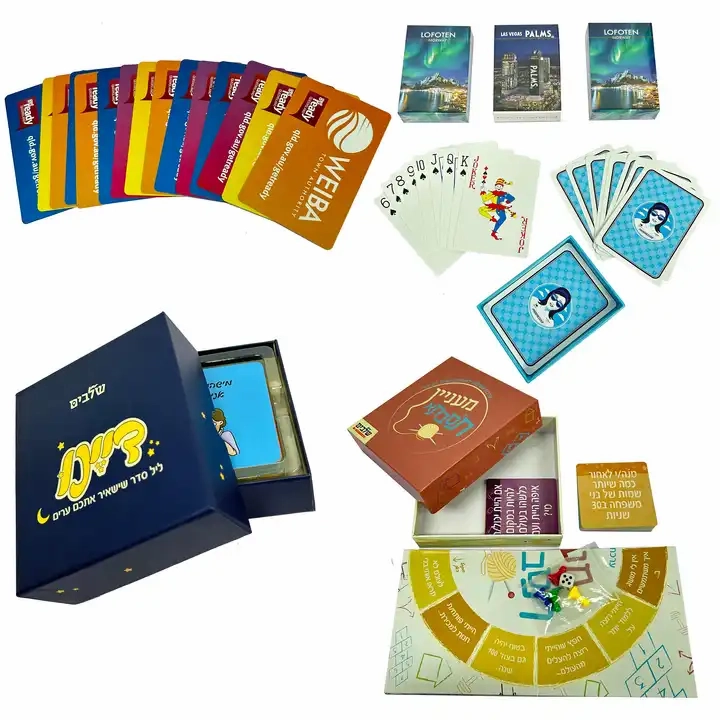
Printing poker cards is more than putting artwork on cardstock. It is a brand experience decision that affects how a deck feels, shuffles, lasts, and sells. For OEM and ODM buyers, the right printing approach can turn a simple deck into a premium product, a collectible, or a high-conversion promotional item.
Why Printing Poker Cards Matters
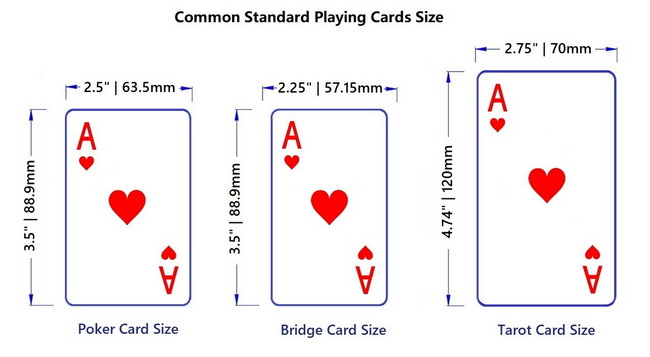
Poker cards are used in casinos, retail games, promotional campaigns, tabletop products, and private-label merchandise. Standard poker size is commonly 2.5 x 3.5 inches, or 63.5 x 88.9 mm, and it remains the global default for most custom decks. That size is popular because it balances handling comfort, print efficiency, and broad market familiarity. [tycoonpackaging]
From a business standpoint, poker card printing affects three things at once: product quality, customer perception, and repeat purchase potential. A deck that looks sharp but shuffles poorly will fail in use, while a well-built deck with strong finishing can feel premium even before the first deal. For brands, that tactile quality often becomes part of the product story.
What Makes a Good Poker Card Deck
A strong custom deck is built from several layers of decisions, not just the front-and-back artwork. The paper stock, coating, finish, print method, and cut tolerance all shape the final result. Professional printers also emphasize bleed and safe zones so important content does not get trimmed during production. [bookprintingchina]
In practice, the best decks usually share these traits:
Consistent card thickness for smooth shuffling and dealing.
Accurate color reproduction so brand colors stay recognizable.
Clean edges and tight cutting tolerance for a premium feel.
Surface finish matched to use case, such as smooth gloss for easy handling or matte/soft-touch for luxury presentation.
Durable coating or lamination to resist wear from repeated use. [xkdisplay]
If you are developing a deck for retail, a gift set, or a game, quality should be treated as a conversion factor, not just a production detail. Customers often judge the whole product by how the cards feel in hand.
Standard Sizes and File Setup
The most common poker card size is 2.5 x 3.5 inches, equivalent to 63.5 x 88.9 mm. Some suppliers also describe this as 63 x 88 mm in practical production terms, but the market convention is still poker size. For design teams, the key is to follow the printer's template rather than relying only on a generic size chart. [thoughtfuldane]
Use this setup checklist before exporting files:
1. Work from the printer's template.
2. Add bleed so backgrounds extend past the trim line. [reddit]
3. Keep text and logos inside the safe zone so they are not cut off. [youtube]
4. Embed fonts to avoid substitution issues. [bookprintingchina]
5. Export as high-resolution PDF or the format requested by the factory. [bookprintingchina]
Recommended Prepress Rules
A good prepress file protects both quality and margin. The design should account for trimming variation, because no die-cut system is perfect. That is why bleed and safe zones matter so much in professional card production. [reddit]
Printing Methods Compared
Different projects need different print technologies. The right method depends on order size, artwork complexity, turnaround time, and budget. Offset printing remains a common choice for large runs, while digital printing is often better for small batches or variable designs. [seseprinting]
| Method | Best for | Strengths | Watch-outs |
| Offset printing | Large-volume card decks | Strong color consistency, efficient at scale xkdisplay | Higher setup cost |
| Digital printing | Short runs, testing, personalization | Fast, flexible, economical for small batches xkdisplay | May be less cost-efficient at very high volume |
| UV printing | Special visual effects and durability | Strong finish and vivid appearance seseprinting | Needs careful material matching |
For B2B buyers, the production method should match the sales model. If you are testing a new game or limited-edition deck, digital printing can reduce risk. If you are launching a mass retail product, offset printing is usually the more scalable route.
Materials and Finishes
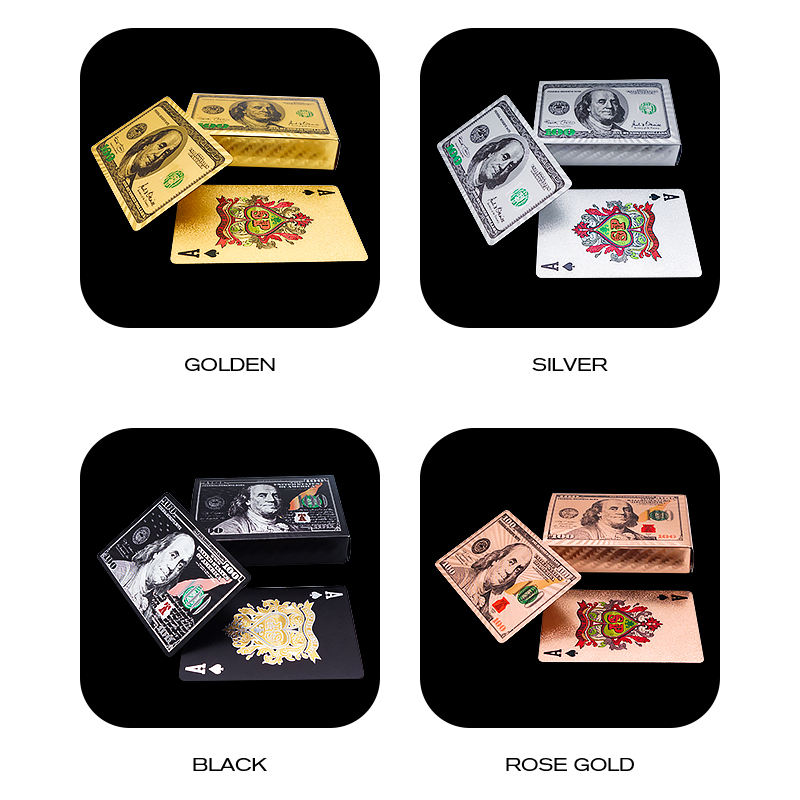
The material system is what makes poker cards feel professional. Common options include SBS, kraft-based stocks, recycled boards, textured papers, metallic paper, holographic stock, and other specialty materials. XingKun also lists finishing options such as aqueous coating, UV coating, spot gloss UV, soft-touch coating, varnish, lamination, anti-scratch lamination, foil stamping, embossing, debossing, and cold foil printing. [xkdisplay]
Here is a practical way to think about finish selection:
Gloss or UV coating: Brighter look, better for bold graphics.
Matte or soft-touch: More premium and modern, with a smoother tactile feel.
Lamination: Better durability for heavy handling.
Spot UV: Useful for highlighting logos, icons, or premium visual accents.
Foil stamping: Ideal for luxury, collector, or gift-oriented decks. [xkdisplay]
A well-chosen finish can change the perceived value of the deck more than adding extra artwork. For example, a standard black deck with soft-touch coating and gold foil can feel far more premium than a fully printed deck with no surface treatment.
Design Strategy for Better UX
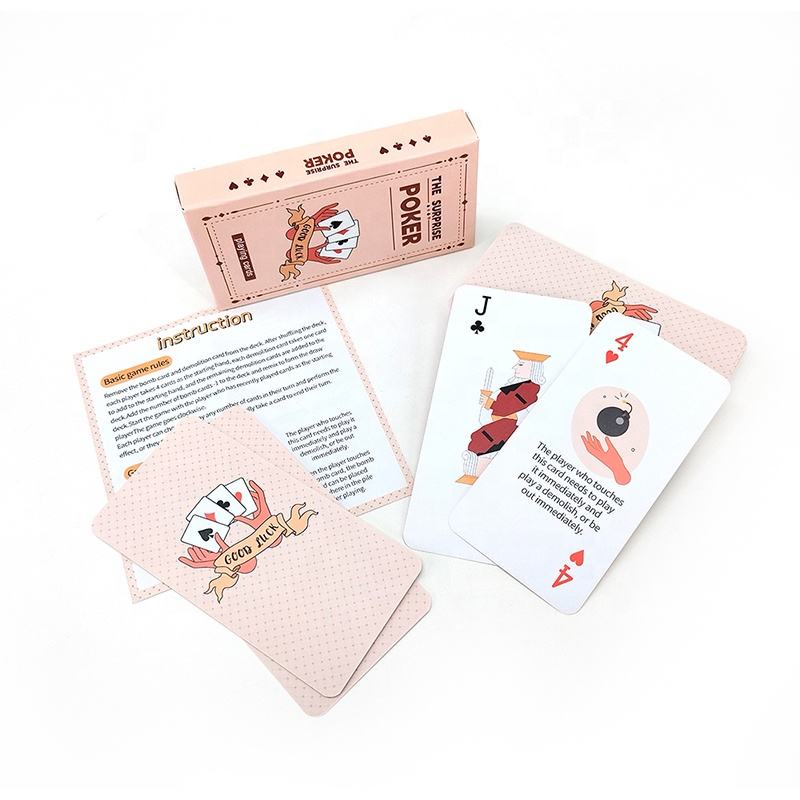
Good card design should be easy to read, easy to recognize, and easy to use in motion. That means high contrast, clear typography, clean iconography, and enough spacing around core elements. Many production issues come from over-designing the card face and forgetting that the user must identify suits, values, and special cards in seconds.
To improve user experience, focus on these rules:
Make the rank and suit instantly visible.
Use consistent visual hierarchy across the deck.
Avoid placing critical text near edges.
Test the deck by printing a paper prototype.
Check cards under different light conditions.
This is especially important for game publishers. If your deck is meant for gameplay, visual beauty should never reduce usability.
Sustainability and Compliance
Sustainability is now part of packaging and print decision-making, not an optional extra. FSC paper is widely recognized as a signal that paper products come from responsibly sourced forests. FSC certifications include FSC 100%, FSC Mix, and FSC Recycled, which help buyers evaluate sourcing and recycled content. [printed]
For brands that sell in international markets, sustainable material choices can support retailer requirements and customer expectations. In print, eco-friendly decisions often include recycled stock, responsibly sourced paper, and lower-waste production planning. If your poker cards are part of a broader packaging program, aligning the deck with sustainable materials can strengthen the whole product line. [spreadly]
Industry Trends in 2026
The printing industry continues to move toward customization, sustainability, hybrid workflows, and smarter production systems. Personalized print, short-run manufacturing, and print-on-demand are growing because brands want more flexibility and less inventory risk. At the same time, sustainable materials and eco-friendly inks are gaining importance across commercial print categories. [squaresigns]
For poker cards, that translates into a few clear opportunities:
Limited-edition decks for collectors and brand campaigns.
Personalized decks for events, promotions, and gift programs.
Small-batch product testing before a full launch.
Sustainable decks that support modern brand positioning.
A strong supplier should be able to support both classic mass production and flexible custom runs. That is especially relevant for brands testing new creative concepts or niche game markets.

How XingKun Supports OEM and ODM Buyers
Shenzhen XingKun Packing Products Co., Ltd. positions itself as a custom printing manufacturer with experience in packaging boxes, playing cards, books, puzzles, stickers, and related products. On the company's card pages, XingKun emphasizes custom card manufacturing, wholesale supply, and a broad range of materials, printing methods, and finishing options. Its poker card product page also highlights durability, precision printing, and customization for themes, colors, and finishes. [qpmarketnetwork]
For overseas brand owners, wholesalers, and manufacturers, that matters because production is not just about printing. It is about turning a brief into a repeatable product system. A factory that can coordinate artwork, structure, materials, and finishing can reduce friction across sampling, mass production, and export packaging.
Production Workflow
A reliable production workflow makes custom poker card printing easier to manage. It also reduces errors and delays. In most professional projects, the process follows a predictable sequence.
1. Confirm deck purpose.
2. Choose size, stock, and finish.
3. Prepare artwork using the supplier's template.
4. Review prepress files for bleed, safe zone, and fonts.
5. Approve proof or sample.
6. Move into mass printing and finishing.
7. Inspect cut quality, color, and packaging before shipment.
This sequence keeps the project under control and gives buyers a chance to catch problems early. For premium decks, sample approval is not optional; it is part of risk control.
Buying Checklist
Before placing an order, ask the supplier these questions:
What card stock do you recommend for my use case?
What coating or finish is best for durability and shuffle feel?
Do you provide a template with bleed and safe zone?
Can you produce sample cards before bulk printing?
What is your minimum order quantity?
Do you support custom tuck boxes or rigid boxes for the deck?
Which file format do you prefer for final artwork?
A vendor that answers these clearly is usually better prepared for OEM and ODM work. It also helps you compare suppliers on more than just price.
Conclusion
Printing poker cards successfully requires a balance of design, durability, print accuracy, and user experience. The best results come from choosing the right size, stock, finish, and production method for your exact market, then matching those choices with a supplier that understands both branding and manufacturing. [printninja]
For brands, the real goal is not just to print a deck. It is to create a product that feels trustworthy, looks premium, and performs well every time it is handled.
FAQ
1. What is the standard size for poker cards?
The most common poker card size is 2.5 x 3.5 inches, or 63.5 x 88.9 mm. [ipacku]
2. What file format is best for printing poker cards?
High-resolution PDF is commonly recommended for production because it preserves layout, images, and fonts more reliably. [bookprintingchina]
3. Why do I need bleed and safe zones?
Bleed prevents white edges after trimming, while safe zones keep important text and logos from being cut off. [youtube]
4. Which finish is best for custom poker cards?
Gloss, matte, soft-touch, UV coating, and lamination all work well depending on your goal; soft-touch and lamination are often chosen for premium or durable decks. [xkdisplay]
5. Are FSC materials available for poker cards?
Yes. FSC paper options are widely used in print to support responsible sourcing and sustainability goals. [druck]
6. Is digital printing good for small custom decks?
Yes. Digital printing is often a strong choice for short runs, prototypes, and personalized decks because it is flexible and cost-effective. [xkdisplay]
References
1. XingKun Poker Cards product page: [https://www.xkdisplay.com/poker-cards.html] [qpmarketnetwork]
2. XingKun custom card decks page: [https://www.xkdisplay.com/zh-CN/products/custom-card-decks.html] [xkdisplay]
3. Playing card dimensions guide: [https://printninja.com/card-dimensions/] [printninja]
4. Standard playing card size guide: [https://ipacku.com/blog/playing-card-dimensions-sizes-types-design-guide/] [ipacku]
5. Bleed and safe area guidance: [https://www.bookprintingchina.com/poker-card-printing] [bookprintingchina]
6. FSC paper explanation: [https://www.printed.com/blog/fsc-papers/] [printed]
7. FSC certification details: [https://druck.pl/en/fsc-printer-7-facts-about-certification/] [druck]
8. Printing industry trends 2026: [https://www.squaresigns.com/blog/printing-industry-trends/] [squaresigns]
9. Market update on card games: [https://www.qpmarketnetwork.com/market-trends/most-popular-trading-card-games/] [qpmarketnetwork]


