Content Menu
● What Is Shelf-Ready Packaging?
● Shelf-Ready Packaging vs. Retail-Ready Packaging
● Why Shelf-Ready Packaging Matters to Retail Brands
>> Key commercial benefits
● The Five Essentials of Effective Shelf-Ready Packaging
>> 1. Easy to Identify
>> 2. Easy to Open
>> 3. Easy to Stock
>> 4. Easy to Shop
>> 5. Easy to Dispose of
● How to Design Shelf-Ready Packaging Step by Step
>> Step 1: Define the retail environment
>> Step 2: Understand the product
>> Step 3: Choose the right packaging format
>> Step 4: Build the opening experience
>> Step 5: Plan shelf-facing graphics
>> Step 6: Test the prototype under real conditions
● Printing and Material Options
● Common Shelf-Ready Packaging Mistakes
>> Weak perforations
>> Oversized tray dimensions
>> Poor product visibility
>> Too much complexity
>> Insufficient transport testing
>> Treating sustainability as an afterthought
● A Practical Example: From Shipping Carton to Retail Tray
● Why Work With an Experienced Packaging Manufacturer
● FAQs
>> What is shelf-ready packaging?
>> What products are suitable for shelf-ready packaging?
>> What is the difference between shelf-ready packaging and a display box?
>> Can shelf-ready packaging be customized with brand printing?
>> Does shelf-ready packaging need to be made from corrugated cardboard?
>> How do I choose the correct tray size?
>> Can shelf-ready packaging reduce retail labor?
>> Should I request a sample before placing a large order?
● References
Shelf-ready packaging is not simply an outer carton. It is a retail-facing packaging system that protects products through transport, opens quickly in-store, and becomes an organized display unit directly on the shelf. For brands selling through supermarkets, pharmacies, convenience stores, specialty retailers, and distributors, a well-engineered shelf-ready packaging solution can reduce handling steps while improving product visibility at the point of purchase.
At Shenzhen XingKun Packing Products Co., Ltd., we have more than 20 years of experience producing custom packaging boxes and printed products for brands and distributors in more than 30 countries and regions. From our production perspective, successful shelf-ready packaging starts by balancing three requirements: transport protection, store efficiency, and shopper appeal. A box that looks attractive but tears poorly is not shelf-ready. A durable shipper that hides the product is not shelf-ready either. The best solution performs reliably from the packing line to the retail shelf.
What Is Shelf-Ready Packaging?
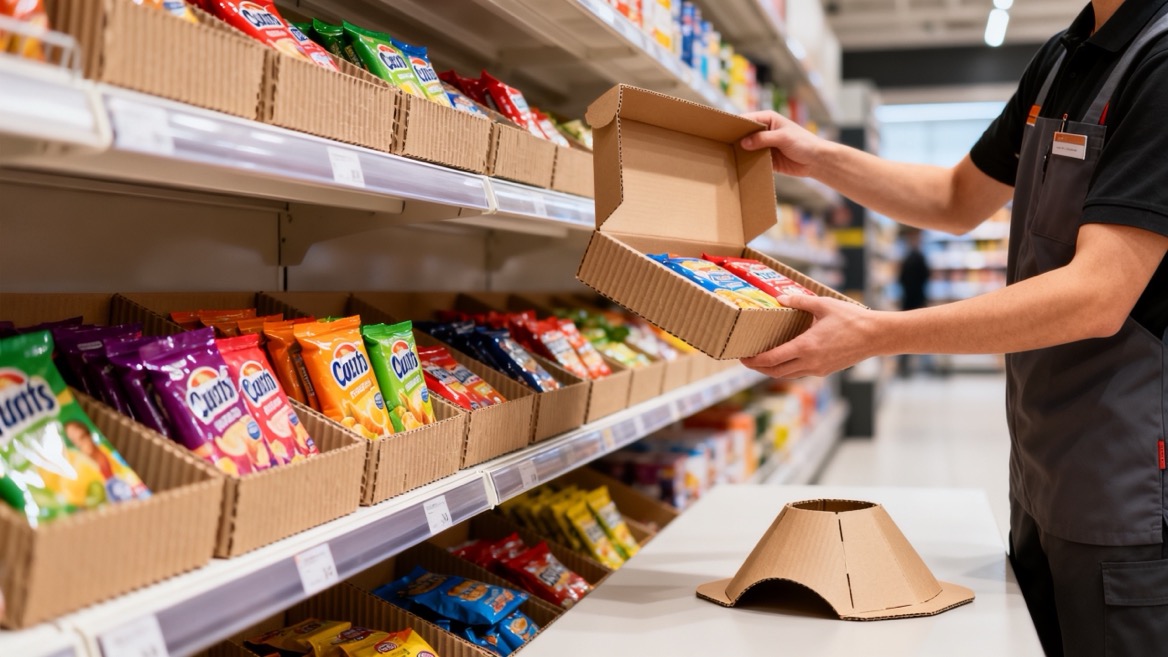
Shelf-ready packaging, often called SRP, is secondary packaging designed to move from a delivery carton to a retail shelf with minimal additional handling. Store personnel can open the carton, remove a perforated section or tear-away lid, and place the remaining tray or display unit directly onto the shelf.
Unlike a conventional shipping carton, shelf-ready packaging must do more than protect products in transit. It must also help retail staff identify the SKU, open the package safely, replenish the shelf efficiently, present the product clearly, and dispose of the empty packaging with minimal effort.
A practical shelf-ready packaging design usually includes:
- A durable corrugated board structure for shipping protection
- Perforations, tear strips, or easy-open features
- Clear opening instructions and orientation markings
- A display tray, front panel, or removable hood
- Shelf-facing printed graphics and product information
- Dimensions matched to the retailer's shelf depth and planogram
- A structure that can be flattened quickly after use
The goal is simple: one package should serve both logistics and merchandising functions.
Shelf-Ready Packaging vs. Retail-Ready Packaging
The terms shelf-ready packaging and retail-ready packaging are often used interchangeably. In practice, both refer to packaging that arrives ready to be placed into a retail environment. However, there can be a slight difference in emphasis.
| Packaging Type | Primary Focus | Typical Features | Best Use |
| Shelf-ready packaging | Fast shelf replenishment | Tear-away top, display tray, easy-open perforation | Supermarkets, pharmacies, convenience stores |
| Retail-ready packaging | Store presentation plus operational efficiency | Printed display case, promotional message, merchandising features | Branded retail campaigns and mass-market products |
| Standard shipping carton | Product protection during delivery | Closed corrugated carton, basic handling marks | Warehouse and business-to-business shipments |
| Counter display packaging | Product visibility at a small display point | Compact tray, header card, branded display panels | Checkout areas, cosmetics, snacks, small accessories |
For most retail projects, the distinction is less important than execution. The packaging should be easy for employees to handle and easy for shoppers to understand. If it cannot be opened quickly, stocked in one movement, and displayed neatly, it will create friction for the retailer.
Why Shelf-Ready Packaging Matters to Retail Brands
Retailers manage high SKU counts, limited shelf space, frequent replenishment cycles, and pressure to keep products available. A conventional carton requires staff to cut open the case, remove individual items, arrange them on the shelf, break down the carton, and dispose of it. This process can be slow and inconsistent.
With shelf-ready packaging, employees can often open a case and place the full product tray on the shelf in a single action. This simplifies routine replenishment and helps maintain a consistent presentation across locations.
Industry guidance commonly describes effective retail-ready packaging through five requirements: it should be easy to identify, easy to open, easy to stock, easy to shop, and easy to dispose of. These principles are useful because they evaluate the entire retail journey rather than focusing only on visual design.
Key commercial benefits
- Faster replenishment: Staff can place products on the shelf without unpacking and arranging every unit individually.
- Clearer shelf presentation: Products remain aligned, upright, and visually consistent.
- Safer opening: Tool-free or low-tool opening can reduce dependence on utility knives.
- Better product access: Customers can see, reach, remove, and return items more easily.
- Reduced handling risk: Fewer individual touches can help reduce scuffing, misplacement, and product damage.
- More effective branding: The front of the tray becomes an additional retail communication surface.
- Simpler disposal: Corrugated packaging can be designed to flatten quickly for recycling streams.
For retail brands, shelf-ready packaging can also reduce the gap between distribution and merchandising. The carton no longer disappears in the stockroom. Instead, part of it becomes a controlled brand display.
The Five Essentials of Effective Shelf-Ready Packaging
A successful shelf-ready packaging box should work for at least three people: the warehouse worker, the retail associate, and the shopper. Below is a practical design framework used by experienced packaging teams.
1. Easy to Identify
Store staff should be able to locate the correct product quickly in the back room. Print the product name, variant, pack count, color reference, barcode information, and handling orientation clearly on the outer case.
Use large text where possible. Avoid relying only on product imagery, especially when several variants share similar graphics.
Important identification details include:
- Brand name
- Product type
- Flavor, fragrance, color, or size variant
- Unit quantity per tray
- "This Side Up" and shelf-facing direction
- Retailer-specific SKU or distribution code where required
- Case barcode and product barcode placement
A common production mistake is to make the outer carton too plain. While plain packaging may appear cost-efficient, it can slow down stockroom identification and increase the risk of placing the wrong product on the shelf.
2. Easy to Open
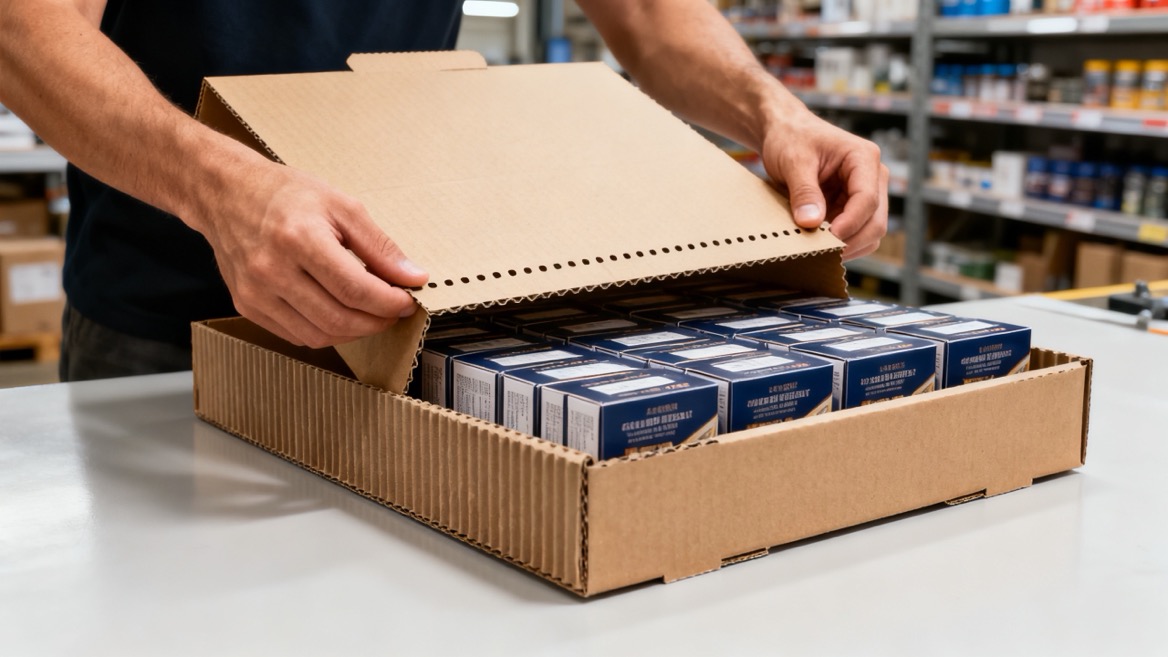
The opening method should be obvious, reliable, and suitable for real store conditions. A perforation that works perfectly during a sample review but tears irregularly after pallet transport is not a practical solution.
Good easy-open features may include:
- Tear strips
- Laser or die-cut perforations
- Thumb holes
- Pull tabs
- Removable top panels
- Two-piece tray-and-hood structures
- Short visual opening instructions
Avoid placing adhesive tape across a perforation line. Also avoid creating a design that requires excessive force, multiple cuts, or special tools. The package should remain strong during shipping but open smoothly at the store.
During structural development, test the opening process after compression, vibration, and handling simulation. This is especially important for products shipped over long distances or through multi-stage distribution networks.
3. Easy to Stock
Shelf-ready packaging should fit the intended shelf location with minimal adjustment. Retail employees should not need to rotate individual products, remove extra dividers, or force the tray into a tight space.
Before finalizing dimensions, confirm:
- Shelf width and depth
- Shelf height restrictions
- Product facing requirements
- Number of units per tray
- Maximum tray weight
- Retailer planogram requirements
- Whether trays will be stacked, side-by-side, or placed in chilled environments
The tray should be stable when lifted and should keep products organized during the move from stockroom to shelf. If the units fall forward or shift when the hood is removed, the design needs further refinement.
Expert tip: Design the tray around the shelf first, not only around the product. A product may fit perfectly inside a carton but still perform poorly if the display tray wastes shelf space or blocks product visibility.
4. Easy to Shop
Once opened, the packaging must allow shoppers to see and access products naturally. The front lip should be high enough to stabilize the items but low enough to reveal essential branding and enable easy removal.
A shopper-friendly display tray should:
- Keep products facing forward
- Make the product label visible
- Allow single-unit removal without disturbing the full row
- Support easy product return if a shopper changes their mind
- Maintain a neat appearance as inventory decreases
- Avoid sharp edges or awkward tear lines
This requirement is especially important for cosmetics, health products, snack foods, beverages, stationery, electronics accessories, pet products, and household goods. In these categories, the packaging often influences whether a product looks premium, organized, and easy to buy.
5. Easy to Dispose of
Retail teams often handle large amounts of packaging waste each day. A strong shelf-ready packaging solution should collapse quickly and be compatible with the retailer's recycling process.
Corrugated board is widely used because it provides strength, printability, and recyclability. Simplifying the material structure can also help. For example, a tray made primarily from corrugated paperboard may be easier to flatten and recycle than a design using unnecessary plastic film, metal staples, or difficult-to-separate components.
Where appropriate, consider:
- Mono-material paper-based construction
- Reduced plastic overwrap
- Minimal adhesive use
- Clearly printed recycling guidance
- Flat-folding panels
- Compact waste volume after use
How to Design Shelf-Ready Packaging Step by Step
Step 1: Define the retail environment
Start with the retailer, shelf location, and product category. Ask whether the package will sit in an aisle, on an endcap, at checkout, in a refrigerated fixture, or inside a specialty display.
Collect accurate information about shelf dimensions, facings, shelf depth, retailer requirements, and planned replenishment frequency.
Step 2: Understand the product
Measure the product's length, width, height, weight, and fragility. Consider whether the product is packed upright, lying flat, nested, or separated by dividers.
For fragile items, such as glass bottles, skincare containers, or electronic accessories, internal stability is critical. For lightweight products, such as sachets or snack bars, visual organization may be the larger challenge.
Step 3: Choose the right packaging format
Common shelf-ready packaging formats include:
- Tear-away display cartons: A closed carton becomes an open retail tray after the top is removed.
- Tray and hood packaging: A printed hood protects the product in transit and lifts away to reveal a display tray.
- Perforated corrugated trays: Suitable for cans, bottles, jars, pouches, and boxed goods.
- Dispenser boxes: Useful for small individually packed products that need controlled dispensing.
- Counter display boxes: Designed for compact products near checkouts or service counters.
- Shelf trays with dividers: Suitable for products that need separation or upright positioning.
The best format depends on product weight, visual requirements, shelf arrangement, and transportation conditions.
Step 4: Build the opening experience
Create a clear opening sequence. A retail employee should understand how to open the package in seconds without reading a long instruction paragraph.
Use short labels such as:
- "Pull Here"
- "Tear Along Line"
- "Remove Top"
- "Place Tray on Shelf"
- "Front Facing"
A prototype should be opened by people who did not design it. Their experience often reveals whether the opening method is intuitive or confusing.
Step 5: Plan shelf-facing graphics
The shelf-facing panel should communicate the brand quickly. Use readable typography, high-contrast colors, consistent brand elements, and a focused message.
Prioritize:
- Brand logo
- Product name
- Key product variation
- Quantity or size
- Product image when relevant
- A concise benefit statement
- Retail-required marks
Do not overcrowd the tray with too much copy. Shelf-ready packaging is viewed at a distance and often under busy retail lighting. A simple hierarchy usually performs better than a dense design.
Step 6: Test the prototype under real conditions
A physical prototype is essential before mass production. It should be reviewed for fit, protection, opening performance, shelf placement, and appearance.
Test the package for:
1. Product fit and stability
2. Compression strength during stacking
3. Opening consistency
4. Perforation accuracy
5. Tray strength after opening
6. Product visibility from the aisle
7. Shopper access
8. Disposal and flattening speed
At XingKun, prototype review is particularly valuable for export customers because shipping routes, humidity, handling methods, and retailer requirements can vary across markets. A design that works in one channel may require adjustment for another.
Printing and Material Options
Material and printing choices influence both function and perceived brand value. The goal is not always to choose the most expensive option. The right choice depends on order volume, product positioning, artwork complexity, and performance needs.
| Option | Suitable For | Main Advantages | Considerations |
| Corrugated board | Shipping and display trays | Strong, printable, practical for transport | Board grade must match product weight |
| SBS paperboard | Lightweight premium retail cartons | Smooth printing surface, refined appearance | Usually needs added protection for heavy loads |
| Digital printing | Short runs, prototypes, seasonal campaigns | Fast setup, flexible artwork changes | Unit cost may be higher at large volumes |
| Flexographic printing | High-volume corrugated packaging | Efficient for repeat production | Fine photographic detail may be limited |
| Litho-laminated printing | Premium retail displays | Strong visual quality and sharp graphics | More complex production process |
| Matte coating | Premium or understated branding | Soft, elegant look | May show scuffs depending on use |
| Gloss coating | Bright consumer packaging | Strong color impact | Can create glare under store lighting |
| Spot UV or foil | Premium accents | Highlights logos and key details | Should not interfere with folding or recycling goals |
The most effective design is usually the one that matches the actual sales channel. For example, a high-volume supermarket product may benefit more from durable corrugated construction and efficient flexographic printing than from costly decorative finishes. A premium gift item or beauty product may justify litho-laminated graphics, spot UV, or soft-touch effects.
Common Shelf-Ready Packaging Mistakes
Even well-designed packaging can fail if practical store requirements are ignored. The following mistakes are common during early development.
Weak perforations
If the tear line breaks unevenly, leaves rough edges, or damages the tray, staff may use knives or discard the display function entirely.
Oversized tray dimensions
A tray that does not match shelf depth can waste valuable retail space, block neighboring products, or create an untidy presentation.
Poor product visibility
High front walls, excessive graphics, or inadequate product orientation can hide labels and make the shelf harder to shop.
Too much complexity
Multiple inserts, loose components, complicated folding actions, and unclear instructions can reduce efficiency. Shelf-ready packaging should simplify work, not create another assembly task.
Insufficient transport testing
A visually impressive package still needs to survive pallet stacking, long-distance shipping, warehouse handling, and retail delivery. The display function is only valuable if the product arrives in good condition.
Treating sustainability as an afterthought
Reducing unnecessary material, simplifying components, and designing for flat disposal should be considered from the beginning. These decisions can improve both material efficiency and store handling.
A Practical Example: From Shipping Carton to Retail Tray
Imagine a brand selling boxed herbal tea through supermarket chains. A standard shipping carton might hold 24 individual tea boxes. Retail staff must open the carton, remove each tea box, arrange two rows on the shelf, and dispose of the outer carton.
A shelf-ready packaging design could use a printed corrugated tray with a removable hood:
- The sealed hood protects the 24 tea boxes during transport.
- Staff follow a "Pull Here" perforation to remove the top.
- The bottom tray holds the tea boxes in two aligned rows.
- The tray slides directly into the shelf space.
- The low front panel keeps the tea box branding visible.
- When empty, the tray is flattened for recycling.
The operational gain is not only speed. The brand also gains a consistent shelf display across stores, while shoppers see an organized product block rather than individually placed boxes.
Why Work With an Experienced Packaging Manufacturer
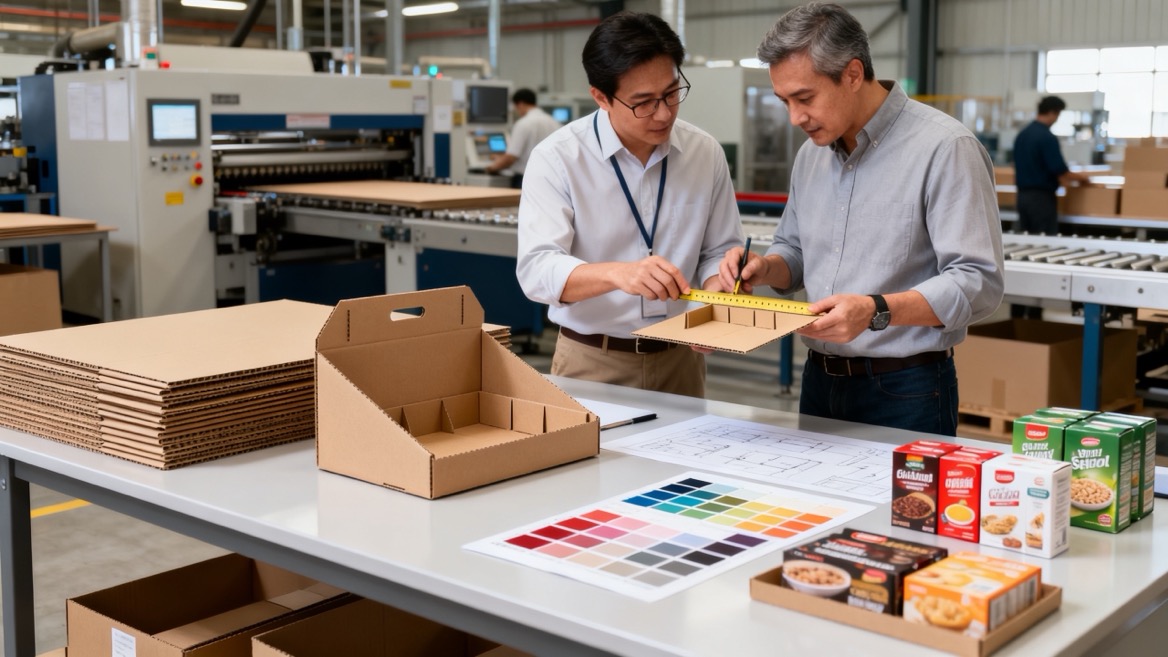
Shelf-ready packaging is a structural packaging project, not just a printing project. It requires coordination between product dimensions, board grade, dieline engineering, printing method, retail shelf requirements, packing configuration, and export logistics.
For brands and distributors, the most productive supplier relationship involves early communication. Share product samples, target shelf dimensions, retail specifications, desired order quantity, artwork files, and shipping destination as early as possible. This allows the packaging team to recommend a practical structure before production begins.
With more than two decades of printing and packaging manufacturing experience, Shenzhen XingKun Packing Products Co., Ltd. supports custom packaging projects with structural development, custom printing, sampling, material selection, and production planning. We work with global customers across more than 30 countries and regions and understand that every retail market has different display, logistics, and commercial requirements.
A well-designed shelf-ready packaging box can help your product arrive protected, replenish faster, and look more compelling on the shelf. The strongest result comes from treating packaging as part of the retail system rather than as an afterthought after the product is complete.
Need a custom shelf-ready packaging solution for your product? Send us your product dimensions, pack quantity, retail shelf requirements, and artwork concept. Our packaging team can help develop a practical display-ready box structure that supports transport protection, efficient replenishment, and stronger in-store presentation.
FAQs
What is shelf-ready packaging?
Shelf-ready packaging is secondary packaging that can move from delivery to the retail shelf with minimal handling. It usually opens into a tray, display unit, or shelf-facing carton that holds products in an organized way.
What products are suitable for shelf-ready packaging?
Shelf-ready packaging is suitable for snacks, beverages, cosmetics, supplements, personal care products, household goods, stationery, pet products, health products, electronics accessories, and many other retail items. The structure should be customized based on product weight, size, fragility, and shelf placement.
What is the difference between shelf-ready packaging and a display box?
A display box is primarily designed to present products to shoppers. Shelf-ready packaging combines display functionality with shipping protection. It must survive distribution first and then convert into a useful retail display or tray.
Can shelf-ready packaging be customized with brand printing?
Yes. Custom printing can include your logo, product name, color system, retail messaging, product images, SKU information, opening instructions, barcodes, and shelf-facing graphics. Printing options can be selected according to order quantity and visual requirements.
Does shelf-ready packaging need to be made from corrugated cardboard?
Corrugated cardboard is a common choice because it provides strength, printability, and efficient transport protection. However, the appropriate material depends on the product, weight, shipping method, visual expectations, and retailer requirements.
How do I choose the correct tray size?
Start with the shelf dimensions, product dimensions, desired number of facings, and units per case. The tray should fit the shelf depth and width while keeping products stable and visible. A physical prototype is strongly recommended before mass production.
Can shelf-ready packaging reduce retail labor?
It can reduce handling steps because employees may place an opened tray or display unit directly onto the shelf instead of unpacking and arranging individual products. The actual benefit depends on the package structure, store process, and product category.
Should I request a sample before placing a large order?
Yes. A sample or prototype helps verify product fit, opening performance, print appearance, structural strength, and shelf presentation. It is particularly important for custom dielines, export shipments, and retailer-specific packaging programs.
References
1. [Custom Box Makers — What Is Shelf-Ready Packaging? A Detailed Guide]
2. [FEFCO — Shelf-Ready Packaging]
3. [Smurfit Kappa — Shelf Ready Packaging]
4. [Mondi — Shelf-Ready Packaging]
5. [Smurfit Westrock — Retail-Ready Packaging]
6. [ECR Retail Ready Packaging Toolkit]


