Content Menu
● What Are Etched Name Plates?
● What Are Printed Name Plates?
● Etched Name Plates vs Printed Name Plates: Quick Comparison
● Durability: The Most Important Difference
● Material Selection Matters as Much as Process
>> Stainless Steel Name Plates
>> Aluminum Name Plates
>> Plastic and Film Name Plates
● Appearance and Branding Comparison
>> When Printed Name Plates Look Better
>> When Etched Name Plates Look Better
● Cost Comparison: Initial Price vs Lifetime Value
>> Evaluate Total Ownership Cost
● Environmental Performance and Compliance Considerations
● How to Choose the Right Name Plate
>> Step 1: Define the Operating Environment
>> Step 2: Identify the Critical Information
>> Step 3: Select the Right Material
>> Step 4: Confirm Installation Method
>> Step 5: Request Samples Before Mass Production
● Expert Insight: Do Not Treat All "Metal Labels" as Equal
● Final Recommendation
● Frequently Asked Questions
>> Are etched name plates more durable than printed name plates?
>> What metal is best for outdoor name plates?
>> Can printed name plates be used outdoors?
>> Are etched name plates suitable for logos?
>> Which is better for serial numbers: etched or printed name plates?
>> Can name plates include QR codes and barcodes?
>> What information should I provide for a custom name plate quote?
● References
Choosing between etched name plates and printed name plates is not simply a design decision. It affects product identification, brand presentation, regulatory readability, service life, installation method, and total ownership cost.
After more than 20 years of producing custom name plates, labels, packaging, and printed products for brands and distributors in over 30 countries and regions, our production team has seen one clear pattern: the best name plate is the one matched to the real operating environment—not merely the lowest initial unit price.
For a clean indoor device panel, printed name plates may offer excellent color performance and cost efficiency. For industrial equipment exposed to oil, abrasion, outdoor weather, chemicals, or repeated cleaning, etched name plates can provide a more secure long-term identification solution.
This guide compares etched name plates vs printed name plates from the perspective of material behavior, production process, durability, appearance, cost, application environment, and purchasing strategy.
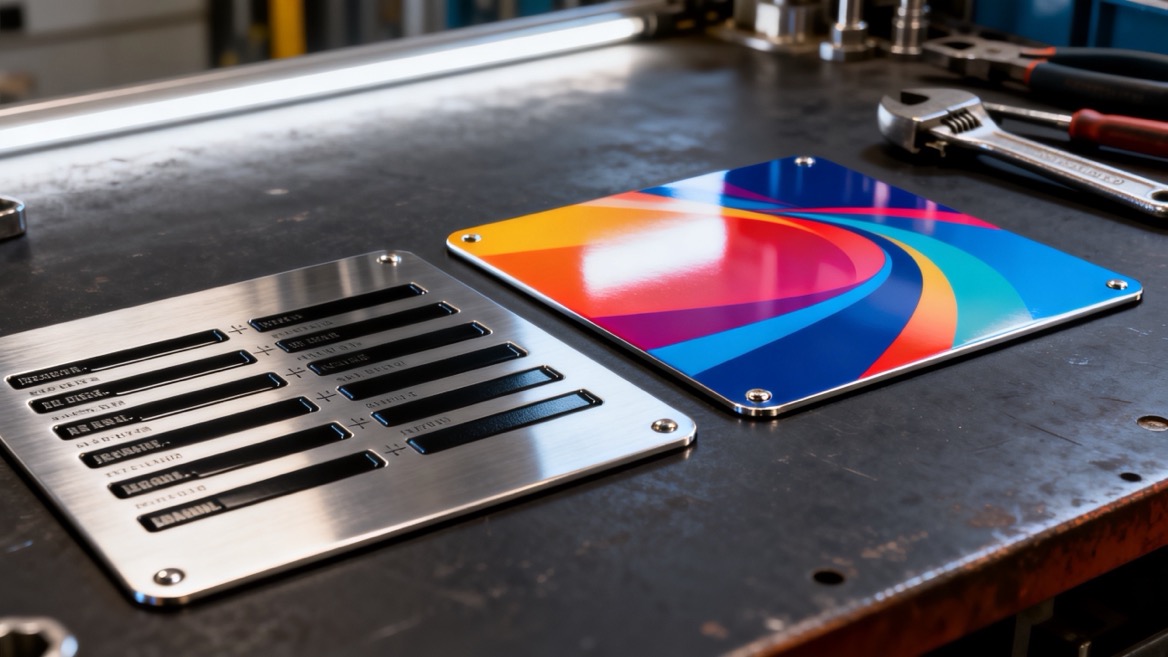
What Are Etched Name Plates?
Etched name plates are metal identification plates made by chemically removing selected areas of a metal surface. The recessed areas can then be filled with enamel or paint to create text, numbers, logos, warning marks, and graphics.
Common materials include:
- Stainless steel
- Aluminum
- Brass
- Nickel silver
- Copper, for selected decorative applications
The key feature is that the design is not only placed on top of the metal. Instead, part of the design is recessed into the material surface. This gives etched metal name plates a physical depth that helps protect important information from wear.
In many industrial projects, etched name plates are used for:
- Machine identification plates
- Serial number plates
- Equipment data plates
- Electrical panel labels
- Safety warning plates
- Marine equipment markers
- Military and aerospace components
- Outdoor machinery labels
- Asset tags
- Premium metal logos
Because the text and graphics are recessed, etched name plates are often selected when a buyer needs long-term legibility under difficult conditions.
What Are Printed Name Plates?
Printed name plates use ink, color layers, or digitally printed graphics to create information on a substrate. The printing method can vary depending on the material, design, order quantity, and durability requirements.
Common printed name plate methods include:
- Screen printing
- Digital printing
- Offset printing
- Pad printing
- UV printing
- Sub-surface printing
- Thermal transfer printing, for selected label applications
Printed name plates can be produced on many materials, including:
- Aluminum
- Stainless steel
- Polycarbonate
- Polyester
- PVC
- Acrylic
- ABS
- PET
- Vinyl films
A printed name plate can be highly functional and visually attractive. It is especially useful when the project requires full-color graphics, gradients, detailed artwork, product photographs, variable layouts, or lower-cost high-volume production.
The main consideration is that traditional surface printing places ink on top of the substrate. If the plate receives frequent rubbing, solvent exposure, UV exposure, or abrasive contact, the printed layer may gradually lose clarity unless the correct ink system, protective coating, or sub-surface process is selected.
Etched Name Plates vs Printed Name Plates: Quick Comparison
| Comparison Factor |
Etched Name Plates |
Printed Name Plates |
| Main Process |
Metal surface is chemically recessed |
Ink or graphics are applied to the substrate |
| Typical Materials |
Stainless steel, aluminum, brass |
Metal, plastic, film, acrylic, polycarbonate |
| Wear Resistance |
Very high, especially with recessed fill |
Depends on ink, coating, substrate, and print method |
| Outdoor Suitability |
Excellent when the right metal is selected |
Good to excellent with suitable inks and protective layers |
| Color Range |
Usually limited to selected filled colors |
Broad color range, including gradients and photo-quality graphics |
| Fine Graphic Detail |
Good for logos, text, and line art |
Excellent for detailed artwork and multicolor branding |
| Tactile Effect |
Recessed text and graphics |
Usually smooth surface |
| Unit Cost |
Often higher, especially for short runs |
Often more economical for standard designs |
| Best Use Case |
Harsh industrial, marine, and outdoor environments |
Indoor equipment, branded panels, consumer products, high-color projects |
| Lead Time |
May require more process steps |
Often faster for standard artwork |
| Long-Term Readability |
Strong under abrasion and cleaning |
Depends heavily on print system and exposure conditions |
Durability: The Most Important Difference
The most important difference between etched name plates and printed name plates is how the information survives use over time.
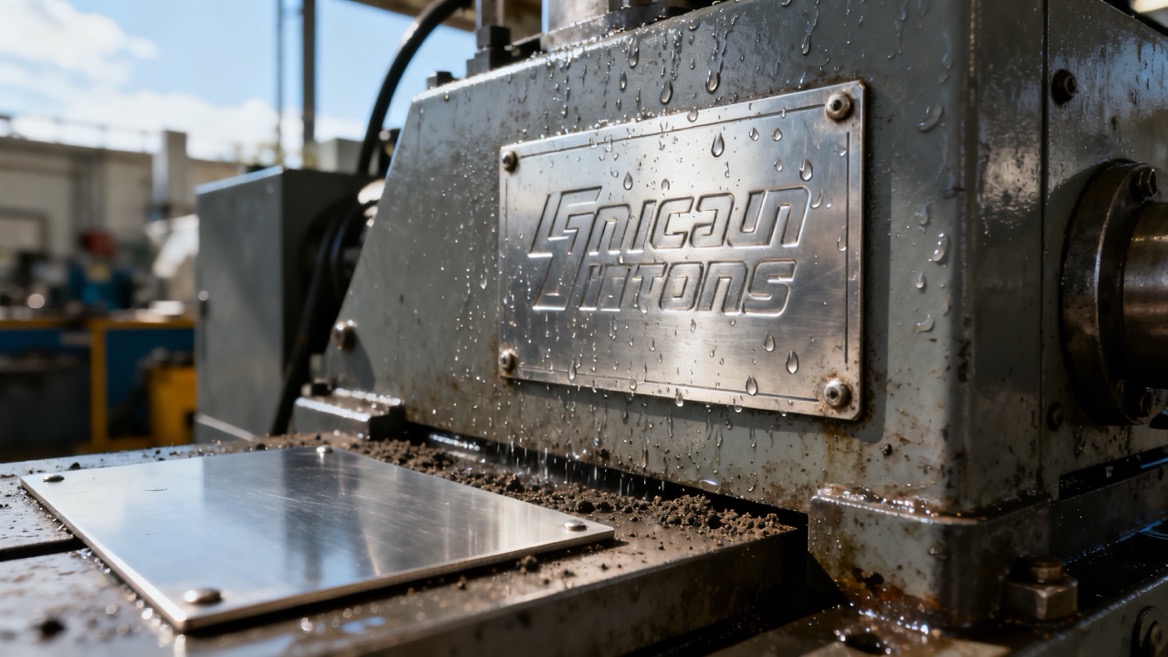
An etched metal name plate has a recessed design. When paint or enamel is filled into that recessed area, it sits below the surface of the metal. This can reduce direct contact with the graphic during normal handling, cleaning, and abrasion.
For example, a stainless steel etched name plate mounted on a pump, valve, construction machine, generator, or marine control box can remain readable after repeated exposure to dirt, vibration, moisture, and physical contact.
Printed name plates can also be durable. However, durability depends on several variables:
- Substrate material
- Ink chemistry
- Print method
- Protective overlaminate
- Clear coating
- Adhesive type
- Exposure to UV light
- Exposure to chemicals
- Temperature range
- Frequency of cleaning
- Installation surface
A screen-printed aluminum name plate may perform very well in a controlled indoor industrial environment. But if the same plate is installed outdoors on a machine exposed to fuel, salt spray, sunlight, and abrasion, it may require upgraded materials or a different process.
Practical rule: If identification failure could create maintenance delays, safety concerns, warranty disputes, or compliance problems, prioritize long-term readability over initial cost.
Material Selection Matters as Much as Process
A common purchasing mistake is comparing only "etching" and "printing" without comparing the underlying material.
The same process can perform differently on different substrates.
Stainless Steel Name Plates
Stainless steel is a preferred material for high-demand environments. It offers strong resistance to corrosion, impact, heat, moisture, and chemical exposure.
It is commonly used for:
- Industrial machinery
- Food processing equipment
- Marine applications
- Oil and gas equipment
- Outdoor installations
- Heavy vehicles
- Medical equipment
- Security and asset identification
An etched stainless steel name plate is often chosen when the requirement is permanent industrial identification.
Aluminum Name Plates
Aluminum is lightweight, corrosion-resistant, and economical compared with stainless steel. It can be etched, screen printed, anodized, engraved, or digitally printed.
Aluminum works well for:
- Electrical equipment
- Consumer appliances
- Control panels
- HVAC systems
- Automotive components
- Electronics
- Branded equipment labels
Anodized aluminum can provide improved hardness and corrosion resistance. In some projects, sub-surface graphics are sealed beneath the anodized layer, improving protection against scratching and fading.
Plastic and Film Name Plates
Polycarbonate, polyester, PVC, acrylic, and other plastics are often used for printed overlays, membrane switches, appliance labels, and decorative panels.
They are popular because they can provide:
- High-resolution printing
- Transparent windows
- Backlighting options
- Embossed buttons
- Complex shapes
- Lightweight construction
- Competitive pricing
However, plastic printed name plates should be selected carefully if the product will operate near solvents, extreme heat, outdoor UV exposure, or heavy mechanical wear.
Appearance and Branding Comparison
For branding teams, printed name plates usually offer more visual freedom.
Printed name plates can reproduce:
- Full-color logos
- Fine gradients
- Multiple color layers
- Photographic images
- QR codes
- Barcodes
- Complex diagrams
- Product instructions
- Variable information
This makes printing especially suitable for consumer electronics, household appliances, retail displays, promotional products, and branded equipment panels.
Etched name plates usually offer a more technical and premium industrial appearance. Their visual strength comes from metal texture, contrast, depth, and permanence rather than unlimited color reproduction.
An etched stainless steel logo plate, for example, can make a machine or premium product appear more robust, engineered, and durable.
When Printed Name Plates Look Better
Choose printed name plates when you need:
- Full-color brand identity
- Detailed product images
- Fine multi-color illustrations
- High-volume production efficiency
- Lightweight plastic overlays
- Variable designs across multiple product models
- Large instruction panels
When Etched Name Plates Look Better
Choose etched name plates when you need:
- A premium metal appearance
- Recessed text or graphics
- Long-term industrial credibility
- Deep black, white, or colored filled lettering
- Permanent serial number information
- Strong resistance to abrasion
- A durable surface for demanding equipment
Cost Comparison: Initial Price vs Lifetime Value
Printed name plates are often more cost-effective for projects that require standard materials, simple installation, high-volume output, or large full-color artwork.
However, the lowest price per piece is not always the lowest cost over the full product lifecycle.
Consider this example:
A manufacturer installs a low-cost printed name plate on outdoor electrical equipment. After prolonged UV exposure and repeated cleaning, the label becomes difficult to read. The manufacturer may then face:
- Product service delays
- Replacement labor costs
- Warranty administration
- Brand damage
- Safety information loss
- Distributor complaints
- Compliance documentation issues
In that case, a higher-cost etched name plate could have been the more economical option.
Evaluate Total Ownership Cost
Before selecting a name plate, ask:
1. How long must the information remain readable?
2. Will the plate be installed indoors or outdoors?
3. Will it contact oils, fuels, solvents, salt spray, or cleaning chemicals?
4. Will workers touch or clean it frequently?
5. Is the information safety-critical?
6. Is the name plate part of a premium brand experience?
7. What would replacement cost after product shipment?
The correct name plate is the one that reduces risk over the full life of the product.
Environmental Performance and Compliance Considerations
For industrial name plates, visual quality is only one part of the decision. Buyers should also evaluate whether the identification method can remain legible under expected environmental conditions.
Durable marking systems may need to withstand:
- High humidity
- Water exposure
- Low temperatures
- High temperatures
- UV weathering
- Abrasion
- Cleaning chemicals
- Oils and lubricants
- Fuel splash
- Salt spray
- Vibration
- Repeated handling
For safety-related markings, product manufacturers may need to consider applicable marking and labeling requirements. Some standards assess permanence, adhesion, resistance to defacement, and legibility after environmental exposure.
This is especially relevant for:
- Electrical products
- Industrial control equipment
- Appliances
- Medical devices
- HVAC systems
- Power equipment
- Export machinery
- Safety-critical components
A professional name plate supplier should not only ask for artwork. They should ask where the name plate will be used, what it will touch, how it will be mounted, and how long it must remain readable.
How to Choose the Right Name Plate
Use this practical selection process before requesting a quotation.
Step 1: Define the Operating Environment
Start with the real use conditions.
Ask whether the product will be exposed to:
- Outdoor sunlight
- Rain or water immersion
- High heat
- Freezing temperatures
- Oil and fuel
- Industrial chemicals
- Saltwater conditions
- Heavy abrasion
- Repeated cleaning
- Frequent human contact
If the environment is severe, etched stainless steel or high-performance anodized aluminum may be more appropriate.
Step 2: Identify the Critical Information
Not all information carries the same risk.
Information that often requires maximum durability includes:
- Serial numbers
- Safety warnings
- Electrical ratings
- Compliance marks
- Model numbers
- Maintenance instructions
- Barcode or QR identification
- Asset tracking codes
For these details, legibility should remain the first priority.
Step 3: Select the Right Material
Choose the material based on performance needs.
| Application Condition |
Recommended Direction |
| Premium indoor equipment |
Printed aluminum or etched aluminum |
| Outdoor equipment |
Etched stainless steel, anodized aluminum, or protected printed metal |
| Marine or coastal use |
Etched stainless steel or specialized corrosion-resistant construction |
| Full-color product branding |
Printed aluminum, acrylic, polycarbonate, or polyester |
| Heavy abrasion |
Etched stainless steel or deeply etched aluminum |
| Electrical panels |
Printed aluminum, etched aluminum, or anodized aluminum |
| Consumer appliances |
Printed metal or plastic name plates |
| Machinery data plates |
Etched metal name plates |
Step 4: Confirm Installation Method
Even the best name plate can fail if it is mounted incorrectly.
Common attachment options include:
- Pressure-sensitive adhesive
- Rivet holes
- Screw holes
- Spot welding
- Mechanical fasteners
- Adhesive plus holes
- Magnetic mounting for temporary use
For high-vibration equipment, mechanical fastening may provide more security than adhesive alone. For smooth indoor panels, industrial adhesive can offer a clean and efficient solution.
Step 5: Request Samples Before Mass Production
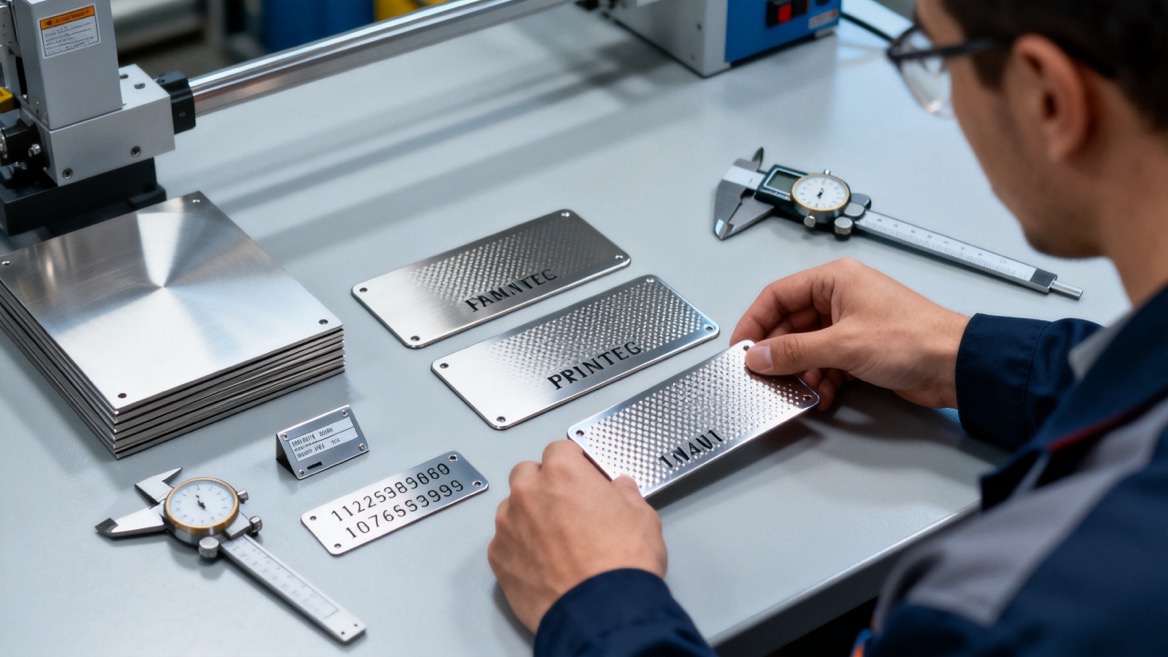
A sample review can prevent expensive mistakes.
Check:
- Text legibility
- Color accuracy
- Metal thickness
- Edge finish
- Hole position
- Adhesive strength
- Scratch resistance
- Chemical resistance
- Barcode scanning performance
- Installation appearance
At Shenzhen XingKun Packing Products Co., Ltd., we recommend confirming physical samples for projects involving outdoor exposure, regulated information, custom colors, complex mounting, or premium brand surfaces.
Expert Insight: Do Not Treat All "Metal Labels" as Equal
Many buyers use terms such as "metal label," "metal sticker," "equipment plate," and "name plate" interchangeably. In production, these terms can represent very different products.
A thin printed aluminum label with adhesive backing is not the same as a chemically etched stainless steel equipment plate.
The difference may include:
- Metal grade
- Thickness
- Printing or etching depth
- Ink system
- Coating
- Adhesive specification
- Hole tolerance
- Edge treatment
- Corrosion resistance
- Production method
- Expected service life
To receive an accurate quotation, provide as much detail as possible:
- Material preference
- Dimensions
- Thickness
- Artwork file
- Quantity
- Colors
- Surface finish
- Mounting method
- Application environment
- Required delivery destination
- Expected service life
The more complete the information, the more accurately a manufacturer can recommend a suitable solution.
Final Recommendation
Choose etched name plates when durability, abrasion resistance, permanent identification, industrial credibility, and harsh-environment performance are your main priorities.
Choose printed name plates when full-color branding, complex artwork, cost efficiency, lightweight materials, and flexible graphic design are more important.
In many product lines, the strongest strategy is not choosing one method for every product. It is using etched name plates for heavy-duty equipment, safety information, and permanent identification, while using printed name plates for branded panels, instructions, decorative graphics, and indoor applications.
For reliable custom name plates, Shenzhen XingKun Packing Products Co., Ltd. can help evaluate your material, finish, printing or etching method, mounting solution, and application environment before production. Send your artwork, dimensions, quantity, and use conditions to receive a practical production recommendation and quotation.
Frequently Asked Questions
Are etched name plates more durable than printed name plates?
In most abrasive or harsh industrial environments, etched name plates are generally more durable because the design is recessed into the metal surface. Printed name plates can also perform well when they use suitable materials, inks, coatings, and protected printing methods.
What metal is best for outdoor name plates?
Stainless steel is often the preferred choice for demanding outdoor environments because of its strength and corrosion resistance. Anodized aluminum can also be a strong option when lower weight and cost efficiency are important.
Can printed name plates be used outdoors?
Yes. Printed name plates can be used outdoors when the right substrate, ink, coating, and adhesive are selected. For long-term outdoor exposure, discuss UV resistance, moisture exposure, temperature range, and chemical contact with the manufacturer before production.
Are etched name plates suitable for logos?
Yes. Etched name plates can reproduce logos, text, symbols, and simple graphics with a premium metal appearance. They are especially suitable for industrial brands, machinery, luxury products, and equipment requiring a durable identity plate.
Which is better for serial numbers: etched or printed name plates?
For serial numbers that must remain readable for many years, etched metal name plates are often the safer choice. Printed serial number plates may be suitable for controlled indoor applications or products with less demanding service conditions.
Can name plates include QR codes and barcodes?
Yes. Both etched and printed name plates can include QR codes and barcodes. The final code size, contrast, printing method, and surface finish should be tested to ensure reliable scanning after installation.
What information should I provide for a custom name plate quote?
Provide the material, size, thickness, artwork, quantity, color requirement, finish, mounting method, application environment, and destination country. If the plate will face chemicals, UV light, heat, moisture, or abrasion, include those conditions in the request.
References
1. [UL Solutions — Compliance Guidelines for Marking and Labeling Systems]
2. [UL Solutions — Marking and Labeling Systems Program]
3. [ANSI Webstore — UL 969, Marking and Labeling Systems]
4. [NPTEC — Metal Nameplates and Serial Plates]
5. [Etched Nameplate Company — Industrial Nameplates Buyer's Guide]
6. [Roemer Industries — Etched Metal Nameplates]
7. [Data Graphics — Custom Equipment Nameplates]


