Content Menu
● Introduction: Why Source Clothing Boxes from China
● How We Evaluated Top Clothing Box Manufacturers
>> Experience: Factory and Operational Maturity
>> Expertise: Materials, Processes and Compliance for Clothing Boxes
>> Authoritativeness: China's Packaging and Printing Clusters
>> Trust: What We Looked for in Each Factory Profile
● Transparent Selection Criteria for the Top 10
● Top 10 Clothing Box Manufacturers in China (2026)
>> 1. Shenzhen XingKun Packing Products Co., Ltd.
>> 2. Shanghai DE Printed Box
>> 3. Pakoro Packaging
>> 4. YUTO Packaging
>> 5. Newstep International
>> 6. UNICO Packing
>> 7. Guangzhou Jinguan Printing
>> 8. Bailipack
>> 9. JYLUXE Packaging
>> 10. LeelinePackage & Pakmaker (High‑Volume and Fast‑Turn Options)
● Capacity, MOQ and Certification Snapshot
● Industry Pain Points and "Internal" Pitfalls to Avoid
>> Common Pain Points in Clothing Box Sourcing
>> Internal Avoidance Guide: A Less‑Discussed but Critical Practice
● Buyer's Practical Guide: Verifying Factories, Samples and Logistics
>> How to Verify Factory Certifications (ISO, FSC, CE/RoHS‑Related Claims)
>> Sample Workflow: From RFQ to Pre‑Production
>> Logistics Considerations: Carton Strength and Container Loading
● Market Data and 2025–2026 Trends in Clothing Box Manufacturing
● Conclusion and Call to Action
● FAQ: Advanced Questions from Apparel Procurement Managers
● References
Introduction: Why Source Clothing Boxes from China
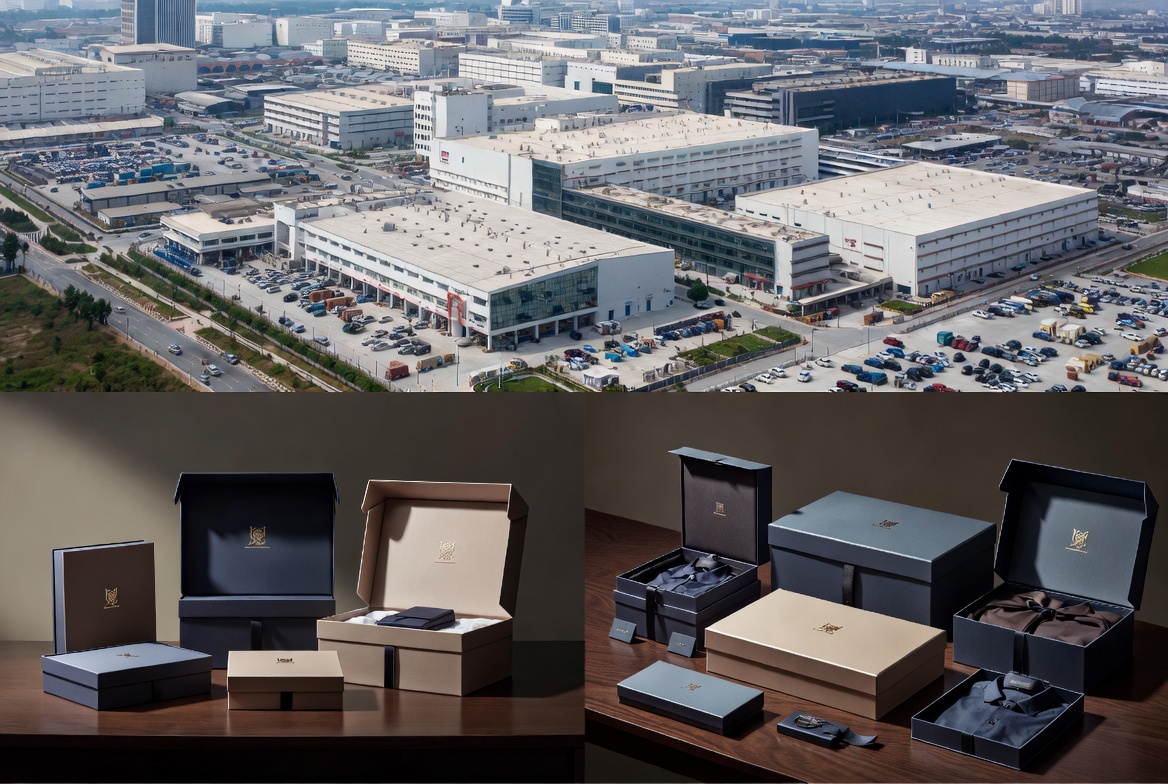
China hosts one of the world's largest garment packaging ecosystems, with hundreds of specialized paper‑box and rigid‑box manufacturers serving apparel brands and retailers. Dense clusters in the Pearl River Delta (Shenzhen, Dongguan, Guangzhou) and Yangtze River Delta (Shanghai, Suzhou) provide integrated printing, die‑cutting, and finishing capabilities, enabling both large‑volume and highly customized clothing boxes. [packshion]
For international buyers, China's advantages include cost‑competitive production, broad material options (from recycled greyboard to FSC‑certified art paper), and experienced export teams familiar with EU, US, and Asia‑Pacific compliance requirements. At the same time, the market is crowded and quality levels vary, making structured supplier selection essential. [ensun]
How We Evaluated Top Clothing Box Manufacturers
Experience: Factory and Operational Maturity
In this guide, we prioritized factories with at least 10–15 years of operation and a demonstrable track record in exporting garment or apparel packaging. Longevity alone is not enough, but it often correlates with optimized workflows, stable teams, and repeatable quality. [packshion]
We also checked evidence of continuous equipment upgrades—such as adoption of Heidelberg, ManRoland or equivalent presses—and annual output figures, where disclosed, as indicators of reliable capacity for ongoing apparel programs. [pakoro]
Expertise: Materials, Processes and Compliance for Clothing Boxes
High‑performing clothing box suppliers demonstrate deep process know‑how across:
- Substrate selection: greyboard thickness vs. compression strength, coated art paper vs. kraft for brand positioning and shipping durability. [ensun]
- Structural engineering: foldable vs. rigid, shoulder boxes, magnetic closures, and insert design tailored to garments (shirts, dresses, knitwear). [pakoro]
- Printing and finishing: color consistency (Pantone matching), foil, embossing/debossing, UV, lamination, and varnish tailored to fashion branding. [packshion]
On the compliance side, leading manufacturers increasingly work with FSC‑certified paper, vegetable‑based inks, and can support documentation for REACH, RoHS‑like restricted substances policies, and transport‑packaging standards when boxes form part of a product sold in regulated markets. [sunautomation]
Authoritativeness: China's Packaging and Printing Clusters
China's status as a global center for packaging stems from strong regional clusters: Dongguan and Shenzhen are recognized hubs for custom paper packaging and garment boxes; Shanghai and Suzhou host large integrated printing and converting plants; and Guangzhou concentrates many export‑oriented packaging firms. These regions benefit from access to upstream paper suppliers, machinery vendors, and skilled operators, which reduces lead time and improves consistency. [siskiyoucustommilling]
Multiple industry sources show that hundreds of garment‑packaging manufacturers operate in China, with typical mid‑sized firms employing 50–500 staff and some national players exceeding 1,000. This diversity allows buyers to match supplier size and specialization to their own brand stage—from emerging fashion labels to global retail chains. [uuprint]
Trust: What We Looked for in Each Factory Profile
For each manufacturer in the list, we focused on:
- Founding year and scale (factory area, employee count) as trust anchors. [ensun]
- Export markets (e.g., EU, US, Asia) and apparel‑related reference customers, where publicly mentioned. [pakoro]
- OEM/ODM scope: ability to support structural design, brand artwork, sample development, and packaging engineering—not just printing. [pakoro]
- Service behavior: responsiveness, willingness to explain limitations (e.g., tolerances, feasible finishes), and practical MOQs. This is often visible in how companies describe themselves publicly and the flexibility of their offerings. [packshion]
Transparent Selection Criteria for the Top 10
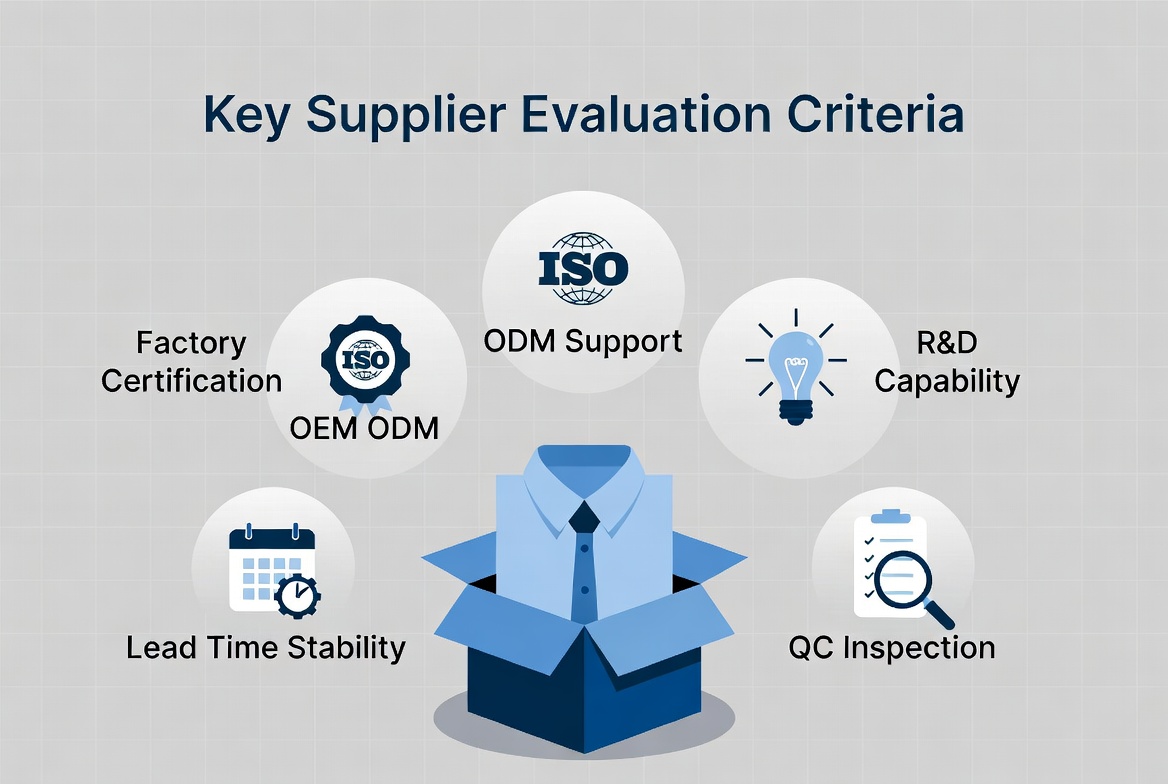
To build a practical "shortlist" for clothing box sourcing, we applied the following transparent criteria:
1. Primary product relevance: The company must actively produce garment or apparel‑oriented packaging boxes (rigid box, foldable carton, or specialty apparel box lines). [ensun]
2. Export experience: Clear evidence of overseas customers or exported products, through websites, platform listings or case mentions. [packshion]
3. Manufacturing infrastructure: Documented factory site, equipment list (preferably modern offset presses and converting lines), and scalable capacity rather than purely trading. [pakoro]
4. Quality credentials: ISO 9001, FSC, or similar certifications; or at minimum, documented QC processes for raw material inspection, in‑process checks, and final outgoing inspection. [ensun]
5. Service model: OEM/ODM support, sample capability, and reasonable lead times for both mass production and urgent orders. [pakoro]
The ten companies below reflect a mix of large‑scale plants and medium‑sized, high‑flexibility manufacturers so that different buyer profiles (fast‑fashion, premium labels, DTC brands) can find suitable partners.
Top 10 Clothing Box Manufacturers in China (2026)
1. Shenzhen XingKun Packing Products Co., Ltd.
Founded in 2004, Shenzhen XingKun Packing Products Co., Ltd is a medium‑sized printing and packaging manufacturer specializing in custom packaging boxes, display stands, paper boxes, and related printed products. The company operates from a 3,000 m² facility with annual output exceeding 10 million units and exports to more than 30 countries, making it relevant for fashion brands seeking stable yet flexible capacity. [pakoro]
XingKun is equipped with Heidelberg CD102 four‑color and Heidelberg XL75 six‑color presses, enabling high‑end business printing and consistent color management for clothing boxes and branded packaging. Its positioning as a "quality‑driven, service‑oriented" supplier is reinforced by fast lead times—typically 7–15 days for standard orders and 3–7 days for urgent samples—and a partnership approach focused on honest communication of product specifications and limitations. [pakoro]
For apparel buyers, XingKun is particularly suited to small and mid‑size brands that require:
- High‑value, custom clothing boxes without extremely high MOQs.
- Deep OEM support on structure, artwork, and associated printed materials (labels, hang tags, inserts).
- Efficient English‑language communication and agile responses when collections change frequently. [pakoro]
Its combination of modern equipment and medium‑scale flexibility means XingKun can balance cost‑effectiveness with design customization—making it a representative "high cost‑performance" partner rather than an overly self‑promoted option.
2. Shanghai DE Printed Box
Shanghai DE Printed Box operates a large 100,000 m² facility supplying corrugated cartons and luxury rigid boxes to global customers, including apparel brands. Their advanced printing technology and strict QC systems position them well for high‑volume clothing box programs where uniformity across thousands of units is critical. [packshion]
This manufacturer is best suited to buyers planning large seasonal drops or multi‑store rollouts, thanks to scalable capacity and robust infrastructure. However, MOQs are typically aligned with industrial‑scale programs, so smaller brands may find them less flexible than medium‑sized suppliers. [packshion]
3. Pakoro Packaging
Pakoro Packaging focuses on fully customizable garment boxes with luxury finishes such as embossing, foil stamping, and high‑end laminations. Founded in 2005, it emphasizes eco‑friendly materials and certified paper, positioning itself as a sustainability‑oriented partner for fashion brands. [packshion]
Pakoro is particularly appealing for labels that want low minimum order quantities combined with premium visual impact, making it suitable for boutique fashion brands and DTC apparel businesses. Its ability to combine flexible MOQs with upscale graphics and finishes supports small launches, special collections, and brand refreshes. [packshion]
4. YUTO Packaging
YUTO Packaging is known for integrating research, development, and production, and is often selected for complex projects that combine apparel with electronics or specialty inserts. The company supports mass‑market packaging for global brands and can engineer garment boxes that accommodate accessories, devices, or multi‑product sets. [packshion]
For buyers in athleisure, smart clothing, or apparel sold with gadgets, YUTO offers strong technical expertise and project management capability, although complexity may translate into higher development effort and longer sampling cycles compared to simpler box manufacturers. [packshion]
5. Newstep International
Newstep International specializes in high‑end gift boxes and eco‑friendly bags, serving European and American brands for over 25 years. Their 17,000 m² automated facility, along with FSC and ISO 9001/14001 certifications, underscores a mature approach to sustainability and quality management. [packshion]
This supplier suits premium fashion houses and gift‑oriented apparel brands that require sophisticated finishing (hot stamping, laminating, UV printing) and strong environmental credentials. MOQs may be moderate to high given their positioning, but the combination of automation and certification provides confidence for compliance‑sensitive markets. [packshion]
6. UNICO Packing
UNICO Packing operates ManRoland and Heidelberg presses, producing rigid gift boxes, corrugated cartons, and related printed products. The company highlights honesty, professionalism, and willingness to adapt designs to customer requirements, positioning itself as a practical choice for apparel cartons and rigid clothing boxes. [packshion]
Buyers who need a technically capable partner for standard shirt boxes, foldable cartons, and accompanying printed matter can benefit from UNICO's blend of high‑end equipment and attentive service. Its profile is suited to mid‑range fashion brands and retailers that value reliability without ultra‑luxury positioning. [packshion]
7. Guangzhou Jinguan Printing
Guangzhou Jinguan Printing operates a 30,000 m² factory with Heidelberg presses and claims daily output of around 50,000 units across notebooks, games, and paper boxes. This high‑volume capacity extends to garment packaging, supported by robust QC procedures for large runs. [packshion]
Jinguan is a good fit for buyers prioritizing scale and repeat orders—such as uniform suppliers, mass‑market apparel, or promotional clothing programs—where speed and unit cost are critical considerations. Its industrial footprint may be less optimized for very small batches or highly experimental designs. [packshion]
8. Bailipack
Bailipack emphasizes low‑carbon production and eco‑friendly materials, investing in German UV and six‑color printers for crisp, high‑impact graphics. Founded in 2005, it supports both small and large orders, making it attractive to brands with strong sustainability narratives. [packshion]
Apparel brands focused on green positioning—organic cotton, recycled fibers, ESG‑driven collections—can leverage Bailipack's eco‑friendly garment boxes and high‑quality printing to align packaging with product values. Buyers should still verify detailed environmental attributes (paper sourcing, ink type) to match specific market requirements. [packshion]
9. JYLUXE Packaging
JYLUXE Packaging targets value‑added packaging that aims to reduce overall costs while increasing perceived value, offering one‑stop sourcing for boxes, bags, and printed materials. With experience serving USA, Canada, and Europe, it understands mainstream Western brand expectations for apparel packaging. [packshion]
This supplier suits fashion brands seeking coordinated packaging systems—clothing boxes plus bags and accessories—without managing multiple vendors. It is particularly useful for retailers and DTC brands building cohesive unboxing experiences and cross‑category packaging portfolios. [packshion]
10. LeelinePackage & Pakmaker (High‑Volume and Fast‑Turn Options)
LeelinePackage operates a 20,000 m² facility producing over one million units monthly, using FSC‑certified materials and soy‑based inks to support environmentally responsible garment packaging. It combines large‑scale capacity with sustainability features, making it suitable for high‑volume apparel programs in regulated markets. [packshion]
Pakmaker, by contrast, leans heavily on fast turnarounds and versatile options, supported by its self‑owned facility and dedicated packaging team. For promotions, short‑term campaigns, or urgent clothing box needs, Pakmaker can be considered as a speed‑focused partner, though buyers should verify whether their rapid handling aligns with required QC depth for premium garments. [packshion]
Capacity, MOQ and Certification Snapshot
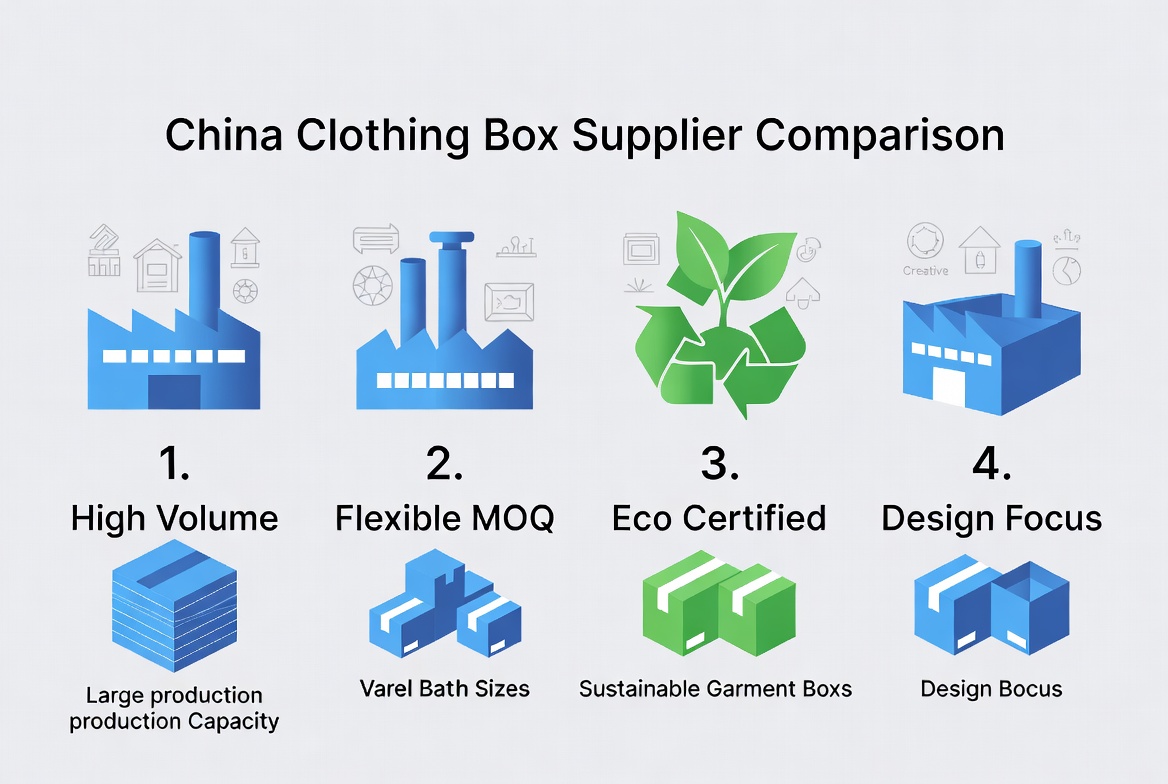
The table below summarizes indicative positioning based on publicly available information and typical industry patterns. Actual data should be confirmed directly with each supplier.
| Manufacturer | Typical Capacity / Scale | Indicative MOQ for Clothing Boxes | Key Certifications / Credentials | OEM/ODM Focus |
| Shenzhen XingKun Packing Products Co., Ltd | 3,000 m² plant, >10 million units annually, medium‑sized export‑oriented company. (pakoro) | Often flexible; suitable for small and mid‑size brands, samples in 3–7 days. (pakoro) | Internal QC, modern Heidelberg presses; buyers should confirm specific ISO/FSC status. (pakoro) | Strong OEM/ODM for paper boxes, display stands, labels, and other printed items. (pakoro) |
| Shanghai DE Printed Box | 100,000 m² facility with large‑scale production. (packshion) | Higher MOQs aligned with mass production. | Advanced printing and strict QC; ISO and FSC common in this tier (verify directly). (packshion) | Comprehensive OEM support for corrugated and rigid boxes. (packshion) |
| Pakoro Packaging | Medium facility with premium focus, garment box specialization. (packshion) | Low MOQ options for boutique brands. (packshion) | Eco‑friendly materials, certified paper (FSC‑type), sustainability focus. (packshion) | High‑customization OEM with luxury finishes. (packshion) |
| YUTO Packaging | Large integrated R&D and production capacity. (packshion) | Project‑based MOQs, typically mid‑high. (packshion) | Serves global brands; ISO/FSC and advanced quality systems are typical (verify). (packshion) | Complex ODM/OEM for apparel + electronics and multi‑product packaging. (packshion) |
| Newstep International | 17,000 m² automated plant. (packshion) | Moderate‑high MOQs; oriented to premium brands. (packshion) | FSC, ISO 9001/14001 for sustainability and quality. (packshion) | ODM/OEM for high‑end gift and garment boxes. (packshion) |
| UNICO Packing | Modern presses, diversified product mix. (packshion) | Mid‑range MOQs, suited to mainstream fashion. (packshion) | Quality‑oriented; verify ISO / FSC individually. (packshion) | OEM for rigid and folding apparel boxes. (packshion) |
| Guangzhou Jinguan Printing | 30,000 m² plant, up to ~50,000 units/day. (packshion) | Higher MOQs, ideal for volume orders. (packshion) | Standardized QC; confirm formal certifications. (packshion) | OEM for paper boxes including garment lines. (packshion) |
| Bailipack | Eco‑oriented, German printing lines. (packshion) | Flexible across small and large orders. (packshion) | Emphasis on low‑carbon processes and eco materials, likely FSC (verify). (packshion) | OEM for high‑print‑quality garment boxes. (packshion) |
| JYLUXE Packaging | Integrated packaging solutions for export markets. (packshion) | Mid‑range MOQs, multi‑category packaging. (packshion) | Export experience to USA/EU; confirm specific certificates. (packshion) | ODM/OEM for coordinated box + bag systems. (packshion) |
| LeelinePackage / Pakmaker | Leeline: high‑volume (1M+ units/month); Pakmaker: fast‑turn plant. (packshion) | Leeline: high MOQs; Pakmaker: flexible for rush orders. (packshion) | Leeline uses FSC materials and soy inks; Pakmaker's certifications should be individually verified. (packshion) | OEM for large‑scale or fast‑turn clothing boxes. (packshion) |
Industry Pain Points and "Internal" Pitfalls to Avoid
Common Pain Points in Clothing Box Sourcing
Procurement managers frequently encounter several recurring risks when sourcing clothing boxes:
- Material downgrading: Switching specified paper weight or greyboard thickness after sample approval to save cost, resulting in weaker boxes and crushed corners during shipment. [ensun]
- Color inconsistency: Inadequate color proofing or poor ink control leading to brand colors deviating across batches. [packshion]
- Hidden tooling and plate charges: Die‑cut and plate fees not fully disclosed at quotation stage, hurting landed cost calculations for apparel programs. [ensun]
- Lead‑time slippage: Underestimated production timelines when capacity is over‑committed, causing delays to new clothing launches. [pakoro]
Internal Avoidance Guide: A Less‑Discussed but Critical Practice
One insider rule that experienced buyers follow, but is rarely written about publicly, is "never finalize annual pricing before you've audited at least one mid‑season replenishment run."
Many factories treat initial orders as "showcase runs" with above‑average material and QC attention; the real consistency test comes when a mid‑season reorder is placed under time pressure. Before locking in year‑long pricing or signing framework agreements, request: [sinospect]
- A repeat run with identical specs three to six months after the first order.
- Independent verification of board caliper and burst strength on both runs.
- Random carton compression tests at your warehouse or third‑party lab.
If quality noticeably drops on the replenishment batch, that is a strong signal to renegotiate QC clauses or consider alternative suppliers—even if the sample and first shipment were excellent.
Buyer's Practical Guide: Verifying Factories, Samples and Logistics
How to Verify Factory Certifications (ISO, FSC, CE/RoHS‑Related Claims)
To verify ISO 9001 or similar certificates, buyers should:
1. Request a scanned copy with certificate number and issuing body.
2. Check the certification body's public registry (most accredited bodies list certificate status online) using that number. [china-clothing-manufacturer]
3. Cross‑check through recognized accreditation databases or official sites (e.g., CNAS in China) if needed. [sourcingwill]
For CE or RoHS‑related claims on packaging associated with regulated products, verify test reports from independent labs and ensure that the scope truly covers your product category and material type. Some sourcing guides from Alibaba and specialized apparel‑sourcing blogs emphasize that generic "CE" logos without traceable reports should be treated with caution. [seller.alibaba]
Sample Workflow: From RFQ to Pre‑Production
A robust sample workflow for clothing boxes typically includes:
- Structural white sample: Plain board prototype to confirm size, fit and assembly.
- Color prototype (printed sample): Includes artwork, finishing and approximate material, used to validate visual quality. [ensun]
- Pre‑production sample (PPS): Produced on the actual production line with final materials and tooling, sometimes under third‑party inspection.
Procurement teams should document acceptance criteria for each stage (dimensions, board thickness, color tolerance, surface defects) and incorporate them into purchase contracts and supplier SOPs. [sourcingwill]
Logistics Considerations: Carton Strength and Container Loading
With e‑commerce expansion, shipping damage to clothing boxes has become a measurable cost factor in apparel supply chains. Buyers should: [sunautomation]
- Align outer shipping carton specifications (board grade, double‑wall vs. single‑wall) with expected transport distance and handling conditions.
- Require suppliers to provide stacking strength data or test reports when garments are heavy or stored long‑term.
- Clarify Incoterms (FOB, CIF, DAP) and responsibilities for insurance, especially for high‑value branded boxes.
Close collaboration with packaging suppliers—such as XingKun or other experienced export‑oriented manufacturers—can help simulate transport scenarios and adjust box and carton design to reduce damage rates. [sunautomation]
Market Data and 2025–2026 Trends in Clothing Box Manufacturing
Recent market analyses and platform data show that packaging and garment‑box demand continues to grow, driven by e‑commerce, global fashion exports, and increased focus on sustainability. Industry reports and statistics platforms (e.g., Statista and regional industry associations) highlight: [ensun]
- Rising share of eco‑friendly materials and recyclable packaging in apparel sectors, especially in Europe and North America. [sunautomation]
- Increasing adoption of automation, AI and IIoT in box plants worldwide to improve speed, reduce waste, and stabilize quality. [sunautomation]
For procurement teams, these trends mean that suppliers able to demonstrate sustainable material sourcing, energy‑efficient production, and data‑driven QC (e.g., traceable inspection records) are likely to offer better long‑term performance and compliance alignment.
Conclusion and Call to Action
China's clothing box manufacturing landscape offers a wide spectrum of partners—from very large, automation‑heavy plants to agile medium‑sized factories like Shenzhen XingKun Packing Products Co., Ltd that serve small and mid‑size apparel brands with flexible, high‑value solutions. For procurement managers, combining rigorous verification of certifications, material consistency, and mid‑season quality performance with clear OEM/ODM expectations is the most reliable way to secure long‑term packaging partners. [ensun]
If you are currently shortlisting suppliers for upcoming collections, consider engaging two to three manufacturers from this list—including a flexible design‑oriented factory such as XingKun—to compare samples, QC documentation, and communication quality before finalizing your framework agreements. [pakoro]
FAQ: Advanced Questions from Apparel Procurement Managers
Q1: How can I verify whether a factory's ISO 9001 certificate is authentic and not expired?
A: Request a copy of the certificate, then search the certificate number on the issuing body's public registry to check validity dates and scope; cross‑check with national accreditation systems (such as CNAS) where applicable. [china-clothing-manufacturer]
Q2: How do I ensure that the board strength for clothing boxes remains consistent across multiple orders?
A: Define minimum caliper and compression strength in specifications, require suppliers to record lot‑wise material data, and periodically perform independent lab tests on incoming shipments—especially mid‑season replenishments. [sinospect]
Q3: What's the best way to prevent color shifts between sample and mass production?
A: Use standardized color proofs (e.g., hardproofs or digital proofs), insist on Pantone‑matched inks, and ensure the factory locks press settings for approved jobs; for key SKUs, consider attending press checks or using third‑party color audits. [packshion]
Q4: How can I assess a factory's real capacity and lead‑time reliability before a large apparel launch?
A: Ask for recent production records (e.g., average monthly output, typical lead times), evaluate equipment lists and automation levels, and request references from customers with similar order sizes in apparel or related packaging. [sunautomation]
Q5: What indicators show that a supplier can genuinely support OEM/ODM rather than only basic printing?
A: Look for in‑house structural designers, sample rooms, documented R&D activities, and case studies where they improved box design (structure, material, cost) for brands; XingKun and other design‑oriented firms often highlight these capabilities in their service descriptions. [pakoro]
References
- Garment packaging manufacturers overview and cluster data (China) – ensun industry search. [ensun]
- 2026 trends in packaging box manufacturing – Packshion industry article. [packshion]
- 2026 corrugated manufacturing outlook and automation trends – SUN Automation Group. [sunautomation]
- Guides on verifying ISO and other certifications from Chinese suppliers – Sinospect, specialized sourcing blogs, and apparel‑sourcing FAQs. [sites.google]
- Platform‑level manufacturer listings for garment boxes – Made‑in‑China and similar B2B portals (for broader vendor discovery). [made-in-china]


