Content Menu
● What Are Corrugated Boxes Made Of?
>> Linerboard Choices Affect More Than Appearance
● Corrugated Boxes vs. Cardboard Boxes: What Is the Difference?
● Single-Wall, Double-Wall, and Triple-Wall Corrugated Boxes
>> Single-Wall Corrugated Boxes
>> Double-Wall Corrugated Boxes
>> Triple-Wall Corrugated Boxes
● How to Choose the Right Corrugated Flute
● Understanding Corrugated Box Strength: ECT, Burst, and Compression
>> Edge Crush Test: Board-Level Compression Resistance
>> Burst Strength: A Different Material Property
>> Box Compression Testing: Evaluate the Actual Structure
● A Practical Five-Step Packaging Validation Plan
>> 1. Define the Distribution Journey
>> 2. Build a Representative Packed Sample
>> 3. Choose Relevant Tests
>> 4. Define Acceptance Criteria Before Testing
>> 5. Record and Approve the Final Specification
● Custom Corrugated Box Styles and Printing Options
>> Regular Slotted Containers
>> Die-Cut Mailer Boxes
>> Printed and Laminated Corrugated Packaging
● How to Reduce Packaging Cost Without Weakening Protection
● Are Corrugated Boxes Recyclable?
● What to Send Your Corrugated Box Manufacturer
● Start Your Custom Corrugated Packaging Project
● Frequently Asked Questions About Corrugated Boxes
>> 1. Are Corrugated Boxes the Same as Cardboard Boxes?
>> 2. Which Corrugated Flute Is Best for Shipping?
>> 3. Are Double-Wall Boxes Always Necessary for Heavy Products?
>> 4. Can Corrugated Boxes Have High-Quality Printed Graphics?
>> 5. How Can I Check Whether a Custom Box Is Strong Enough?
● References
Corrugated boxes are paper-based packaging containers made with fluted paper bonded to flat linerboards. Their layered construction provides rigidity and cushioning, making them useful for shipping, storage, retail presentation, and customized product protection.
However, choosing custom corrugated boxes involves more than selecting a size and adding a logo. The right packaging must match your product's fragility, shipping environment, stacking conditions, and presentation requirements.
At Shenzhen XingKun Packing Products Co., Ltd., we bring more than 20 years of printing and packaging experience to conversations with brands and distributors across over 30 countries and regions. Our starting point is straightforward: understand the product and its journey before specifying the box.
This guide explains how corrugated packaging works, where common specifications can mislead buyers, and how to build a clearer manufacturing brief.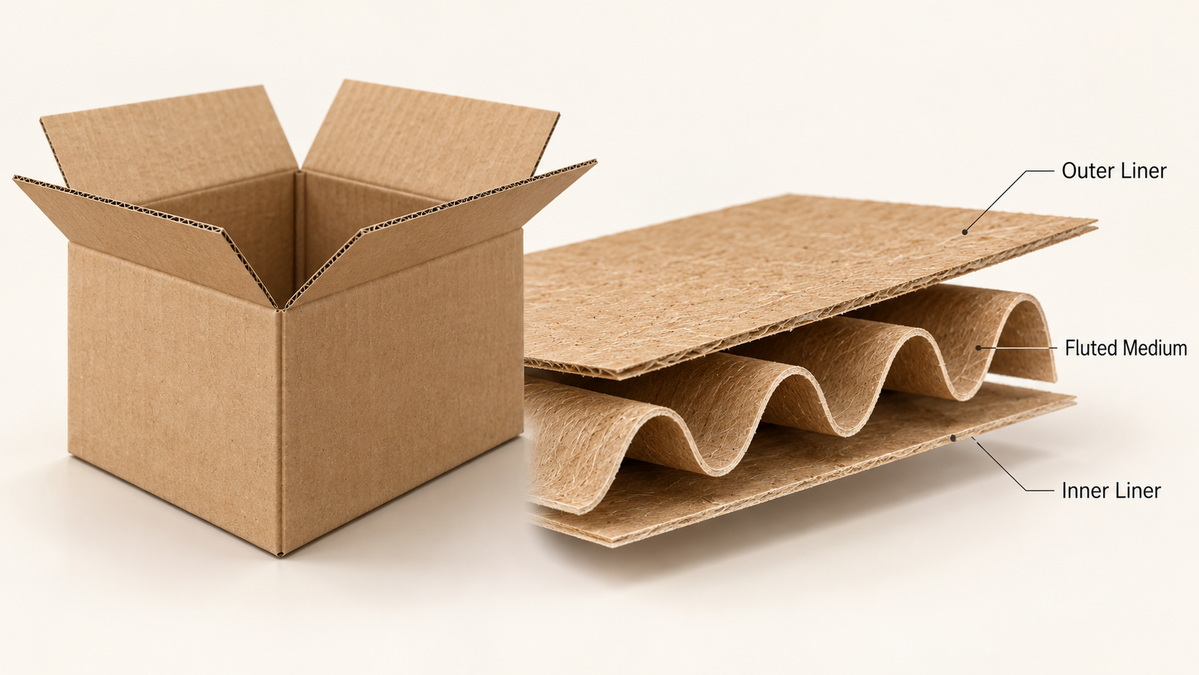
What Are Corrugated Boxes Made Of?
A standard single-wall corrugated board contains three paper layers:
- Outer linerboard, which forms the exterior surface.
- Fluted medium, the wave-shaped paper between the liners.
- Inner linerboard, which forms the inside surface.
The flutes keep the liners apart, increasing bending rigidity without requiring a solid, heavy sheet. When oriented vertically in a box wall, they also help support compression loads.
Corrugated board is manufactured by shaping the medium into flutes and bonding it to linerboards with adhesive. The combined board is then converted into packaging through cutting, creasing, printing, folding, and joining.
Linerboard Choices Affect More Than Appearance
Linerboards can contain virgin fibers, recycled fibers, or a combination. Their properties influence strength, surface quality, moisture response, and printing results.
Brown and white surfaces offer different visual possibilities, but color alone does not establish board performance. A purchasing specification should identify the required construction and measurable properties rather than relying on descriptions such as "premium cardboard."
Corrugated Boxes vs. Cardboard Boxes: What Is the Difference?
"Cardboard" is a broad everyday term, not a precise material specification. Buyers often use it to describe both folding cartons and corrugated shipping boxes.
For sourcing purposes, distinguish solid paperboard from fluted corrugated board.
| Feature | Solid Paperboard Cartons | Corrugated Boxes |
| Structure | Non-fluted paperboard | Fluted medium bonded to liners |
| Typical applications | Cosmetics, food cartons, retail sleeves | Shipping, mailers, protective packaging |
| Cushioning | Usually depends on additional components | Fluted structure provides cushioning |
| Printing surface | Generally smooth | Depends on liner and flute profile |
| Selection priority | Presentation and product containment | Protection, stacking, shipping, presentation |
These materials often work together. A printed folding carton can present the product, while an outer corrugated box protects it during distribution.
The practical question is not which material is universally better. It is which packaging combination performs the required job efficiently.
Single-Wall, Double-Wall, and Triple-Wall Corrugated Boxes
Wall construction describes the number of fluted layers in the board.
Single-Wall Corrugated Boxes
Single-wall board contains one fluted medium between two liners. It is a common starting point for shipping cartons, subscription packaging, and custom mailer boxes.
Its performance depends on the paper combination, flute profile, dimensions, and manufacturing quality—not simply its three-layer construction.
Double-Wall Corrugated Boxes
Double-wall board contains two fluted mediums and three liners. Different flute profiles can be combined to balance cushioning, rigidity, and surface quality.
It is worth evaluating for heavier products, demanding stacking conditions, or applications where single-wall samples do not provide adequate protection.
Triple-Wall Corrugated Boxes
Triple-wall board contains three fluted mediums and four liners. It can serve demanding industrial packaging applications.
However, "triple wall" is not a universal load rating. Product support, box geometry, closures, storage conditions, and tested performance still determine suitability.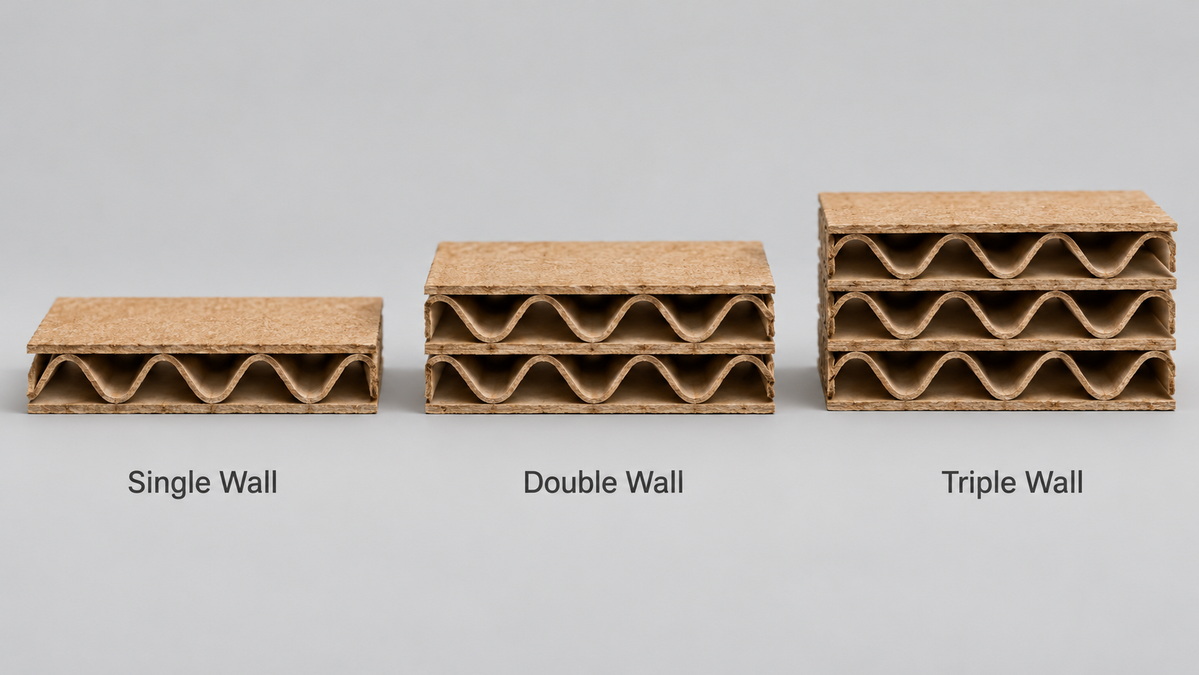
How to Choose the Right Corrugated Flute
Flute selection influences thickness, cushioning, converting behavior, and print appearance.
The following table provides starting points rather than guaranteed performance rankings.
| Flute Profile | General Characteristic | Applications to Evaluate |
| A flute | Larger flute profile with cushioning potential | Protective packaging for fragile products |
| B flute | Relatively compact profile | Die-cut boxes and retail-ready packaging |
| C flute | General-purpose balance | Distribution and shipping cartons |
| E flute | Fine profile with a smoother printing surface | Branded mailers and retail packaging |
| F flute | Very fine profile | Compact, presentation-focused packaging |
Larger profiles generally offer cushioning and vertical compression advantages. Smaller profiles support finer graphics and compact retail structures.
Nevertheless, flute size alone cannot determine strength. A well-specified smaller-flute construction may outperform a poorly specified thicker board for a particular requirement.
Ask your manufacturer to explain the complete board combination and validate the finished package.
Understanding Corrugated Box Strength: ECT, Burst, and Compression
One of the most important purchasing improvements is to replace vague strength descriptions with relevant test requirements.
Edge Crush Test: Board-Level Compression Resistance
The Edge Crush Test, or ECT, measures the edgewise compression resistance of a corrugated board specimen.
It helps characterize a property associated with stacking performance. However, it does not directly state how much product weight a finished box can safely carry.
Box dimensions, construction, converting quality, and environmental conditions also influence performance.
Burst Strength: A Different Material Property
A burst test measures resistance to rupture under increasing pressure.
It evaluates a different failure mechanism from edge crushing. Consequently, burst and ECT results should not be treated as interchangeable measurements.
The appropriate specification depends on the expected hazards and any applicable customer or distribution requirements.
Box Compression Testing: Evaluate the Actual Structure
Box compression testing evaluates the compression resistance of the assembled container.
It brings the box's dimensions, panels, corners, joints, and closures into the assessment. For demanding applications, this is more informative than selecting packaging from a board description alone.
Validation is the key principle: use material specifications to guide development, then test whether the complete packaging system performs as intended.
A Practical Five-Step Packaging Validation Plan
A production-ready box should protect the product, remain functional, and meet agreed appearance requirements.
1. Define the Distribution Journey
Document whether the package will travel as an individual parcel, inside a master carton, or on a pallet.
Include handling conditions, storage duration, stacking arrangements, and anticipated moisture exposure. A retail display box and a parcel shipper face different demands.
2. Build a Representative Packed Sample
Use the intended product, inserts, closures, labels, and packing method.
An empty box or a loosely similar substitute cannot demonstrate how the actual product interacts with its packaging.
3. Choose Relevant Tests
Consider compression, drop, vibration, and moisture-related assessments according to the risks identified.
For qualifying individual parcel shipments, ISTA Procedure 3A covers packaged products weighing 70 kilograms or less. Its suitability should be confirmed for the specific distribution scenario.
4. Define Acceptance Criteria Before Testing
Agree on what constitutes failure:
- Product breakage or loss of function.
- Unacceptable cosmetic damage.
- Opening or closure failure.
- Excessive movement inside the package.
- Unreadable labels or unacceptable box deformation.
Clear criteria prevent disagreements after testing.
5. Record and Approve the Final Specification
Keep the approved sample, material specification, drawings, and test results together.
If the board, dimensions, insert, or closure changes, review whether further validation is necessary.
Custom Corrugated Box Styles and Printing Options
Structure and graphics should be developed together, rather than treated as separate purchasing decisions.
Regular Slotted Containers
Regular slotted containers are practical shipping-box structures with flaps that meet when closed.
They suit many distribution applications, but their effectiveness still depends on correct sizing, board selection, and sealing.
Die-Cut Mailer Boxes
Die-cut mailers can incorporate tuck closures, roll-end panels, or other structural features.
They offer opportunities for branded presentation and convenient opening. Check closure security and assembly time alongside appearance, particularly when packaging will be handled repeatedly.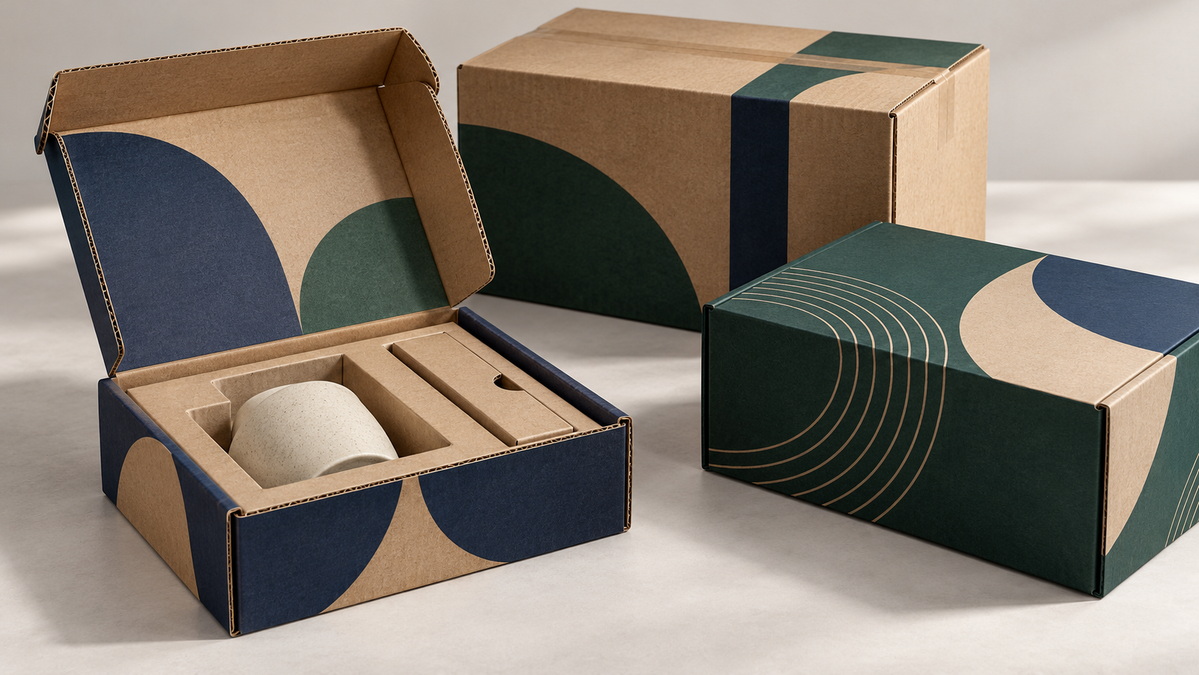
Printed and Laminated Corrugated Packaging
Printing choices may include flexographic printing, digital printing, or litho-laminated graphics.
Flexographic printing can suit repeat production and practical shipping graphics. Digital printing can support short runs or changing artwork. Litho-lamination can provide detailed printed surfaces for presentation-focused packaging.
Request samples on a comparable material and construction. Screen artwork alone cannot establish color, surface finish, fold behavior, or the visibility of underlying flutes.
How to Reduce Packaging Cost Without Weakening Protection
The lowest box price does not necessarily produce the lowest delivered cost.
Compare packaging material, inserts, assembly labor, storage, freight, and damage exposure together.
Start by reviewing fit. Excess space can require more void fill and may increase shipping dimensions. However, removing clearance without understanding cushioning needs can create a new damage risk.
Next, compare complete packaging systems. A carefully designed insert may allow a more efficient outer box, while an oversized heavy-duty box may still leave a fragile product unsupported.
Finally, review packing operations. A visually impressive structure can become expensive if it is slow to assemble or difficult to close consistently.
The objective is not the thinnest possible board. It is an efficient, repeatable packaging system that meets the agreed protection requirements.
Are Corrugated Boxes Recyclable?
Corrugated packaging can be recyclable, but the complete design and local recycling infrastructure matter.
Coatings, laminations, contamination, and attached components can affect collection and processing. Recyclability should therefore be assessed for the finished package, not assumed from its paper content.
For context, FEFCO reports an 82.5% European paper-and-board packaging recycling rate for 2022. That figure covers a broader material category; it is not a product-specific guarantee or a worldwide corrugated-box recycling rate.
Practical design questions include:
- Can unnecessary plastic components be removed?
- Can consumers easily separate different materials?
- Are barrier treatments necessary for the application?
- Are disposal instructions appropriate for the destination market?
Avoid environmental claims that exceed the evidence available for your actual packaging.
What to Send Your Corrugated Box Manufacturer
A detailed enquiry makes quotations easier to compare and reduces avoidable revisions.
Provide the following information:
1. Product dimensions, weight, fragility, and photographs.
2. Required internal box dimensions and packing arrangement.
3. Shipping method and destination markets.
4. Stacking and storage requirements.
5. Preferred style, printing coverage, and finish.
6. Insert, divider, or cushioning requirements.
7. Order quantity and expected reorder pattern.
8. Testing, appearance, and dimensional acceptance criteria.
Specify whether dimensions are internal or external. Also clarify how dimensions are ordered on drawings, rather than assuming every supplier uses the same convention.
For repeat orders, retain an approved physical sample and a written specification. This creates a clearer reference for both purchasing and production teams.
Start Your Custom Corrugated Packaging Project
At Shenzhen XingKun Packing Products Co., Ltd., we approach packaging as a combination of product protection, print quality, and practical manufacturing requirements.
Send us your product dimensions, weight, destination market, expected quantity, and artwork requirements. Request a proposed corrugated structure, a representative sample, and clearly documented acceptance criteria before approving production.
That gives your team a stronger basis for choosing packaging—not just a more attractive quotation.
Frequently Asked Questions About Corrugated Boxes
1. Are Corrugated Boxes the Same as Cardboard Boxes?
Not precisely. "Cardboard" is a broad informal term. Corrugated boxes specifically use fluted paper bonded to linerboards. Folding cartons generally use solid paperboard without that fluted structure.
2. Which Corrugated Flute Is Best for Shipping?
There is no universally best flute. C flute is commonly evaluated for general shipping, while other profiles suit different protection and presentation needs. Choose using the complete board specification and package testing.
3. Are Double-Wall Boxes Always Necessary for Heavy Products?
No. Product weight is only one factor. Dimensions, product support, stacking conditions, and handling hazards also matter. Compare suitable constructions and validate them rather than selecting by wall count alone.
4. Can Corrugated Boxes Have High-Quality Printed Graphics?
Yes. Suitable liners and printing methods can produce detailed branded packaging. Review representative samples because flute profile, surface properties, artwork, and finishing influence the final appearance.
5. How Can I Check Whether a Custom Box Is Strong Enough?
Start with a clear specification, then evaluate the complete packed product using relevant tests. Board ratings provide useful information, but they do not replace assessment of the assembled packaging system.
References
1. Custom Box Makers. ["Understanding Corrugated Boxes: Materials, Benefits & Uses."] Original article reviewed for its definitions, structure, material descriptions, and application coverage. [customboxmakers]
2. Fibre Box Association. ["What Is Corrugated?"] Industry explanation of linerboards, flutes, structural behavior, and differences between flute profiles. [fibrebox]
3. Shorr Packaging. ["The Ultimate Guide to Corrugated Boxes."] Reference for wall constructions, flute combinations, and corrugated strength terminology. [shorr]
4. FEFCO. ["Testing Methods & Recommendations."] Lists methods for bursting strength, edgewise crush resistance, water absorptiveness, packaging compression, and drop testing. [fefco]
5. International Safe Transit Association. ["Test Procedures."] Defines the application of Procedure 3A to individual parcel-delivery packaged products weighing 70 kilograms or less. [ista]
6. FEFCO. ["Circular by Nature: Easy to Recycle."] Reports the 2022 European paper-and-board packaging recycling rate of 82.5%, attributed to Eurostat. [fefco]
7. Packaging Warehouse. ["New Recycling Guidelines by FEFCO."] Explains the relevance of material combinations and collection, sorting, and recycling infrastructure to recyclability. [packaging-warehouse]


