Content Menu
● What Is Pillow Box Packaging?
● When Custom Pillow Boxes Are the Right Choice
>> When to Choose Another Packaging Structure
● How to Size Custom Pillow Box Packaging Correctly
>> A Five-Step Product-Fit Process
● Choosing Materials for Kraft and Printed Pillow Boxes
>> Match the Board to the Structure
● Custom Pillow Box Printing and Finishing
>> Design Around Curves, Creases, and Closures
>> Window Pillow Boxes: Visibility With Trade-Offs
● A Practical Sample-Approval and Quality-Control Workflow
>> Approve Structure Before Decorative Details
>> Record Acceptance Criteria
● Pillow Boxes for E-Commerce: Test the Complete Package
● Food Safety and Environmental Claims Need Specific Evidence
>> Pillow Boxes for Food Require Intended-Use Checks
>> Kraft Appearance Does Not Prove Recyclability
● How to Compare Custom Pillow Box Quotes
● Start Your Custom Pillow Box Project With XingKun
● Frequently Asked Questions
>> Are pillow boxes supplied flat?
>> Can I use a pillow box for fragile jewelry?
>> What dimensions should I send for a quotation?
>> Are kraft pillow boxes automatically recyclable?
>> Can pillow boxes hold food directly?
>> What should I approve before bulk production?
● References
Pillow box packaging gives small products a distinctive curved presentation without the bulk of a rigid gift box. For brands sourcing custom pillow boxes, however, attractive printing is only one part of the decision. Product fit, board performance, closure reliability, and shipping protection determine whether the finished package actually works.
At Shenzhen XingKun Packing Products Co., Ltd., we bring more than 20 years of printing and packaging manufacturing experience to brands and distributors across over 30 countries and regions. This guide takes a practical, manufacturer-oriented approach to selecting packaging boxes: start with the product, validate the structure, and approve the details before production.
What Is Pillow Box Packaging?
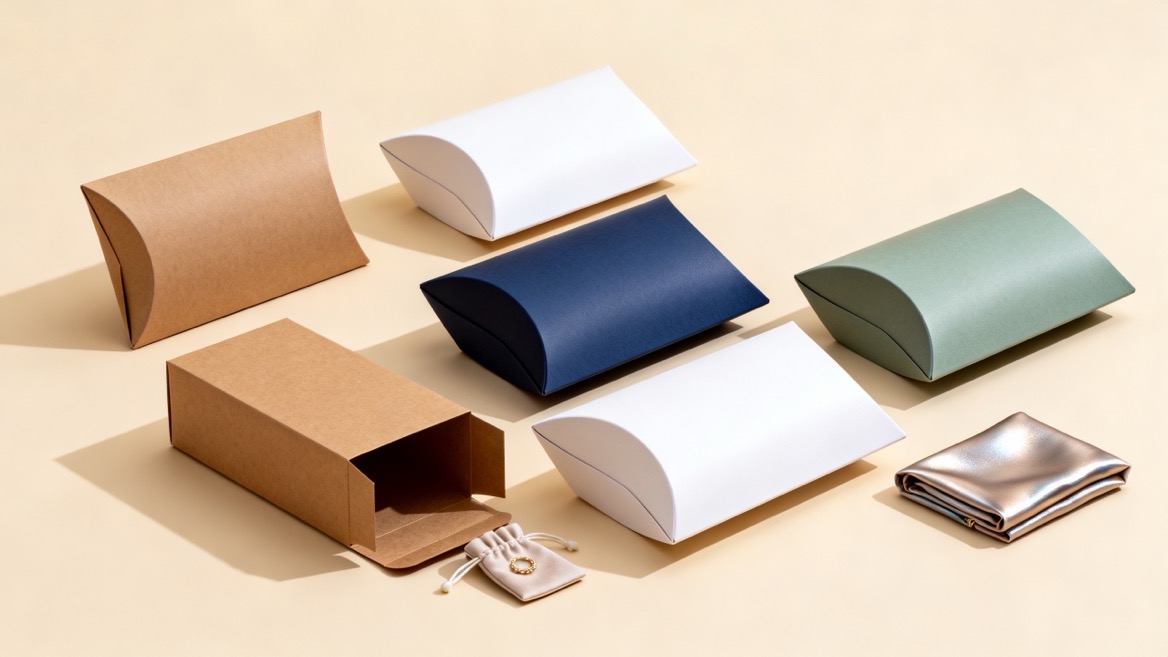
A pillow box is a curved folding carton with inward-folding end flaps. Its pillow-like profile creates a compact gift presentation, while its broad central panels provide space for branding.
Many paperboard versions arrive flat with a manufacturer-glued side seam. Users open the body and tuck the curved flaps inward. Closing the ends typically requires no additional adhesive, but that does not mean the entire carton is manufactured without glue.
Think of a pillow box primarily as presentation packaging. It can hold and organize suitable products, but its shape alone does not establish adequate protection for parcel delivery.
When Custom Pillow Boxes Are the Right Choice
Custom pillow boxes work best when the product is relatively lightweight, compact, and compatible with a curved interior. Common applications include:
- Jewelry placed on a backing card or inside a protective pouch.
- Socks, scarves, and other compressible accessories.
- Small cosmetic products with secure primary containers.
- Wrapped confectionery and individually packaged treats.
- Wedding favors, promotional gifts, and boutique merchandise.
The important question is not simply whether the product fits. It is whether the product remains stable, the ends stay closed, and the customer can remove it comfortably.
When to Choose Another Packaging Structure
Consider a different carton or a stronger packaging system for heavy glass containers, sharp objects, leak-prone products, or merchandise requiring substantial stacking strength.
A rigid box may better support a premium presentation, while a corrugated shipping carton can provide transit protection. Neither alternative is automatically sufficient: the complete package still needs evaluation against its intended handling conditions.
How to Size Custom Pillow Box Packaging Correctly
Pillow box dimensions can be misleading because curved ends reduce usable space. A flat dieline measurement is not interchangeable with the assembled carton's internal capacity.
Avoid ordering solely from generic "small," "medium," or "large" categories. Suppliers may use different measurement conventions, and products with identical outer dimensions can need different clearances.
A Five-Step Product-Fit Process
1. Measure the packed product, including its pouch, backing card, wrapping, or insert.
2. Record the maximum dimensions, weight, and any protruding components.
3. Ask the supplier to identify internal usable dimensions and the measurement convention on the drawing.
4. Test a physical prototype with the actual product, not only a digital mockup.
5. Check flap closure, panel distortion, product movement, and removal before approving the dieline.
Do not apply a universal clearance allowance. Compressible fabric and a rigid cosmetic container behave differently inside the same curved structure.
| Product characteristic | Design priority | Sample check |
| Rigid container | Clearance near curved ends | Flaps close without pressing against the product |
| Soft accessory | Controlled presentation | Package does not bulge or look underfilled |
| Small jewelry | Positioning and surface protection | Item stays on its card or inside its pouch |
| Wrapped food | Compatibility with primary wrapping | Wrapping remains intact during packing |
Choosing Materials for Kraft and Printed Pillow Boxes
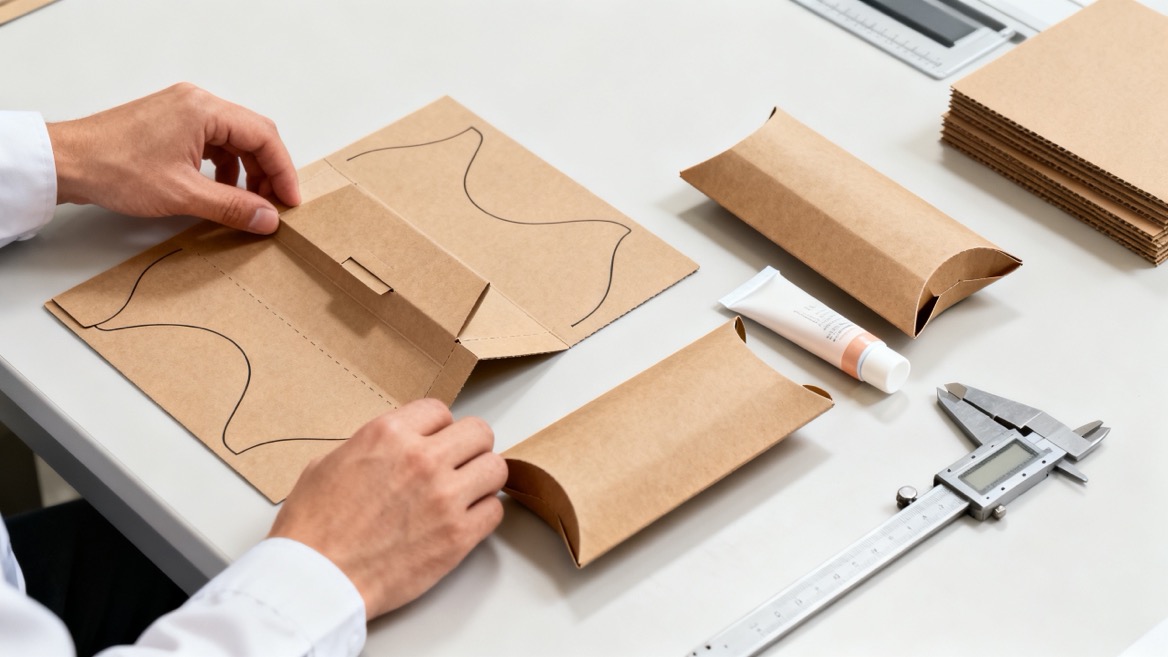
Material selection should balance appearance, stiffness, folding behavior, and product requirements. Paper color or thickness alone cannot predict the performance of a finished box.
Ask for the proposed board grade, grammage, caliper, and surface treatment. Grammage measures mass per unit area; caliper measures thickness. They describe different properties, and neither replaces prototype testing.
| Material option | Typical presentation | Points to confirm |
| Brown kraft paperboard | Natural-looking gift or boutique packaging | Ink contrast, surface consistency, and crease quality |
| White coated paperboard | Detailed graphics and bright brand colors | Print reproduction, coating suitability, and scuff resistance |
| Recycled paperboard | An option for documented recycled-content requirements | Verified content, appearance variation, and performance |
| Suitable corrugated construction | Additional cushioning or stiffness where the structure permits | Curved-fold feasibility, dimensions, and product protection |
Match the Board to the Structure
A thicker board is not always a better board for a pillow box. The curved end folds must work without excessive resistance, visible cracking, or spring-back.
For a new project, request alternative material samples where appropriate. Compare them after folding and filling, rather than judging only an unconverted sheet.
Custom Pillow Box Printing and Finishing
Strong packaging artwork makes the brand easy to recognize and the product easy to understand. A restrained design can communicate more clearly than several competing decorative effects.
Printing methods should be selected around the substrate, order quantity, artwork, and production setup. Ask the manufacturer to explain the recommended process and provide an appropriate proof.
Design Around Curves, Creases, and Closures
Keep essential text, barcodes, and fine details away from folds and curved closure areas. Follow the approved dieline's bleed and safety requirements rather than assuming one universal artwork margin.
Before releasing artwork, confirm:
- Logo placement on the assembled front panel.
- Readability of product names, ingredients, and required information.
- Brand-color expectations and the agreed proofing method.
- Barcode performance on the finished, curved package.
- Alignment of foil, embossing, windows, and printed graphics.
Foil stamping, embossing, spot coatings, and textured finishes can add visual interest. Select them deliberately, then assess their effect on cost, readability, folding, and disposal instructions.
Window Pillow Boxes: Visibility With Trade-Offs
A window can show the product without opening the package. However, removing board changes the structure, and a film patch introduces another material.
Confirm window placement, edge strength, attachment quality, and compatibility with the product. Do not assume that a windowed carton has the same recycling pathway as an otherwise comparable unwindowed carton.
A Practical Sample-Approval and Quality-Control Workflow
Sample approval is where an attractive concept becomes a repeatable specification. Buyers should agree on what is being approved and how production will be checked.
Approve Structure Before Decorative Details
Start with an unprinted structural sample when possible. Fill it with the actual product and check assembly, fit, closure, and removal.
Then review a printed sample or production-representative proof. A digital rendering cannot establish board stiffness, tactile finish, closure behavior, or resistance to rubbing.
Record Acceptance Criteria
Create a written approval checklist covering:
- Agreed dimensions and tolerances.
- Board grade and specified finishes.
- Print appearance against the approved reference.
- Clean cutting, consistent creasing, and side-seam bonding.
- End-flap closure and insert positioning.
- Packing method, carton markings, and quantity verification.
Keep the approved reference sample and document any accepted changes. This gives the buyer and manufacturer a shared basis for discussing production quality rather than relying on descriptions such as "premium" or "strong."
Pillow Boxes for E-Commerce: Test the Complete Package
A pillow box and a shipping container perform different jobs. The first presents the product; the second helps protect it through distribution.
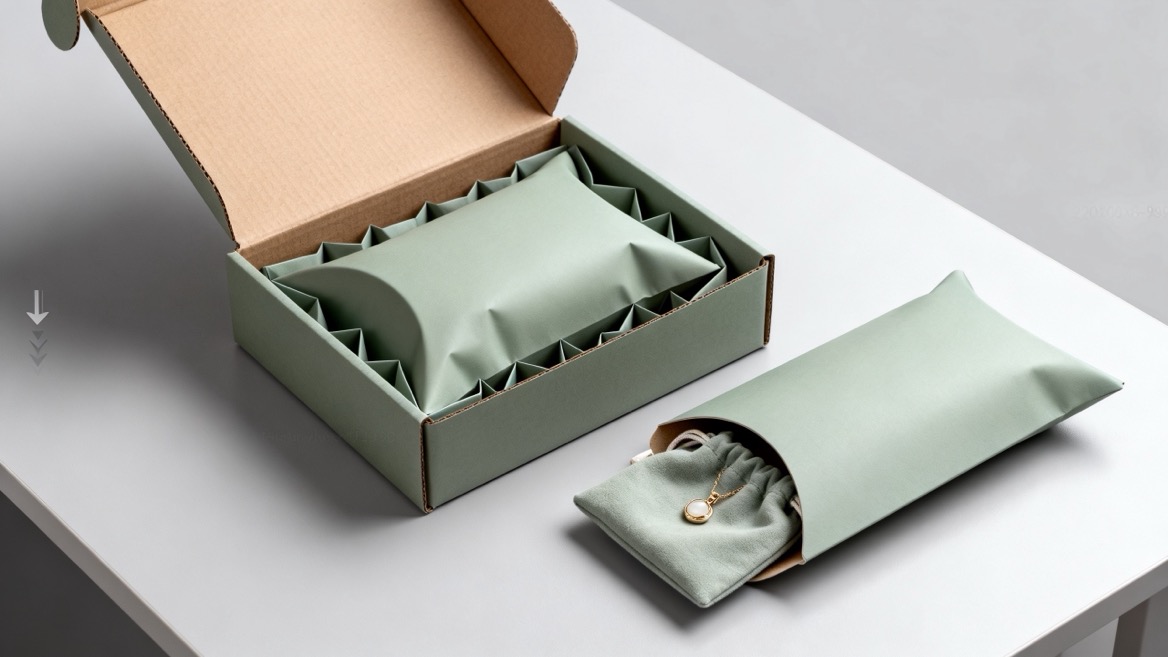
For parcel shipments, evaluate the complete system: product, primary container, insert, pillow box, cushioning, and outer carton or mailer. Improving one component does not necessarily solve a weakness elsewhere.
ISTA Procedure 3A addresses individual packaged products shipped through parcel delivery systems, with a stated scope of 70 kilograms or less. A qualified testing provider can help determine whether that procedure or another test is appropriate for your shipment.
The useful outcome is not merely a report. It is evidence that the product remains protected and the packaging meets the agreed acceptance criteria after representative handling stresses.
Food Safety and Environmental Claims Need Specific Evidence
Pillow Boxes for Food Require Intended-Use Checks
For cookies, chocolates, or other foods, distinguish between an outer presentation carton and a material that may contact food directly.
For products entering the United States, FDA guidance explains that the regulatory status of a food-contact material depends on its individual components and intended use. Relevant conditions include food type, temperature, and storage conditions.
Ask for documentation appropriate to the intended application, including relevant coatings, adhesives, and other components. A generic "food-grade" statement is not a substitute for that review.
Kraft Appearance Does Not Prove Recyclability
A brown carton may look environmentally responsible, but appearance does not establish sourcing, recycled content, or recyclability. Those are separate claims requiring separate support.
FSC labels distinguish certified forest materials, qualifying mixed inputs, and recycled materials. Do not print a certification mark merely because the board supplier mentions certification; confirm the applicable authorization and claim.
For U.S. marketing, the FTC Green Guides explain that unqualified recyclable claims generally require suitable recycling facilities to be available to at least 60 percent of consumers or communities where the item is sold. Review the finished construction and the applicable market requirements before making disposal claims.
How to Compare Custom Pillow Box Quotes
The lowest unit price does not necessarily produce the lowest delivered cost. Compare quotations using the same structure, material, print specification, finish, and packing assumptions.
Request separate clarification of:
- Box quantity and price breaks.
- Tooling, sampling, and setup charges.
- Inserts, windows, and decorative processes.
- Flat-packed or assembled delivery.
- Outer-carton specifications and freight terms.
- Production timing and approval deadlines.
A useful comparison considers packaging, packing labor, freight, and potential replacement costs together. Avoid assuming that pillow boxes always cost less than every alternative; order size and specifications can change the result.
Start Your Custom Pillow Box Project With XingKun
Shenzhen XingKun Packing Products Co., Ltd. manufactures packaging boxes and other printed products for international customers.
Request a project-specific quotation with your product dimensions, weight, order quantity, destination, artwork, and preferred finishes. Include a product sample or photographs where possible, and ask about structural sampling before bulk production.
Validation should come before volume: agree on product fit, material, artwork, and acceptance criteria before committing to the final order.
Frequently Asked Questions
Are pillow boxes supplied flat?
Many paperboard designs are supplied flat with the side seam already bonded. Confirm the delivery format, assembly steps, and any separately supplied inserts with your manufacturer.
Can I use a pillow box for fragile jewelry?
Possibly, with suitable positioning and protection. Use a backing card, pouch, or insert as needed, and evaluate the complete shipping package before parcel delivery.
What dimensions should I send for a quotation?
Provide the packed product's maximum length, width, height, and weight. Include wrapping and accessories, then ask the supplier to confirm the carton's usable internal dimensions.
Are kraft pillow boxes automatically recyclable?
No. Coatings, windows, adhesives, and local collection systems affect the assessment. Use a documented claim that accurately describes the finished package in its intended market.
Can pillow boxes hold food directly?
Only after checking the materials and documentation for the specific food-contact use. Wrapped food in an outer carton presents different requirements from unpackaged food touching the carton.
What should I approve before bulk production?
Approve the structure, product fit, board, artwork, finish, closure, and packing method. Record the agreed acceptance criteria and retain a reference sample.
References
1. Custom Box Makers — Dian Priastuti, "The Complete Pillow Box Guide," published March 24, 2026. Background source for pillow box structure, common applications, customization options, and the original article being reworked. [customboxmakers]
2. International Safe Transit Association — "ISTA 3A: Packaged-Products for Parcel Delivery System Shipment 70 kg (150 lb) or Less," procedure overview. Source for parcel-delivery test scope and the distinction between presentation packaging and a tested shipping system. [ista]
3. U.S. Food and Drug Administration — "Determining the Regulatory Status of Components of a Food Contact Material." Source for component-specific regulatory status, intended-use requirements, and supplier documentation considerations. [fda]
4. U.S. Food and Drug Administration — "Food Types & Conditions of Use for Food Contact Substances." Source for food categories and temperature/storage conditions relevant to food-contact evaluation. [fda]
5. Forest Stewardship Council — "What the FSC Labels Mean." Source for the distinctions between FSC 100%, FSC Mix, and FSC Recycled labels. This reference does not imply that XingKun holds any particular certification. [fsc]
6. U.S. Federal Trade Commission — "Guides for the Use of Environmental Marketing Claims," 16 CFR Part 260, particularly Section 260.12. Source for recyclable-claim qualifications and the 60 percent access threshold. Local and other applicable requirements must also be checked. [ftc]


