Content Menu
● LED Name Plates vs Traditional Office Nameplates: What Is the Difference?
>> What Are LED Name Plates?
>> What Are Traditional Office Nameplates?
● At-a-Glance Comparison: Illuminated vs Non-Illuminated Nameplates
● Visibility and Readability: Does Illumination Always Help?
>> Where LED Name Plates Can Add Value
>> Where Traditional Office Nameplates Perform Well
● Appearance and Branding: Match the Sign to Its Role
>> LED Name Plates for Selected Brand Touchpoints
>> Traditional Nameplates for a Unified Office System
● Materials, Printing, and Manufacturing Quality
>> Assess the Complete LED Assembly
>> Assess Traditional Nameplates Beyond Material Names
● Cost Comparison: Calculate Ownership, Not Just Purchase Price
>> What Determines the Initial Cost?
>> An Illustrative Electricity Calculation
>> Use a Five-Year Ownership Checklist
● Durability and Maintenance: What Can Fail?
>> LED Nameplate Maintenance
>> Traditional Nameplate Maintenance
● Accessibility: Separate Employee Names from Permanent Room Identification
● A Practical Prototype Test Before Placing a Bulk Order
>> Step 1: Select Representative Locations
>> Step 2: Test Real Content
>> Step 3: Review the Installed Sample
>> Step 4: Simulate an Update
>> Step 5: Record Acceptance Criteria
● Which Nameplate Type Fits Your Office?
● Plan Your Custom Nameplate Project with XingKun
● Frequently Asked Questions
>> Are LED Name Plates Better Than Traditional Office Nameplates?
>> Do LED Name Plates Allow Instant Name Changes?
>> How Long Do LED Name Plates Last?
>> Are Traditional Office Nameplates Cheaper?
>> Can an LED Nameplate Meet Accessibility Requirements?
>> What Should I Send a Nameplate Manufacturer?
● References
LED name plates vs traditional office nameplates is a decision about more than appearance. The right option affects readability, installation, maintenance, employee identification, and the impression your workplace makes on visitors. Illuminated nameplates can create a distinctive focal point. Traditional office nameplates provide identification without electrical infrastructure.
From a manufacturing and procurement perspective, I would start with one question: what must the nameplate accomplish in its actual location?
This comparison draws on published lighting and accessibility guidance, alongside practical specification considerations. Shenzhen XingKun Packing Products Co., Ltd.'s stated background—more than 20 years in printing and packaging, serving brands and distributors across over 30 countries and regions—provides the manufacturing context. The recommendations below are not presented as results from an independently documented product trial.
LED Name Plates vs Traditional Office Nameplates: What Is the Difference?
What Are LED Name Plates?
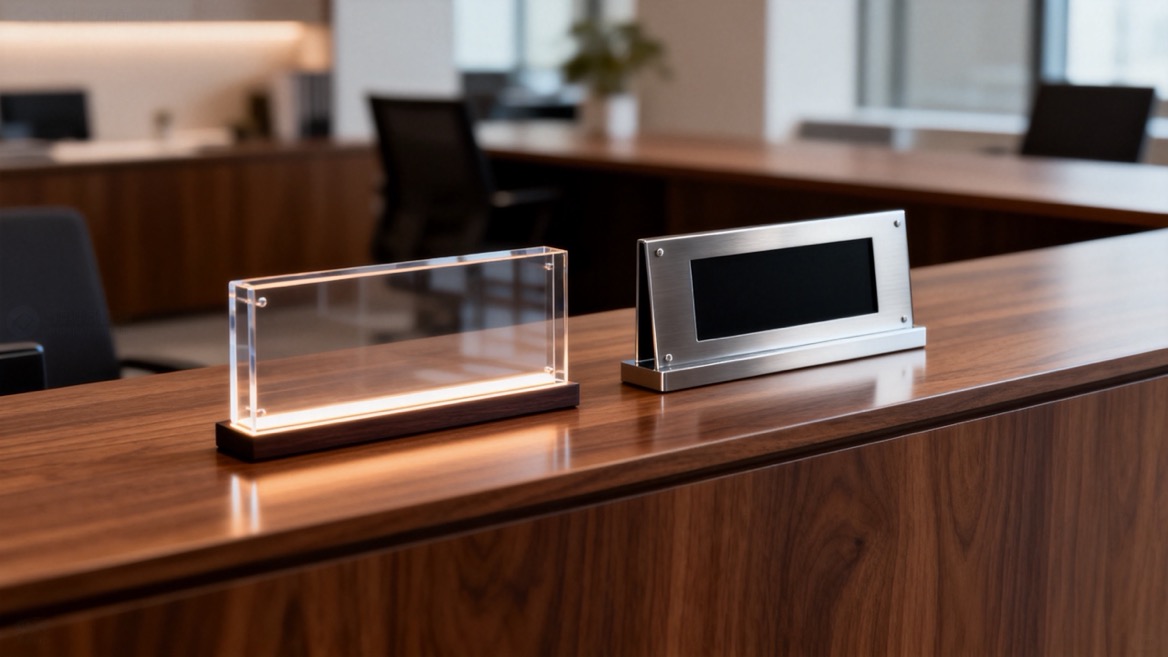
LED name plates use light-emitting diodes to illuminate a name, title, logo, or decorative panel. Common configurations include edge-lit acrylic, backlit panels, and illuminated lettering.
These products usually combine a display surface, a lighting component, and a power supply. Some require a nearby outlet; others need a planned low-voltage connection.
An important distinction: an illuminated nameplate is not necessarily a digital display. Many LED name plates contain fixed printed or engraved information. Changing the employee's name may still require replacing the panel.
What Are Traditional Office Nameplates?
Traditional office nameplates identify people or spaces without built-in lighting. Typical formats include printed acrylic panels, engraved plates, metal holders with replaceable inserts, and freestanding desk signs.
They rely on surrounding light for visibility. Their performance therefore depends on contrast, lettering, surface finish, placement, and viewing distance—not simply the material.
For this comparison, "traditional" means non-illuminated. It does not mean outdated or limited to one visual style.
At-a-Glance Comparison: Illuminated vs Non-Illuminated Nameplates
| Comparison point | LED name plates | Traditional office nameplates |
| Visual character | Illuminated focal point | Understated or decorative identification |
| Low-light performance | Built-in illumination can help | Depends on ambient lighting |
| Power requirement | Requires a suitable power source | No operating electricity |
| Installation | May involve cable routing and power planning | Usually mechanically simpler |
| Maintenance | Surface cleaning plus electrical checks | Surface cleaning and mounting checks |
| Content updates | Depends on panel design | Replaceable inserts can simplify updates |
| Failure points | Panel, mounting, LEDs, connections, power supply | Panel, printing, holder, mounting |
| Typical application | Reception features and selected branded areas | Desks, office doors, and larger identification programs |
| Purchasing priority | Light quality and serviceability | Legibility and replacement efficiency |
Neither category wins every application. The most effective office signage program may combine them.
Visibility and Readability: Does Illumination Always Help?
Where LED Name Plates Can Add Value
Built-in illumination can make a nameplate easier to notice when ambient lighting is limited. That can be useful at a reception counter, in a presentation area, or against a dark architectural background.
However, visibility and readability are different. A glowing panel may attract attention while making small text difficult to interpret.
When reviewing a custom LED nameplate, check:
- Whether illumination is even across the panel.
- Whether bright edges distract from the name.
- Whether lettering remains clear from side angles.
- Whether reflections interfere with reading.
- Whether the display remains understandable when switched off.
More brightness is not automatically better. The objective is comfortable recognition at the intended distance.
Where Traditional Office Nameplates Perform Well
In a well-lit office, non-illuminated nameplates may provide all the visibility required. Contrasting text and backgrounds, uncluttered layouts, and non-glare surfaces are particularly important.
The U.S. Access Board identifies contrast and non-glare finishes as relevant requirements for covered visual signs. It also explains that textured or varied backgrounds can reduce legibility.
My specification priority would be to test the nameplate in the workplace rather than approve it solely from a close-up product photograph.
Appearance and Branding: Match the Sign to Its Role
LED Name Plates for Selected Brand Touchpoints
Illuminated nameplates offer another design variable: light. They can support a distinctive reception treatment or highlight a particular desk or display.
The practical challenge is consistency. The same logo can look different when printed on an opaque panel and illuminated through a translucent one.
Ask the supplier to evaluate:
- Brand colors with the lighting on and off.
- Fine details in illuminated artwork.
- Light leakage around unwanted areas.
- Panel thickness and visible edge treatment.
- Cable concealment in the proposed installation.
An attractive sample is only useful if the finished installation preserves that appearance.
Traditional Nameplates for a Unified Office System
Traditional office nameplates suit projects where consistency matters more than visual emphasis.
A coordinated system can share typography, dimensions, holders, and finishes across departments. A restrained acrylic or metal design can still communicate a carefully considered brand identity.
For large offices, this standardization also makes replacements easier to specify. The goal is not merely to order matching signs today, but to reproduce them when teams or job titles change.
Materials, Printing, and Manufacturing Quality
Assess the Complete LED Assembly
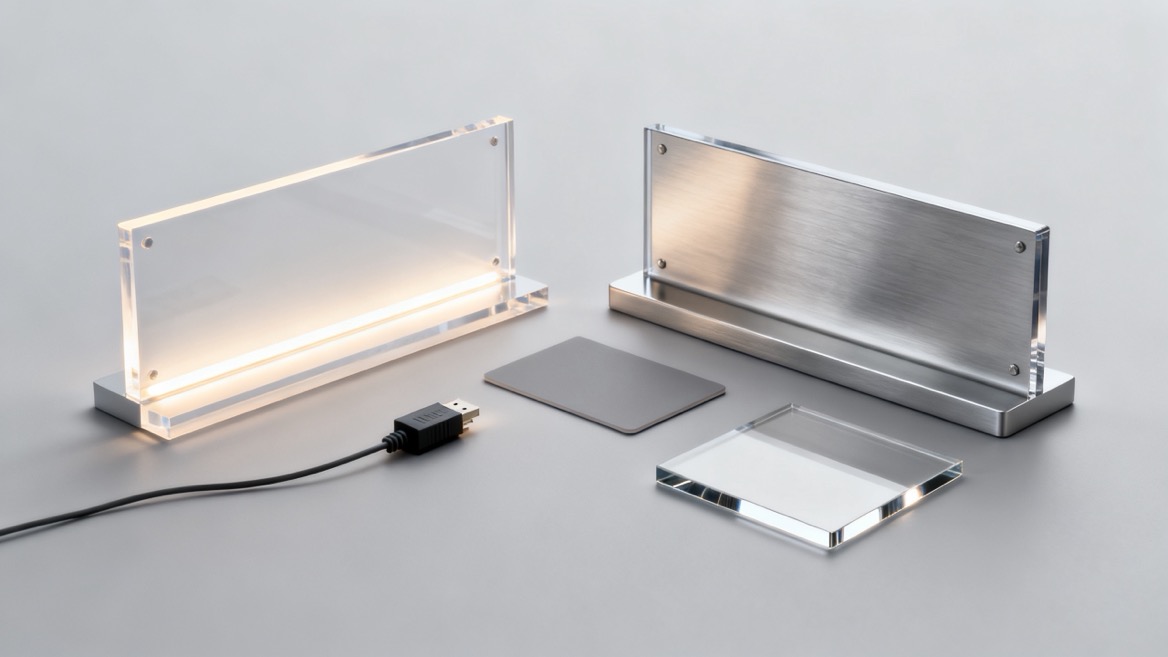
An LED nameplate is an assembly, not just an illuminated panel. Buyers should evaluate the display material, printed or engraved graphics, lighting components, wiring, connectors, mounting arrangement, and power supply together.
Useful questions include:
1. Can the display panel be replaced separately?
2. Can the power supply be accessed after installation?
3. Are light distribution and color consistent between samples?
4. What cleaning instructions apply to the surface?
5. What warranty covers the complete product?
Published LED lifespan figures should not be treated as a warranty for the finished nameplate. A lighting component's expected useful life does not establish the durability of every connector, printed surface, or mounting element.
Assess Traditional Nameplates Beyond Material Names
"Acrylic," "aluminum," or "engraved" does not describe a complete quality specification.
Ask for the material grade where relevant, thickness, dimensions, edge finish, printing method, attachment design, and approved cleaning procedure.
Request a physical sample when appearance or handling matters. Inspect the lettering, edges, surface finish, and mounting fit.
For Shenzhen XingKun Packing Products Co., Ltd., a useful enquiry should therefore include the intended application and artwork—not simply a request for a price per piece.
Cost Comparison: Calculate Ownership, Not Just Purchase Price
What Determines the Initial Cost?
There is no reliable universal price difference between LED name plates and traditional office nameplates.
Costs vary with dimensions, quantity, materials, artwork, finishing, mounting, electrical components, and packaging. A complex engraved metal plate may cost more than a basic illuminated acrylic product.
Compare quotations against the same brief. Otherwise, a lower price may simply reflect a different specification.
An Illustrative Electricity Calculation
Consider a hypothetical LED nameplate drawing 3 watts, operating 10 hours per day for 250 days annually.
Its annual electricity use would be:
(3÷1,000)×10×250=7.5 kWh
At an assumed electricity price of $0.20 per kWh, the annual energy cost would be $1.50 per nameplate.
These are illustrative assumptions, not measured XingKun product specifications. For a real project, use the complete assembly's measured power consumption and your local tariff.
The comparison also needs care: LED efficiency advantages over incandescent lighting do not mean LED nameplates save electricity compared with non-illuminated nameplates. Traditional plates consume no operating electricity.
Use a Five-Year Ownership Checklist
Include:
- Purchase price and shipping.
- Mounting and electrical installation.
- Electricity, where applicable.
- Replacement panels or inserts.
- Repair access and replacement components.
- Staff time for updates and maintenance.
Serviceability can matter more than a small difference in unit price.
Durability and Maintenance: What Can Fail?
LED Nameplate Maintenance
LEDs can gradually lose light output rather than fail suddenly. ENERGY STAR explains that operating temperature affects degradation and useful life.
For nameplates, this makes thermal management and assembly quality relevant purchasing questions.
Maintenance planning should also cover loose connections, power-supply replacement, surface damage, and access to wiring. Ask whether repair requires removing the entire sign.
Traditional Nameplate Maintenance
Non-illuminated plates avoid electrical failure points, but they still require care. Printed surfaces, holders, edges, and mounting components should be suitable for the environment and cleaning routine.
Do not assume every cleaning chemical is compatible with every substrate or ink system. Obtain the supplier's instructions.
Where employee names change frequently, a replaceable insert may offer a more practical advantage than a particularly elaborate permanent finish.
Accessibility: Separate Employee Names from Permanent Room Identification
Accessibility requirements depend on sign function and jurisdiction.
In the United States, the Access Board distinguishes signs identifying permanent rooms and spaces from occupant names, company names, and logos. Covered permanent-room signs can require tactile characters, braille, and specific placement.
Lighting alone does not establish accessibility compliance. A beautifully illuminated employee nameplate is not automatically a substitute for a required room-identification sign.
For some projects, the practical arrangement is a permanent room identifier alongside a separate, changeable employee-name panel.
Confirm requirements for the destination market before production. This is particularly important when one signage design will be supplied internationally.
A Practical Prototype Test Before Placing a Bulk Order
A useful evaluation does not need to begin with the entire building.
Step 1: Select Representative Locations
Choose a bright desk, a typical corridor, and a reception area. Include locations where mounting or cable access may be difficult.
Step 2: Test Real Content
Use actual names and titles, including the longest expected examples. Short demonstration text can hide layout problems.
Step 3: Review the Installed Sample
Check viewing distance, reflections, edge quality, mounting stability, and ease of reading. For illuminated products, inspect both powered and unpowered appearance.
Step 4: Simulate an Update
Replace an insert or panel. Record the tools, time, and access required.
Step 5: Record Acceptance Criteria
Approve dimensions, artwork, finish, mounting, packaging, and—where applicable—light appearance against the sample.
This process turns subjective preferences into a repeatable purchasing standard.
Which Nameplate Type Fits Your Office?
Choose LED name plates when illumination serves a clear purpose, power can be provided neatly, and the assembly can be maintained.
Choose traditional office nameplates when the environment is adequately lit, identification needs are widespread, or frequent personnel changes make simple updates important.
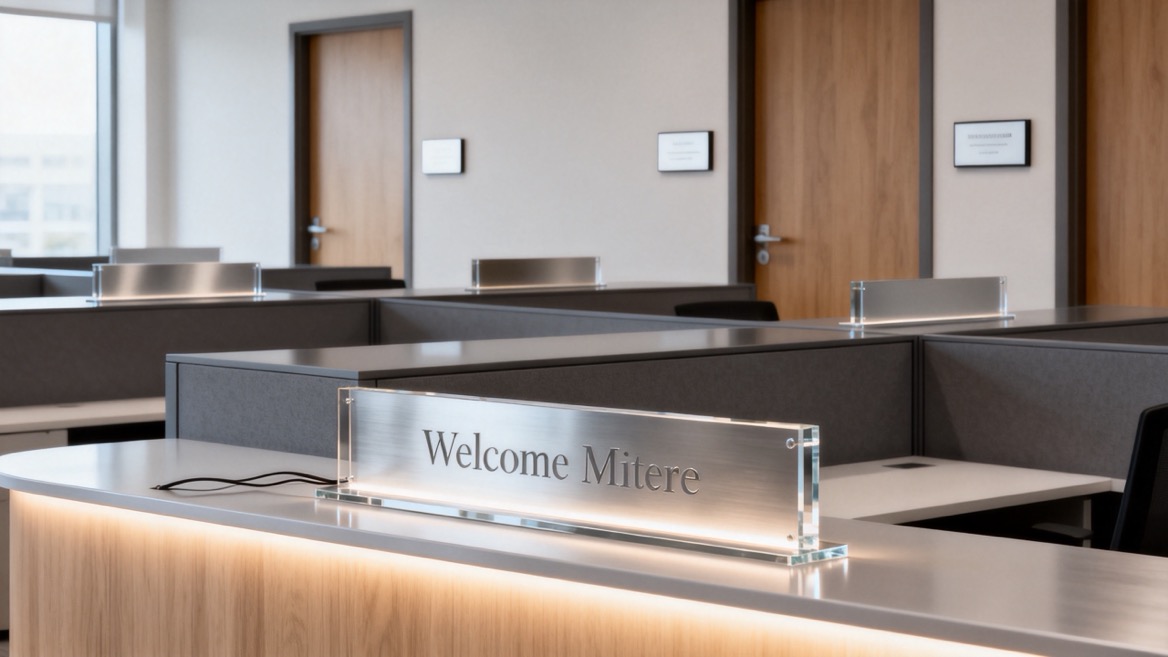
Consider a hybrid approach when reception needs a distinctive feature but everyday desks and doors need economical consistency.
From a buyer's perspective, the best decision is the one that supports the location, the user, and the replacement process—not the one that looks most dramatic in a catalogue.
Plan Your Custom Nameplate Project with XingKun
Prepare a brief covering quantities, dimensions, artwork, languages, installation locations, mounting preferences, and expected update frequency.
For LED options, add power availability and operating hours. For permanent room signs, identify applicable accessibility requirements.
Contact Shenzhen XingKun Packing Products Co., Ltd. with that brief and request a sample-led comparison of feasible options. Ask the team to confirm materials, production tolerances, replacement arrangements, and packaging before approving the full order.
Frequently Asked Questions
Are LED Name Plates Better Than Traditional Office Nameplates?
They are better when built-in illumination solves a genuine visibility or design need. Traditional office nameplates may be more practical in well-lit spaces or projects requiring many easily updated signs.
Do LED Name Plates Allow Instant Name Changes?
Not necessarily. Many illuminate fixed printed or engraved panels. Instant electronic updates require a digital display system, which is a different product category.
How Long Do LED Name Plates Last?
There is no universal lifespan for a complete nameplate. LED performance, operating temperature, power-supply quality, usage, and assembly design all matter. Request product-specific warranty terms rather than relying on general LED lighting figures.
Are Traditional Office Nameplates Cheaper?
They may require fewer components and simpler installation, but prices depend on the specification. Compare equivalent dimensions, finishes, quantities, and mounting requirements.
Can an LED Nameplate Meet Accessibility Requirements?
Potentially, but illumination is not proof of compliance. Requirements depend on the sign's purpose, design, location, and jurisdiction. Required tactile room identification must be addressed separately where applicable.
What Should I Send a Nameplate Manufacturer?
Provide artwork, names, titles, quantities, dimensions, placement photographs, mounting preferences, and the delivery destination. Include power details for illuminated products and compliance requirements for covered room signs.
References
1. [U.S. Access Board — Guide to the ADA Accessibility Standards: Chapter 7, Signs]. Primary guidance supporting the discussion of sign scope, permanent-room identification, tactile requirements, contrast, non-glare finishes, and placement. [access-board]
2. [ENERGY STAR — Learn About LED Lighting]. Supports the explanation of lumen depreciation, useful-life assessment, and the influence of operating temperature. Its comparisons concern lighting technologies, not electricity savings against non-illuminated nameplates. [energystar]
3. [U.S. Department of Energy — LED Basics]. Background on LED technology, system efficiency, and useful-life terminology. General lighting information is not presented here as a finished-nameplate warranty. [energy]


