Content Menu
● 1. Ordering Custom Name Plates Without Defining Their Purpose
>> Appearance-Led Orders vs. Application-Led Orders
● 2. Choosing Nameplate Materials by Appearance Alone
>> Aluminum vs. Stainless Steel vs. Plastic Nameplates
● 3. Confusing Printed, Engraved, and Etched Nameplates
>> Decorative Graphics vs. Long-Term Identification
● 4. Selecting Adhesive Without Testing the Mounting Surface
>> Adhesive Mounting vs. Mechanical Fastening
● 5. Approving Artwork Only on a Computer Screen
>> What to Check Before Artwork Approval
● 6. Forgetting Tolerances and Installation Clearances
>> Nominal Dimensions vs. Functional Fit
● 7. Treating Compliance as a Generic Supplier Claim
>> Material Recognition vs. Suitable Finished Construction
● 8. Overlooking Serial Numbers and Barcode Quality
>> Visual Approval vs. Data Validation
● 9. Comparing Unit Prices Instead of Total Project Cost
>> What a Comparable Quotation Should Include
● 10. A Sample-to-Production Approval Workflow
>> Five Approval Gates
● 11. An Illustrative Case: The Attractive Plate That Lifts
● 12. Build a Reorder-Ready Nameplate Specification
● Start Your Custom Name Plate Project with a Clear Brief
● Frequently Asked Questions
>> What is the best material for custom name plates?
>> Are engraved nameplates always better than printed nameplates?
>> Can adhesive-backed nameplates be used outdoors?
>> Should I approve a physical sample before ordering?
>> What should I send with a quotation request?
>> How can I prevent mistakes on repeat orders?
● References
Ordering custom name plates should be straightforward. Yet a small mistake in material selection, artwork, adhesive, or production specifications can turn an attractive plate into an expensive replacement project. Whether you need branded product nameplates, office identification plates, or industrial equipment labels, successful ordering starts with understanding how the finished plate will actually be used.
At Shenzhen XingKun Packing Products Co., Ltd., our company background includes more than 20 years of printing and packaging experience and service to brands and distributors across over 30 countries and regions. From a manufacturing perspective, we recommend treating a nameplate as a complete system—not simply a printed logo on a chosen material.
This guide compares common ordering mistakes with better purchasing decisions, helping you balance appearance, durability, installation, and total cost.
1. Ordering Custom Name Plates Without Defining Their Purpose
The first mistake is requesting a quotation before explaining the application.
A decorative plate on premium packaging has different priorities from a machine identification plate exposed to cleaning chemicals. An office door plate may need replaceable information, while an equipment plate may require permanent serial numbers.
Appearance-Led Orders vs. Application-Led Orders
| Ordering approach |
What the buyer specifies |
What may be overlooked |
| Appearance-led |
Color, logo, dimensions, finish |
Exposure, mounting, service life |
| Application-led |
Function, environment, substrate, readability |
Design is developed within practical limits |
Neither appearance nor performance should be ignored. The goal is to define both before production.
Start your inquiry with:
- Where the plate will be installed.
- Whether it will be used indoors or outdoors.
- What information it must display.
- Whether it must be permanent or removable.
- What heat, moisture, abrasion, or chemicals it may encounter.
Application should guide every subsequent specification.
2. Choosing Nameplate Materials by Appearance Alone
A brushed metallic finish can look excellent in a photograph. That does not establish whether the material suits your application.
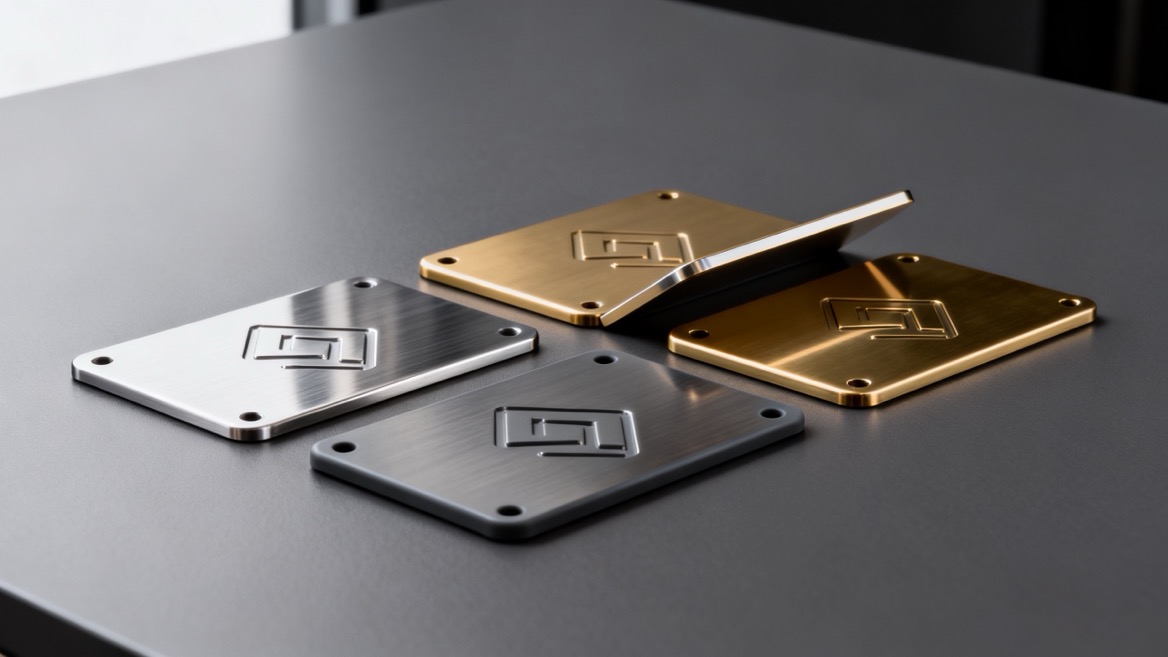
Aluminum, stainless steel, brass, and plastic nameplates offer different combinations of weight, appearance, rigidity, and customization. However, material selection cannot be separated from the marking process and installation method.
Aluminum vs. Stainless Steel vs. Plastic Nameplates
| Material |
Reasons to consider it |
Questions to resolve |
| Aluminum |
Low weight, metallic appearance, anodized options |
Which alloy, finish, and marking process are proposed? |
| Stainless steel |
Strength and corrosion resistance |
Which grade suits the actual exposure? |
| Brass |
Distinctive decorative appearance |
Is surface aging acceptable, or is protection required? |
| Plastic |
Flexible graphic options and nonmetallic appearance |
Which polymer meets the temperature and chemical requirements? |
Avoid assuming that all metal plates are suitable for harsh environments or that all plastic plates are unsuitable for outdoor use.
Ask the supplier to identify the exact material and explain the proposed construction. For demanding applications, request relevant technical documentation or testing rather than a broad "weatherproof" claim.
3. Confusing Printed, Engraved, and Etched Nameplates
Buyers sometimes use "printed," "engraved," and "etched" interchangeably. These processes create different results.
Surface printing places graphics on the material. Engraving removes material to create recessed information. Chemical etching also produces recessed features, which may be color-filled. Photo-anodized aluminum uses a different construction in which the image is sealed within the anodic layer.
Decorative Graphics vs. Long-Term Identification
For a colorful brand plate, printing may offer the desired visual flexibility. For identification exposed to repeated wear, recessed or protected markings may deserve consideration.
The important question is not, "Which process is always best?"
It is, "Which process keeps our information readable under the expected conditions?"
Ask suppliers to explain:
1. Where the image sits within the construction.
2. What protects it from abrasion.
3. Whether color-filled areas have separate durability limitations.
4. How the proposed process handles your smallest text.
Do not accept a general material durability statement as proof that the graphics will last equally long.
4. Selecting Adhesive Without Testing the Mounting Surface
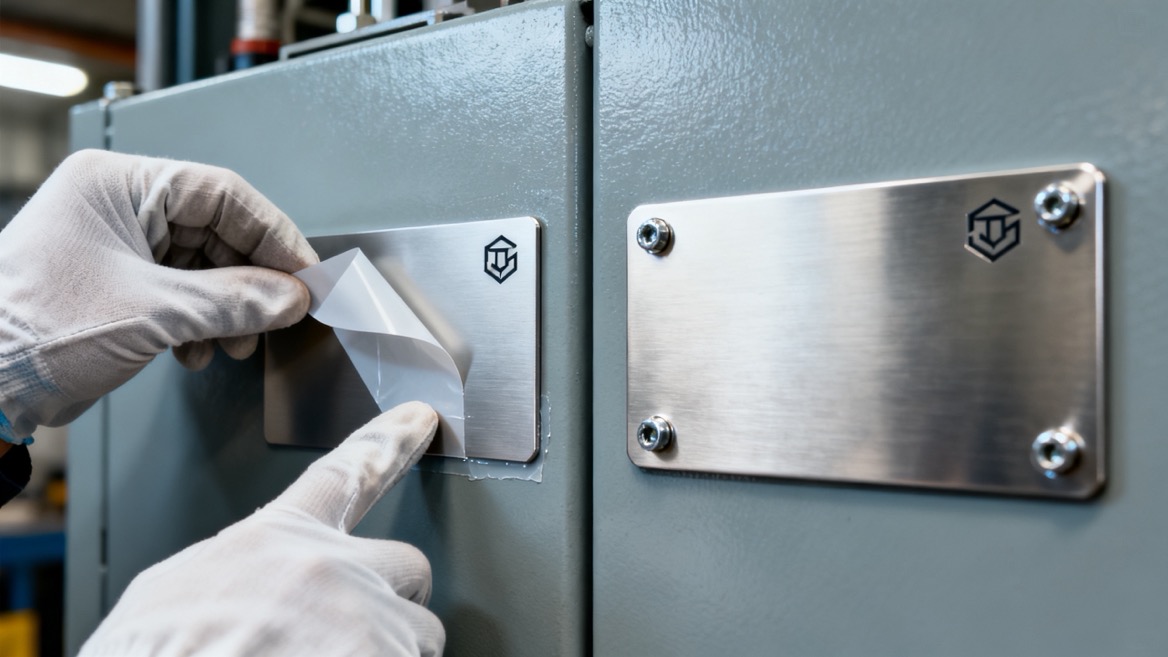
An adhesive-backed nameplate can look perfect and still fail during installation.
"Strong adhesive" is not a complete specification. Bonding depends on the adhesive, surface finish, cleanliness, contact area, application pressure, and operating conditions.
Adhesive Mounting vs. Mechanical Fastening
| Mounting method |
Potential advantage |
Main checks |
| Adhesive backing |
Clean appearance without drilled holes |
Surface compatibility, preparation, temperature, loading |
| Screws or rivets |
Positive mechanical attachment |
Hole positions, hardware, access, substrate suitability |
| Magnetic mounting |
Convenient removal on suitable surfaces |
Ferromagnetic substrate and holding performance |
| Slots or holders |
Replaceable identification |
Fit, clearance, and replacement procedure |
For 3M VHB tapes, the manufacturer emphasizes clean, dry, unified surfaces and sufficient application pressure. Those instructions are product-specific; they should not be generalized to every adhesive.
Send the supplier a sample of the actual mounting surface when practical. Powder-coated steel, textured plastic, and smooth glass should not be treated as interchangeable substrates.
5. Approving Artwork Only on a Computer Screen
A digital proof confirms layout, but it cannot fully represent physical size, surface texture, metallic reflection, or installed readability.
Small lettering that looks clear when enlarged may become difficult to read at final dimensions. Fine lines may also behave differently across printing, engraving, and etching processes.
What to Check Before Artwork Approval
- Print the proof at actual size.
- Review text from the expected viewing distance.
- Check spelling, model numbers, units, and translations.
- Confirm dimensions and hole locations.
- Identify critical colors using an agreed reference.
- Verify that the supplier can reproduce fine details.
For custom logo name plates, discuss how brand colors will appear on the selected substrate. A metallic background may not resemble white paper.
When color or finish is critical, approve a physical sample. A screen image alone should not become the sole acceptance standard.
6. Forgetting Tolerances and Installation Clearances
A plate measuring approximately the right size may still fail to fit a recessed panel or mounting bracket.
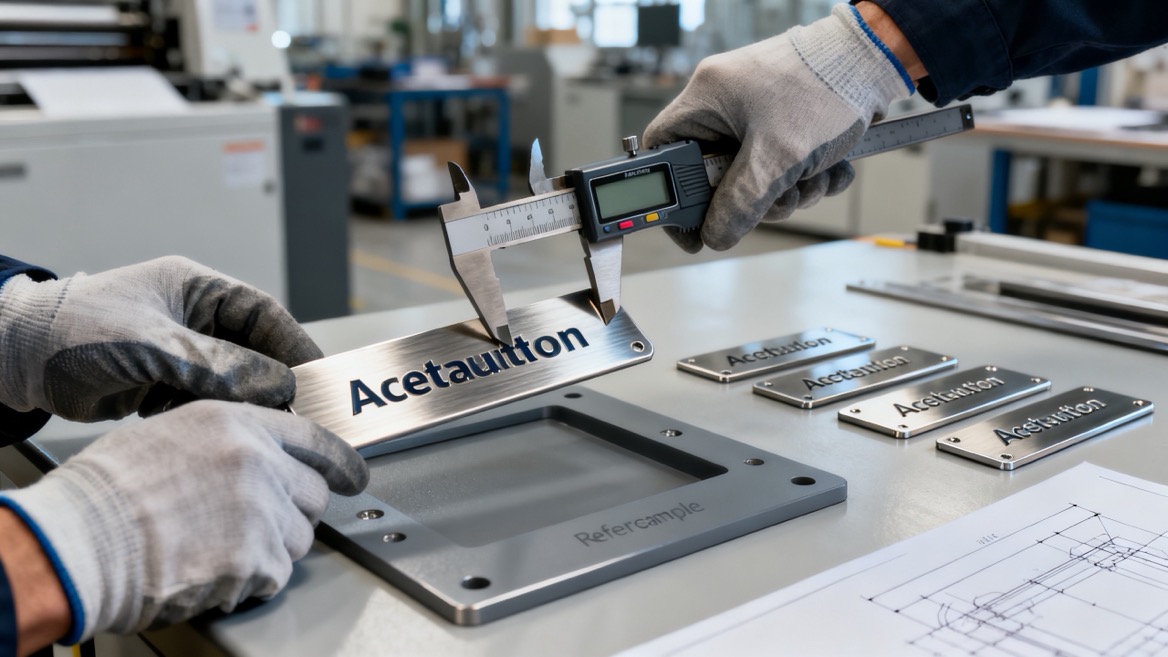
Buyers often specify overall dimensions but overlook thickness, corner radius, hole diameter, and hole position. These details become particularly important when nameplates interface with another manufactured part.
Nominal Dimensions vs. Functional Fit
Provide a dimensioned drawing rather than relying on a product photograph.
Include:
- Overall width, height, and thickness.
- Hole diameters and center locations.
- Corner radii.
- Required flatness or flexibility.
- Adhesive thickness where relevant.
- Critical dimensional tolerances.
Do not demand unnecessarily tight tolerances everywhere. Identify which dimensions control fit and ask the manufacturer to confirm achievable limits.
For curved installations, test the complete assembly. A flat sample does not establish whether the plate will conform without lifting.
7. Treating Compliance as a Generic Supplier Claim
An industrial nameplate may carry safety information, ratings, or instructions. In these applications, compliance requirements deserve early attention.
UL Solutions evaluates marking and labeling systems for specified uses. Its Conditions of Acceptability can cover application surfaces, temperature ratings, exposure conditions, and additional restrictions.
Material Recognition vs. Suitable Finished Construction
A recognized component or familiar adhesive brand does not automatically establish that your finished nameplate is suitable for every regulated application.
Where relevant, clarify:
1. Which end-product requirements apply.
2. Which complete labeling construction is proposed.
3. Which surfaces and exposures are covered.
4. Whether your printing and finishing choices remain within the applicable conditions.
Do not assume that every decorative plate needs certification. Equally, do not leave safety-related marking requirements until after production.
Ask for documentation relevant to your specific project, rather than an unrelated certificate.
8. Overlooking Serial Numbers and Barcode Quality
Variable information creates risks that ordinary logo plates do not.
A batch may look consistent while containing duplicated serial numbers, missing records, or codes that lead to the wrong destination.
Visual Approval vs. Data Validation
For serialized nameplates, approve both the design and the dataset.
A practical control plan should include:
- A clearly defined numbering sequence.
- Rules for prefixes, suffixes, and leading zeros.
- Duplicate and missing-record checks.
- Approved barcode or QR-code content.
- Sample scanning on finished production material.
GS1 guidance explains the importance of barcode contrast and clear areas around the symbol, known as quiet zones. Decorative borders, logos, and nearby text must not intrude into required spaces.
For formal barcode-quality requirements, define the applicable verification method and acceptance criteria. A successful phone scan is useful, but it is not equivalent to standards-based verification.
9. Comparing Unit Prices Instead of Total Project Cost
The lowest quoted price may not produce the lowest purchasing cost.
A cheaper nameplate can become expensive if it requires manual sorting, installation rework, replacement, or another shipment.
What a Comparable Quotation Should Include
| Cost element |
Clarification to request |
| Tooling or setup |
One-time charge or recurring cost? |
| Sampling |
Included, chargeable, or credited later? |
| Variable data |
Included or priced separately? |
| Protective packaging |
Individual protection or bulk packing? |
| Inspection |
Which checks and records are included? |
| Delivery |
Freight scope and agreed trade terms? |
Compare quotations against the same specification.
A price difference is meaningful only when materials, marking processes, adhesives, quantities, inspection requirements, and delivery scope are comparable.
10. A Sample-to-Production Approval Workflow
One of the most useful purchasing improvements is separating design approval from performance approval.
A sample can look correct while remaining unsuitable for installation. Conversely, a technically suitable construction may still need graphic adjustments.
Five Approval Gates
1. Specification: Agree on application, materials, dimensions, mounting, and exposure.
2. Artwork: Approve content, layout, revision number, and variable-data format.
3. Physical sample: Review finish, readability, color, and dimensional fit.
4. Application trial: Install on representative equipment or packaging.
5. Production release: Record the approved construction and acceptance criteria.
Choose test conditions that reflect actual use. These may include cleaning exposure, handling abrasion, temperature changes, or outdoor weathering.
This workflow is a recommended purchasing framework, not a substitute for formal testing required by a particular product standard.
11. An Illustrative Case: The Attractive Plate That Lifts
Consider a hypothetical equipment manufacturer ordering brushed aluminum logo plates for powder-coated housings.
The buyer approves the appearance but specifies only "permanent adhesive." During installation, some plates lift at the corners.
Several explanations are possible: incompatible adhesive, contamination, insufficient pressure, plate rigidity, or surface geometry. Selecting a thicker adhesive without investigation may not solve the actual problem.
A better approach is to:
- Test on the real powder-coated surface.
- Confirm preparation instructions.
- Review plate stiffness and contact area.
- Evaluate the proposed adhesive construction.
- Repeat the installation trial before release.
This example is illustrative, not a reported XingKun customer case. Its lesson is that installation failures require diagnosis rather than guesswork.
12. Build a Reorder-Ready Nameplate Specification
Repeat orders should not depend on remembering what worked last time.
Create a controlled specification containing the approved drawing, artwork revision, material, finish, marking process, adhesive or hardware, packaging, and inspection criteria.
Retain an approved reference sample where practical.
For distributors managing several product variants, assign a unique part number to each construction. Record who can authorize changes, and require written approval before substitutions.
This reduces ambiguity when staff, suppliers, or product designs change.
Start Your Custom Name Plate Project with a Clear Brief
Shenzhen XingKun Packing Products Co., Ltd. welcomes inquiries from brands and distributors seeking custom nameplates alongside coordinated printing and packaging products.
To request a project review, send your artwork, dimensions, quantity, intended application, mounting surface, and expected exposure conditions. Include any required certification or performance criteria.
Ask for confirmation of the proposed construction, sample options, quotation scope, and production schedule before placing the order.
Frequently Asked Questions
What is the best material for custom name plates?
There is no universal choice. Aluminum, stainless steel, brass, and plastics suit different priorities. Select the material together with the marking process, mounting method, and exposure requirements.
Are engraved nameplates always better than printed nameplates?
No. Engraving creates recessed information, while printing can support detailed, colorful graphics. The better option depends on appearance, readability, wear, and the protection provided by the complete construction.
Can adhesive-backed nameplates be used outdoors?
Potentially, but outdoor suitability must be confirmed for the complete assembly. Evaluate the adhesive, plate material, graphics, substrate, moisture exposure, temperature range, and installation procedure.
Should I approve a physical sample before ordering?
A physical sample is particularly valuable when finish, color, fit, readability, or bonding is critical. A digital proof mainly confirms content and layout.
What should I send with a quotation request?
Provide artwork, dimensions, quantity, material preferences, mounting details, application conditions, variable-data requirements, packaging needs, and delivery expectations. Include a drawing and substrate sample when available.
How can I prevent mistakes on repeat orders?
Use a controlled specification, unique part number, approved artwork revision, and retained reference sample. Require written approval for any material, process, or adhesive substitution.
References
1. [UL Solutions — Marking and Labeling Systems Program]. Supports the discussion of evaluated labeling systems, application surfaces, temperature ratings, exposure conditions, and Conditions of Acceptability. [ul]
2. [UL Solutions — Compliance Guidelines for Marking and Labeling Systems]. Explains evaluation of complete constructions and representative environmental exposures. [ul]
3. [3M — Surface Preparation for 3M VHB Tape Applications]. Supports the discussion of cleanliness, dryness, adhesive contact, and application pressure. Guidance applies to the specified tape family. [3m]
4. [GS1 US — Barcode Placement and Printing Guidelines]. Supports barcode contrast and quiet-zone guidance. [gs1us]
5. [Clarion Safety Systems — Custom Etched Nameplates]. Provides industry examples of etched aluminum, stainless steel, brass, recessed graphics, and mounting options. [clarionsafety]
6. [Metal Marker Manufacturing — Custom Metal Nameplates]. Provides manufacturer descriptions of metal choices, engraving, printing, photo-anodizing, and attachment methods. Supplier-specific longevity claims have not been generalized in this article. [metalmarkermfg]


