Content Menu
● Quick Answer: 500 vs 1000 Piece Puzzle
● What Makes a 1000-Piece Puzzle Harder?
>> Piece Count Is Only One Difficulty Factor
● When a 500-Piece Puzzle Is the Better Choice
>> Best Users for 500-Piece Puzzles
>> Best Commercial Uses for 500-Piece Puzzles
>> Design Advice for 500-Piece Custom Puzzles
● When a 1000-Piece Puzzle Is the Better Choice
>> Best Users for 1000-Piece Puzzles
>> Best Commercial Uses for 1000-Piece Puzzles
>> Design Advice for 1000-Piece Custom Puzzles
● 500 vs 1000 Piece Puzzle: Space, Size, and Storage
>> Practical Buyer Checklist
● The Hidden Factor: Artwork Can Matter More Than Piece Count
>> How to Evaluate Puzzle Artwork Before Production
● Materials and Manufacturing: Why Quality Changes the Experience
>> Core Quality Elements for Custom Puzzles
● Which Puzzle Piece Count Is Better for Your Brand?
>> A Smart Two-SKU Strategy
● How to Choose Between 500 and 1000 Pieces
>> Choose a 500-Piece Puzzle If You Want
>> Choose a 1000-Piece Puzzle If You Want
● Common Mistakes to Avoid
>> Choosing Piece Count Before Reviewing the Artwork
>> Ignoring Finished Puzzle Dimensions
>> Using Weak Box Photography
>> Making Unsupported Health Claims
>> Treating Packaging as an Afterthought
● Conclusion
● FAQ
>> 1.Is a 500-piece puzzle easier than a 1000-piece puzzle?
>> 2.How long does a 500-piece puzzle take to complete?
>> 3.How long does a 1000-piece puzzle take to complete?
>> 4.Is a 1000-piece puzzle suitable for beginners?
>> 5.What age is appropriate for a 500-piece puzzle?
>> 6.Are 1000-piece puzzles better for gifts?
>> 7.Should I choose cardboard or wooden custom puzzles?
>> 8.What should I ask a custom puzzle manufacturer before placing an order?
● References
Choosing between a 500 vs 1000 piece puzzle is not simply a question of "easy or hard." The right choice affects the customer's play experience, perceived product value, assembly time, packaging size, retail positioning, and repeat-purchase potential. For brands, wholesalers, artists, and OEM buyers, the piece count should match the target user, artwork style, price point, and intended sales channel.
As a custom puzzle manufacturer working with branded, promotional, educational, and retail projects, XingKun sees a consistent pattern: 500-piece puzzles are often the safer choice for casual users and gift buyers, while 1000-piece puzzles are a stronger fit for committed adult puzzlers, collectors, and premium retail lines. However, image complexity, piece size, material quality, and box design can matter just as much as the number printed on the package.
This guide explains the practical difference between 500-piece and 1000-piece jigsaw puzzles, helping both consumers and B2B buyers select the best format for their goals.
Quick Answer: 500 vs 1000 Piece Puzzle
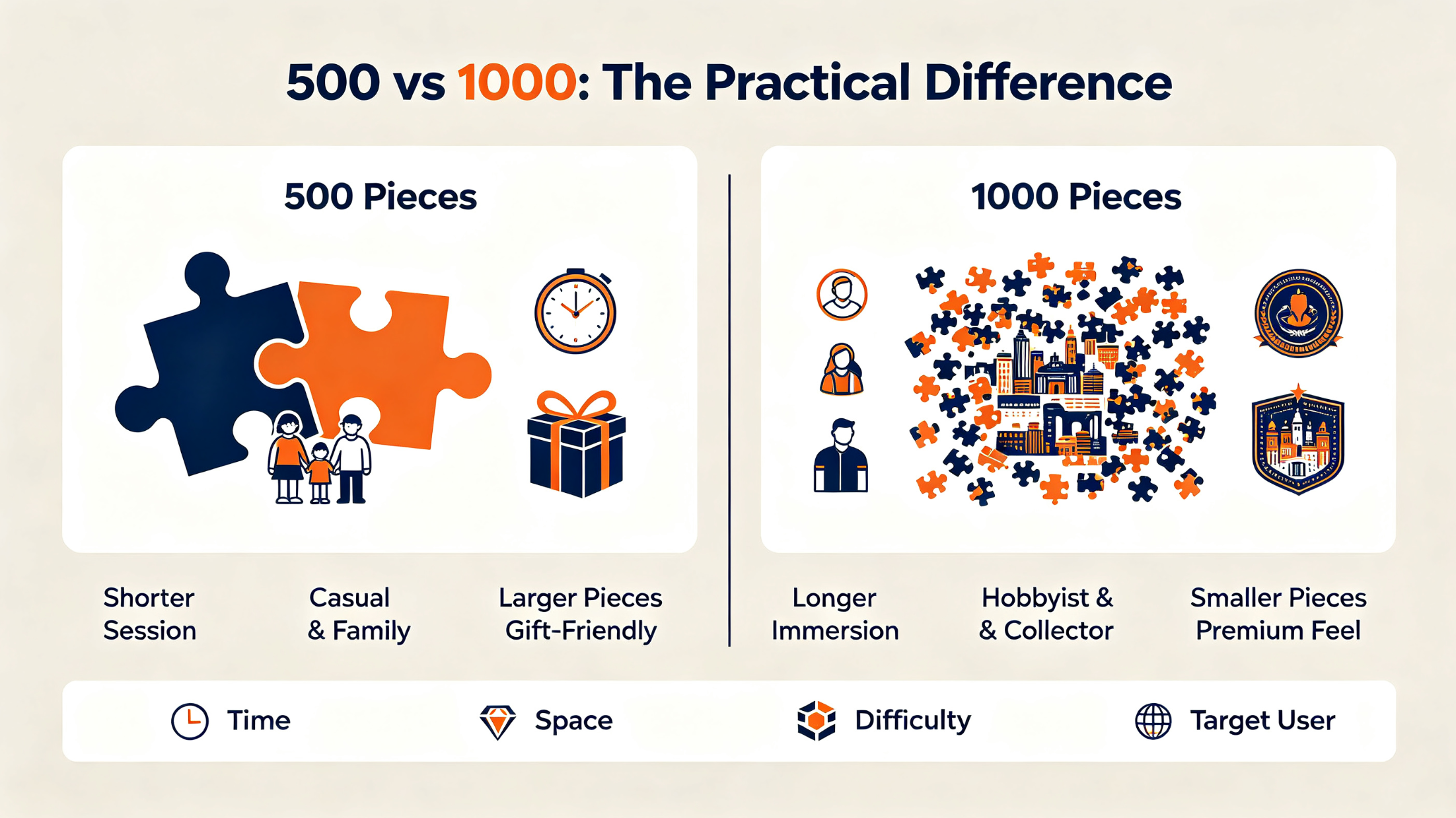
Choose a 500-piece puzzle if you want a more approachable, shorter, and generally less intimidating activity. It is especially suitable for casual adults, families, older children, gift sets, promotional products, and brands entering the puzzle category for the first time.
Choose a 1000-piece puzzle if you want a longer-lasting, more immersive, and more premium experience. It is usually the better choice for adult puzzle enthusiasts, art puzzles, collector editions, online retail brands, and detailed custom designs.
| Factor | 500-Piece Puzzle | 1000-Piece Puzzle |
| Typical user | Casual puzzlers, families, beginners | Adult hobbyists, collectors, experienced puzzlers |
| Difficulty | Easy to moderate | Moderate to challenging |
| Estimated assembly time | About 2–4 hours | About 5–12 hours |
| Table space required | Smaller | Larger |
| Piece handling | Often larger and easier to sort | Often smaller and more numerous |
| Artwork requirements | Clear, high-contrast, simple scenes | Detailed, layered, visually rich images |
| Retail positioning | Accessible, giftable, mid-range | Premium, hobby-focused, collectible |
| Suitable for custom branding | Promotional gifts, photo puzzles, family products | Premium art, licensed IP, seasonal collections |
| Perceived challenge | Relaxing and manageable | Immersive and achievement-oriented |
Completion time varies substantially by player experience, piece cut, image design, lighting, and whether one person or several people assemble the puzzle. One industry guide estimates that 500-piece puzzles often take roughly 2–4 hours, while 1000-piece puzzles may require about 5–10 hours; another retailer notes that 1000-piece designs can take around 5–12 hours depending heavily on the artwork. [puzzlesgalore.co]
What Makes a 1000-Piece Puzzle Harder?
A 1000-piece puzzle is not merely "twice as hard" as a 500-piece puzzle. It contains twice as many physical pieces, but the search process becomes significantly more complex because each piece creates more possible combinations, more color variations, and more opportunities for incorrect placement.
With a 1000-piece puzzle, the user must typically manage:
- More edge pieces to identify and connect
- More similar colors, textures, and shapes
- Smaller image areas per piece
- More sorting trays or workspace zones
- A longer commitment before completion
- Greater dependence on image details and piece-fit quality
A 500-piece puzzle reduces these demands. There are fewer pieces to sort, each piece usually represents a larger visible section of the illustration, and image features are easier to locate. This is why a 500-piece count is frequently positioned as an accessible middle ground for casual puzzlers, while 750–1000 pieces are widely marketed as a balanced weekend or family-game-night challenge. [puzzlewarehouse]
Piece Count Is Only One Difficulty Factor
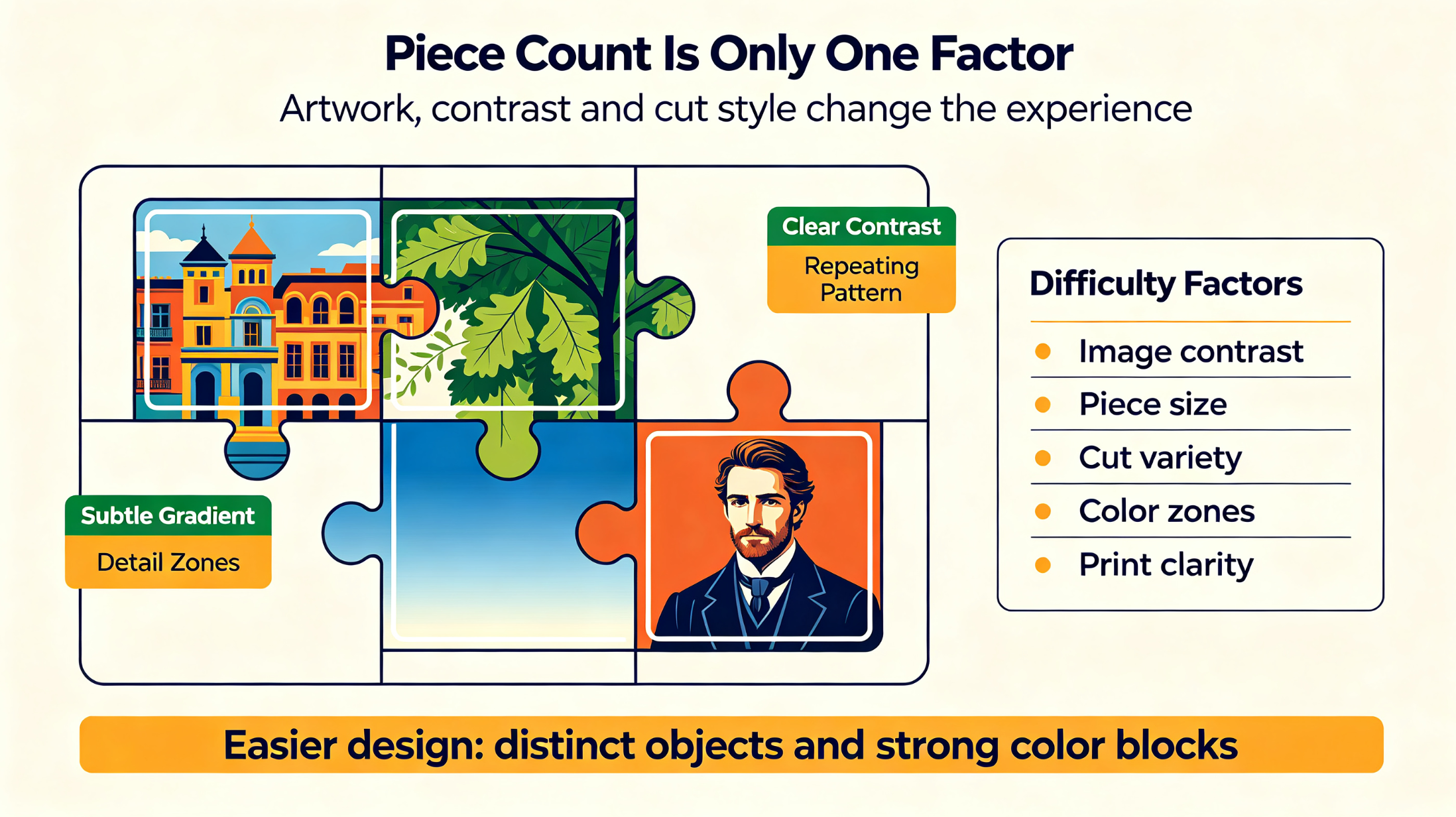
A common mistake is assuming that every 1000-piece puzzle is difficult and every 500-piece puzzle is easy. In reality, a 500-piece puzzle with a monochrome illustration, repeating pattern, dark night sky, dense foliage, or subtle color gradient can be harder than a well-designed 1000-piece cityscape or collage.
The biggest factors affecting puzzle difficulty include:
| Difficulty Factor | Easier Puzzle Design | Harder Puzzle Design |
| Color contrast | Distinct color blocks | Similar shades and soft gradients |
| Image composition | Clearly separated objects | Repetitive or crowded visual areas |
| Subject matter | Buildings, animals, collages, maps | Skies, oceans, forests, abstract art |
| Piece size | Larger pieces | Smaller pieces |
| Piece shape | Varied, recognizable cuts | Highly similar traditional cuts |
| Print clarity | Sharp details and color separation | Low-resolution, muddy, dark artwork |
| Surface finish | Low-glare surface | High gloss with reflections |
For custom puzzle brands, this means the product-development decision should not stop at "500 pieces or 1000 pieces." The artwork should be evaluated before production. A beautiful image is not automatically a good puzzle image.
When a 500-Piece Puzzle Is the Better Choice
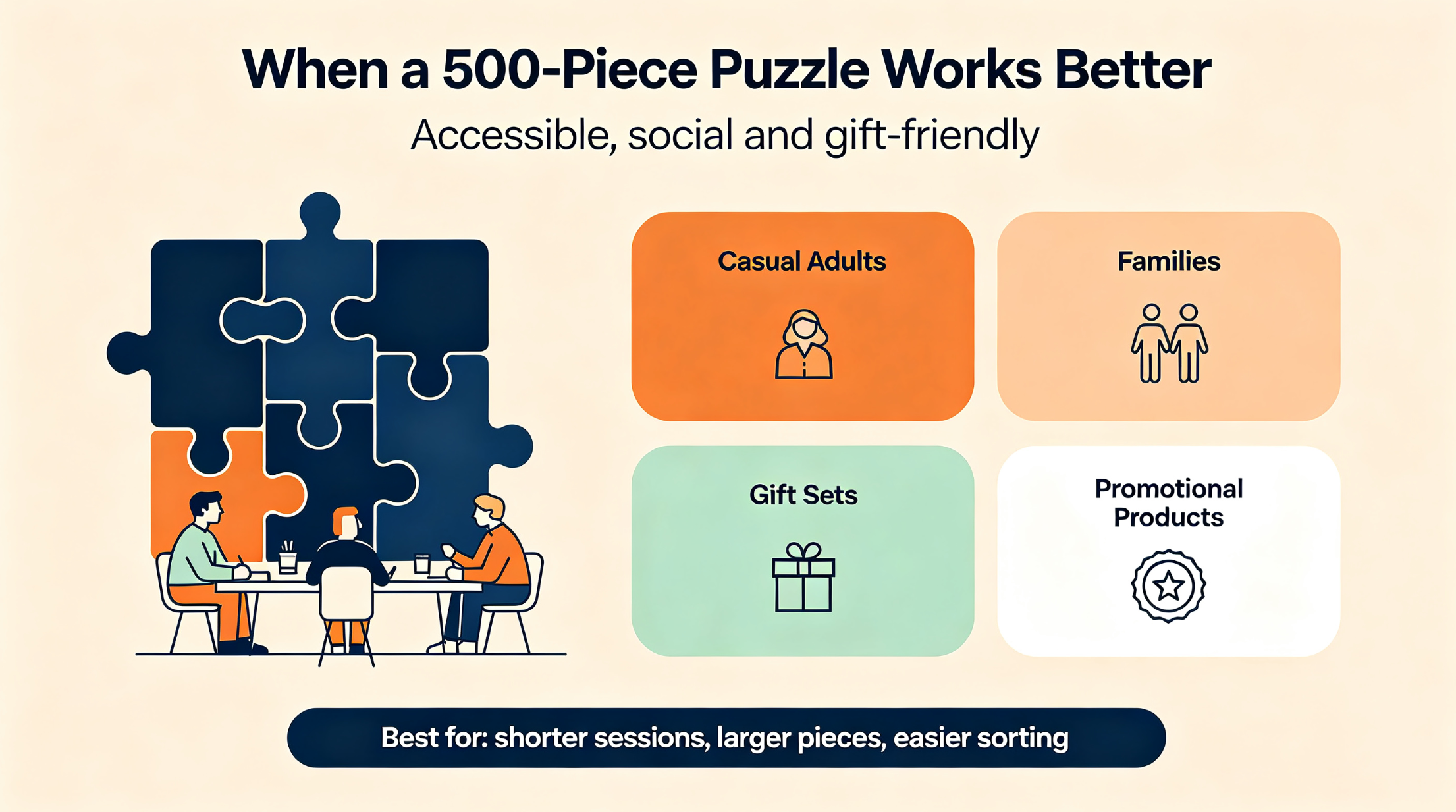
A 500-piece jigsaw puzzle is ideal when the goal is to make puzzling feel enjoyable, social, and achievable rather than demanding. It offers enough depth to feel satisfying without requiring several days of effort or a dedicated table.
Retailers commonly position 300–500-piece products for casual puzzlers because they provide a longer activity than beginner puzzles without becoming overwhelming. Some 500-piece ranges also use larger, easier-to-handle pieces than 1000-piece versions, which can improve accessibility. [puzzlewarehouse]
Best Users for 500-Piece Puzzles
A 500-piece puzzle can be a strong choice for:
- Casual adult puzzlers
- Families working together
- Teenagers and older children, depending on the artwork and piece size
- Seniors who prefer more manageable pieces
- First-time puzzle buyers
- Corporate gift recipients
- Customers seeking a weekend or evening activity
- Buyers purchasing photo puzzles or personalized gifts
- Museums, tourist attractions, schools, and event organizers
- Brands testing a new puzzle collection with lower customer entry barriers
Best Commercial Uses for 500-Piece Puzzles
For B2B buyers, 500-piece puzzles are especially effective in product lines where accessibility and gifting matter more than maximum difficulty.
Examples include:
- Branded promotional puzzles for product launches
- Family-friendly holiday gifts
- Tourism and destination puzzles
- Educational geography, science, or wildlife puzzles
- Photo collage puzzles
- Food, pet, flower, and lifestyle-themed puzzle ranges
- Subscription-box products
- Corporate welcome gifts
- Fundraising merchandise
- Retail bundles paired with books, stationery, candles, or art prints
A 500-piece format can also help reduce buyer hesitation. A consumer may be more willing to purchase a puzzle featuring a new artist, unfamiliar brand, or unusual theme if the project feels manageable.
Design Advice for 500-Piece Custom Puzzles
For a successful 500-piece custom puzzle, prioritize artwork with strong visual "anchors." These are areas that make sorting easier and create visible progress.
Good image characteristics include:
- Distinct foreground and background elements
- Clear color zones
- Recognizable objects such as animals, buildings, vehicles, or flowers
- High-resolution photography or illustration
- A balanced mix of detailed and simple areas
- Strong contrast between adjacent visual sections
Avoid relying entirely on large areas of one tone, such as a plain blue sky, dark ocean, or solid-color background. These may look elegant on the box but can create a frustrating assembly experience.
When a 1000-Piece Puzzle Is the Better Choice
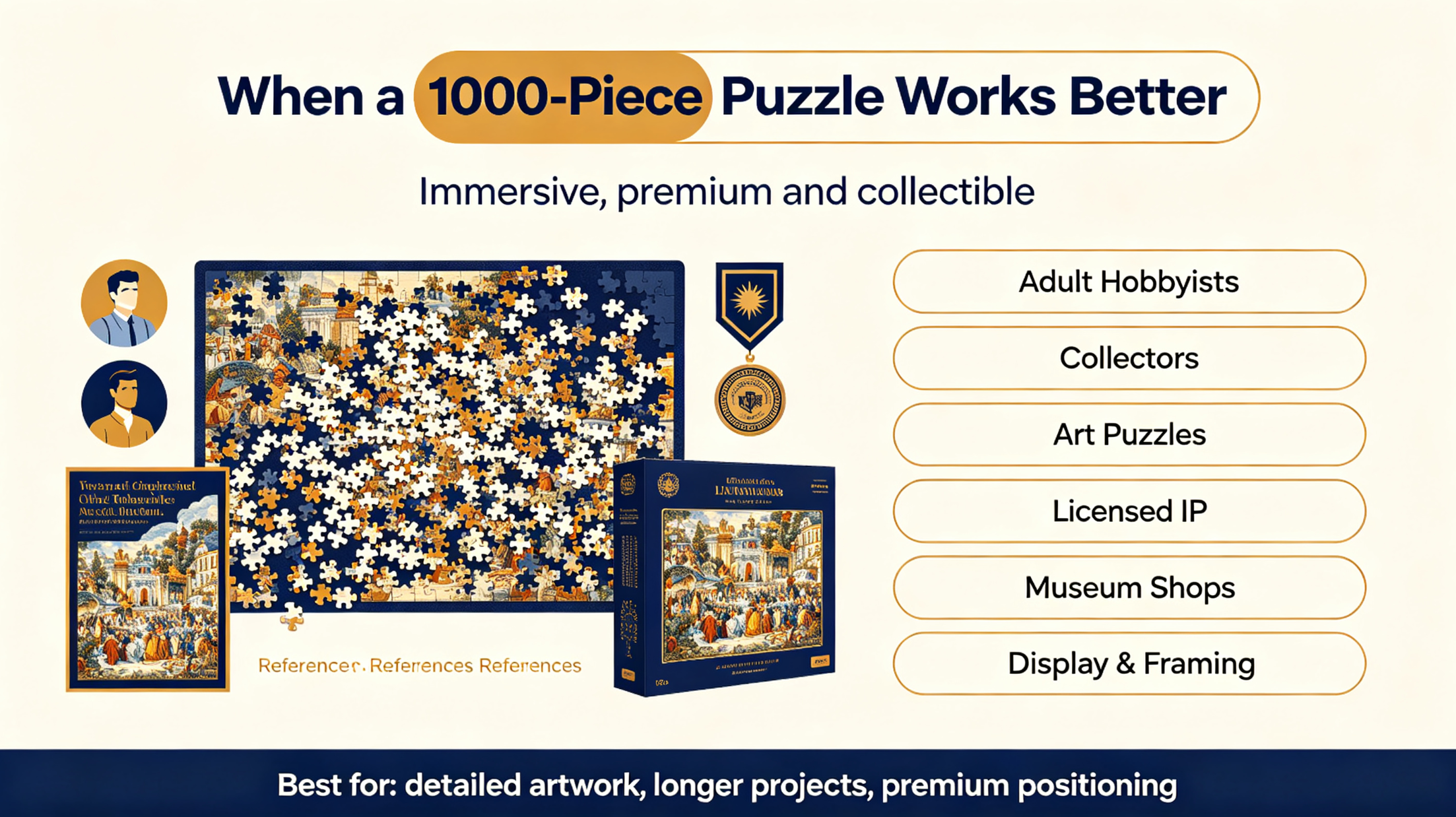
A 1000-piece jigsaw puzzle is often the standard format for adult puzzle enthusiasts because it offers a more substantial project, more visual detail, and stronger perceived value. It can become a multi-session activity, a social centerpiece, or a collectible product that customers display after completion.
For an adult-focused brand, 1000 pieces often communicate that the product is more than a quick activity. It signals challenge, craftsmanship, and immersion.
Best Users for 1000-Piece Puzzles
A 1000-piece puzzle is often the best fit for:
- Experienced adult puzzlers
- Hobby and collector audiences
- Art lovers
- Fans of licensed characters or franchises
- Customers who frame completed puzzles
- Couples or families completing puzzles over several sessions
- Buyers seeking screen-free relaxation
- Gift recipients who enjoy a meaningful long-term activity
- Fans of detailed maps, landscapes, architecture, and illustrated scenes
A 1000-piece count is particularly suitable for customers who enjoy sorting, pattern recognition, and gradual progress. Research has found that jigsaw puzzling draws on multiple visuospatial cognitive abilities. However, cognitive-health claims should be made cautiously: the available evidence identifies puzzling as a potential protective factor associated with cognitive aging, rather than proving that a short period of puzzling causes clinically meaningful cognitive improvement. [pmc.ncbi.nlm.nih]
Best Commercial Uses for 1000-Piece Puzzles
For brands and wholesalers, 1000-piece puzzles are commonly used for:
- Premium art puzzle collections
- Museum-shop merchandise
- Licensed entertainment and anime puzzles
- Fine-art reproductions
- Seasonal collector editions
- Detailed cityscapes and travel scenes
- Architecture and historical illustration puzzles
- Botanical, wildlife, and landscape collections
- Premium e-commerce bundles
- Limited editions with numbered packaging
- Holiday and Christmas puzzle programs
The larger piece count allows more room for detailed artwork. This is valuable for custom projects involving rich illustrations, character ensembles, collages, historical maps, or densely layered scenes.
Design Advice for 1000-Piece Custom Puzzles
A 1000-piece puzzle should make users feel challenged—not punished. A strong design needs visual variety across the entire image.
For better customer satisfaction, consider including:
- Multiple recognizable zones for sorting
- Clear color transitions
- Detailed areas in more than one part of the artwork
- A full-color reference poster or insert
- A high-quality box image that accurately represents the finished puzzle
- A matte or low-glare finish where possible
- Consistent piece thickness and clean die-cutting
- A well-designed resealable bag for loose puzzle pieces
A puzzle may have exceptional artwork but still underperform if the pieces bend, separate poorly, produce excessive dust, or do not fit precisely. In the premium segment, piece fit is part of the brand experience.
500 vs 1000 Piece Puzzle: Space, Size, and Storage
Before choosing a piece count, customers should think about where the puzzle will be assembled. This practical issue affects product satisfaction more than many brands expect.
A typical 1000-piece puzzle often requires a larger puzzle board, dining table, or dedicated surface than a 500-piece version. Exact finished dimensions vary by manufacturer because piece size, die-line format, and puzzle aspect ratio differ. Therefore, brands should always print the completed puzzle dimensions clearly on the box and product page.
| Workspace Question | 500-Piece Puzzle | 1000-Piece Puzzle |
| Can it fit on a coffee table? | Often yes, depending on format | Less likely |
| Is a dedicated puzzle mat useful? | Helpful | Highly recommended |
| Is it easy to pack away mid-project? | Usually easier | Often more difficult |
| Is a family dining table sufficient? | Often yes | Depends on table dimensions |
| Is a reference poster valuable? | Useful | Strongly recommended |
| Is a storage tray helpful? | Helpful | Very helpful |
Practical Buyer Checklist
Before launching a custom 500-piece or 1000-piece puzzle, ask:
1. Who is the primary customer: beginner, family, gift buyer, hobbyist, or collector?
2. Is the image suitable for the intended difficulty level?
3. What are the finished puzzle dimensions?
4. Will customers have enough space to complete it?
5. Does the packaging clearly show piece count, age guidance, finished size, and artwork?
6. Are the pieces easy to handle and accurately cut?
7. Is a poster, storage bag, or premium insert needed?
8. Will the product be positioned as an impulse gift, an accessible activity, or a collector-grade item?
The Hidden Factor: Artwork Can Matter More Than Piece Count
From a puzzle manufacturing perspective, the image selection process is one of the most important quality-control stages. Buyers sometimes submit a visually attractive image that is difficult to convert into a satisfying puzzle.
For example, imagine two products:
- A 500-piece puzzle featuring a foggy gray mountain landscape with a large sky and nearly identical tree textures.
- A 1000-piece puzzle featuring a colorful market scene with signs, clothing, food stalls, buildings, and people.
Although the first product has fewer pieces, it may produce a more difficult and less enjoyable experience. The second product has more pieces, but users can sort the pieces by hundreds of identifiable visual features.
How to Evaluate Puzzle Artwork Before Production
Use this four-part review process before approving a design:
1. Check image resolution.
The source image should be sufficiently sharp for the final puzzle size. Enlarging a low-resolution image can create blurry printing and weak visual clues.
2. Map the visual zones.
Identify at least four to six visually distinct areas, such as sky, buildings, characters, plants, lettering, and foreground objects.
3. Review repetitive sections.
Examine areas containing stripes, leaves, bricks, clouds, water, or solid colors. These sections may increase difficulty substantially.
4. Create a proof or sample.
Review a digital mock-up, color proof, or physical pre-production sample before mass production—especially for premium retail orders.
XingKun's custom-puzzle workflow includes design submission, a 3D preview, printing, custom die cutting, assembly, and packaging. The company also offers options for different piece counts, puzzle formats, materials, and box designs, making it possible to align the final product with the intended customer experience. [xkdisplay]
Materials and Manufacturing: Why Quality Changes the Experience
Whether a puzzle has 500 or 1000 pieces, material selection directly affects the customer's perception of quality. A low-cost puzzle may appear acceptable in product photography but disappoint users during assembly if it has poor fit, rough edges, weak print color, or warping.
Core Quality Elements for Custom Puzzles
For OEM and ODM buyers, request clear specifications for:
- Board thickness: Thicker puzzle board generally provides a more substantial feel and better durability.
- Print quality: High-resolution printing and accurate color reproduction protect the artwork's value.
- Die-cut precision: Clean, consistent cuts improve interlocking fit and reduce frustration.
- Piece variety: A more varied cut can improve the solving experience and discourage incorrect fits.
- Surface finish: Matte or linen-style finishes can reduce glare and support premium positioning.
- Puzzle dust control: Excess paper dust can reduce perceived quality and create a poor unboxing experience.
- Packaging strength: The box must protect corners, printed surfaces, and loose pieces during shipping.
- Bagging and inserts: Resealable bags, posters, thank-you cards, and branded inserts can improve perceived value.
At XingKun, custom puzzle options include cardboard, wood, and eco-focused materials, along with customized printing, piece counts, and packaging. The company describes digital printing, laser cutting, and 3D modeling as relevant production technologies in its custom-puzzle service. [xkdisplay]
Which Puzzle Piece Count Is Better for Your Brand?
For commercial buyers, the right answer depends on your product strategy rather than personal taste alone.
| Brand Goal | Better Starting Point | Why |
| Launch a family-friendly range | 500 pieces | Accessible challenge and broad gifting appeal |
| Sell premium art products | 1000 pieces | Supports more detail and collector positioning |
| Create a corporate giveaway | 500 pieces | More approachable for varied recipients |
| Build a puzzle hobby brand | 1000 pieces | Matches enthusiast expectations |
| Develop children’s educational products | 500 pieces or lower | Match count and piece size to age group |
| Offer personalized photo puzzles | 500 pieces | Easier to complete and more gift-friendly |
| License anime, film, or game artwork | 1000 pieces | Works well for detailed character scenes |
| Sell seasonal holiday puzzles | Both | Use 500 for family gifting and 1000 for collectors |
| Test a new artist collection | 500 pieces | Lower barrier for first-time buyers |
| Create a display-worthy limited edition | 1000 pieces | Stronger premium and framing potential |
A Smart Two-SKU Strategy
Rather than selecting only one format, many brands can create a stronger assortment by releasing both:
- A 500-piece edition for casual customers, gift shops, families, and entry-level purchasers.
- A 1000-piece edition for adult hobbyists, collectors, and customers seeking a deeper project.
For example, an art brand could use the same illustration in two sizes. The 500-piece version can be marketed as an accessible weekend activity, while the 1000-piece version can be positioned as a premium collector's challenge. The two formats allow the brand to serve different customer motivations without changing the creative concept.
How to Choose Between 500 and 1000 Pieces
Use the following decision framework:
Choose a 500-Piece Puzzle If You Want
- A shorter project that feels achievable
- A family-friendly product
- A lower-pressure gift option
- Larger or easier-to-sort pieces
- A puzzle suitable for casual customers
- A product with broad promotional potential
- A clearer entry point for a new puzzle brand
- A more manageable tabletop footprint
Choose a 1000-Piece Puzzle If You Want
- A more immersive hobby experience
- Higher perceived product value
- Detailed or collectible artwork
- A premium e-commerce or retail product
- A multi-day project
- A puzzle intended for adult enthusiasts
- Stronger framing and display potential
- A deeper challenge for repeat customers
Common Mistakes to Avoid
Choosing Piece Count Before Reviewing the Artwork
Do not select 1000 pieces simply because it sounds premium. A poor image can make even a premium puzzle frustrating. Review the artwork's color blocks, details, repetition, and resolution first.
Ignoring Finished Puzzle Dimensions
Customers need to know whether the puzzle will fit on their table or puzzle board. Always show final dimensions in both metric and imperial units for international markets.
Using Weak Box Photography
The puzzle box is a sales tool. It should show the full artwork clearly, communicate the piece count immediately, and make the brand's quality positioning obvious.
Making Unsupported Health Claims
Puzzles are widely associated with concentration, visual-spatial processing, and enjoyable screen-free leisure. But brands should avoid claiming that a puzzle prevents dementia, cures stress, or guarantees cognitive improvement. The academic evidence supports a more careful message: jigsaw puzzling engages multiple cognitive abilities and may be associated with cognitive-aging benefits, but it does not justify exaggerated medical claims. [pmc.ncbi.nlm.nih]
Treating Packaging as an Afterthought
For a custom puzzle, the packaging is part of the product. A premium rigid box, well-designed insert, protective bag, and accurate artwork reproduction can improve unboxing, gifting, reviews, and repeat purchases.
Conclusion
The best choice in the 500 vs 1000 piece puzzle comparison depends on the intended player and the product's commercial role. A 500-piece puzzle is generally better for accessible fun, families, corporate gifts, photo products, and casual buyers. A 1000-piece puzzle is usually stronger for adult hobbyists, detailed artwork, premium collections, and collector-focused retail.
For brands, wholesalers, and OEM buyers, the most successful puzzle is not simply the one with more pieces. It is the one where piece count, artwork, material quality, packaging, and customer expectations work together. Start with your audience, evaluate the artwork carefully, confirm finished dimensions, and request a prototype before scaling production.
If you are developing a branded 500-piece or 1000-piece puzzle range, XingKun can support custom artwork printing, piece-count selection, material options, precision cutting, and retail-ready packaging. Explore XingKun's [custom puzzle manufacturing service] to discuss an OEM or ODM project.
FAQ
1.Is a 500-piece puzzle easier than a 1000-piece puzzle?
Usually, yes. A 500-piece puzzle has fewer pieces to sort and fewer possible placements to evaluate. However, image design can change the difficulty significantly. A repetitive 500-piece design may be harder than a colorful, clearly segmented 1000-piece design.
2.How long does a 500-piece puzzle take to complete?
A 500-piece puzzle commonly takes around 2–4 hours, although time varies according to player experience, number of participants, artwork complexity, and piece-cut style. [puzzlesgalore.co]
3.How long does a 1000-piece puzzle take to complete?
A 1000-piece puzzle often takes roughly 5–12 hours. It may take far longer when the image includes subtle gradients, repeated patterns, large areas of similar color, or low-contrast details. [puzzlesgalore.co]
4.Is a 1000-piece puzzle suitable for beginners?
Yes, provided that the image is beginner-friendly. Choose a design with bright colors, distinguishable objects, multiple visual zones, and clear details. A 1000-piece collage, city scene, or colorful illustrated image can be a good first larger puzzle.
5.What age is appropriate for a 500-piece puzzle?
Appropriate age depends on piece size, puzzle complexity, and child experience rather than piece count alone. Many 500-piece products are more suitable for older children, teenagers, and adults. Brands should provide clear age guidance based on their specific puzzle design and safety requirements.
6.Are 1000-piece puzzles better for gifts?
They can be excellent gifts for adult hobbyists, art lovers, and collectors because they feel substantial and premium. For recipients who are new to puzzles or have limited free time, a 500-piece puzzle may be the more thoughtful option.
7.Should I choose cardboard or wooden custom puzzles?
Cardboard is generally the more scalable and cost-effective choice for mainstream retail, promotional, and high-volume orders. Wood can create a premium, durable, gift-oriented product with a different tactile feel. The right choice depends on target retail price, customer expectations, required volume, and brand positioning.
8.What should I ask a custom puzzle manufacturer before placing an order?
Ask about board thickness, printing method, color proofing, die-cut accuracy, finished dimensions, piece size, packaging options, sample availability, production lead time, quality-control process, export packaging, sustainability options, and minimum order quantities.
References
1. XingKun Printing Products. "[Custom Puzzle Manufacturer]." Accessed September 2026. Information on XingKun's custom puzzle categories, materials, design options, production workflow, printing, cutting, packaging, and OEM/ODM-oriented services. [xkdisplay]
2. Fissler, Patrick, et al. "[Jigsaw Puzzling Taps Multiple Cognitive Abilities and Is a Potential Protective Factor for Visuospatial Cognitive Aging]." *Frontiers in Aging Neuroscience*, 2018. Research discussing the cognitive abilities involved in jigsaw puzzling and the limits of causal conclusions about cognition. [pmc.ncbi.nlm.nih]
3. Puzzle Warehouse. "[Browse Jigsaw Puzzles by Piece Count]." Accessed September 2026. Retail-oriented guidance on typical user suitability across puzzle piece-count ranges. [puzzlewarehouse]
4. House of Puzzles. "[Best Way To Do 1000 Piece Jigsaw Puzzles]." January 10, 2025. Practical guidance on 1000-piece puzzle difficulty, completion time, and the importance of artwork design. [thehouseofpuzzles]
5. Puzzles Galore. "[Jigsaw Puzzle Size Guide: Piece Count Comparison Chart]." Accessed September 2026. General comparison estimates for puzzle sizes and completion times. [puzzlesgalore.co]
6. eeBoo. "[What Makes a Puzzle Easy or Difficult to Complete?]." August 28, 2024. Explanation of how piece count, image content, and visual complexity influence puzzle difficulty. [eeboo]
7. New York Puzzle Company. "[Shop 500 Piece Jigsaw Puzzles]." Accessed September 2026. Product positioning for 500-piece formats with larger, easier-to-handle pieces. [newyorkpuzzlecompany]


