Content Menu
● Scope and Commercial Disclosure
● How We Selected Clothing Box Suppliers
● Canada's Clothing Box Supply Landscape
>> Domestic Production and Offshore Sourcing Serve Different Needs
>> What the Latest Industry Data Actually Shows
● Eight Clothing Box Manufacturers and Suppliers to Consider
>> 1. Shenzhen XingKun Packing Products Co., Ltd.
>> 2. Xianda Printing Co., Ltd.
>> 3. Maituohong Packaging
>> 4. Bonito Packaging
>> 5. Madovar Packaging
>> 6. Instabox
>> 7. Boxmaster
>> 8. SupremeX Inc.
● Supplier Comparison: Capacity, MOQ, and Certification
● Clothing Box Materials and Technical Specifications
>> Specify the Packaging System Before the Paper Grade
>> Match the Test to the Distribution Route
>> Use Relevant Compliance Evidence
● Buyer's Guide: From Supplier Screening to Delivery
>> 1. Verify the Factory and Contracting Entity
>> 2. Approve Samples in Stages
>> 3. Define Quality Acceptance Before Production
>> 4. Compare Landed Cost, Not Only Factory Price
● Common Procurement Problems—and How to Prevent Them
>> An Often-Overlooked Trap: Approving the Empty Box
● Conclusion: Select the Supplier That Fits the Packaging Program
● Frequently Asked Questions
>> 1. How Can We Verify Whether a Supplier's ISO Certificate Has Expired?
>> 2. Does FSC Certification Prove That Every Clothing Box Contains Recycled Paper?
>> 3. Can a 100-Unit Trial Prove That a Supplier Can Handle 50,000 Units?
>> 4. Should We Choose a Canadian Manufacturer or an Overseas OEM Partner?
>> 5. How Do We Prevent a Supplier From Changing Materials After Sample Approval?
● References
Finding a reliable clothing box supplier requires more than comparing print quality and unit prices. Professional buyers need packaging that protects garments, presents a consistent brand image, fits fulfillment operations, and arrives when promised.
Canada offers established domestic packaging manufacturers alongside an active market for imported custom boxes. Government industry statistics report approximately CAD 1.0 billion in exports and CAD 1.7 billion in imports for paperboard container manufacturing in 2025. These figures cover the broader container industry—not clothing boxes alone—but demonstrate the importance of both domestic production and international sourcing.
This guide compares eight clothing box manufacturers and suppliers relevant to Canadian procurement, beginning with four overseas custom packaging options and continuing with four Canadian producers.
The central purchasing principle is verification: confirm the manufacturing location, approve a production-representative sample, validate certificates, and compare delivered costs before committing to a long-term relationship.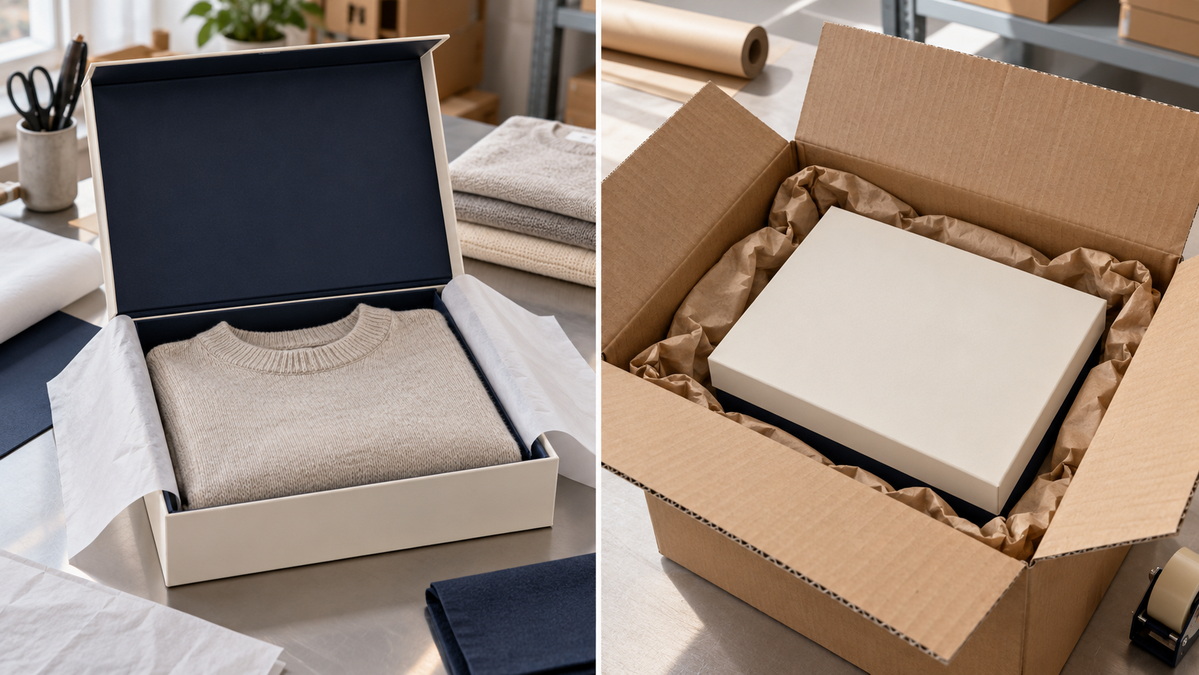
Scope and Commercial Disclosure
This article was prepared for Shenzhen XingKun Packing Products Co., Ltd., which appears first. The sequence is not an independently audited ranking by revenue, capacity, or customer satisfaction.
The first four companies are overseas sourcing options, not Canadian manufacturers. Their inclusion helps Canadian buyers compare offshore customization with local production. Company capabilities below come from published supplier information unless otherwise indicated; certification status and available capacity still require project-level verification.
How We Selected Clothing Box Suppliers
A useful shortlist should reflect procurement risk, not simply website visibility. The following framework provides a transparent basis for comparing suppliers.
| Evaluation area | Suggested weighting | Evidence buyers should request |
| Materials and structural performance | 25% | Board specification, physical samples, fit testing, shipping-test results |
| Quality control and traceability | 20% | Inspection procedures, batch records, defect classifications, corrective-action examples |
| Custom development capability | 15% | Dielines, structural prototypes, finishing samples, design revisions |
| Capacity and delivery reliability | 15% | Process-specific capacity, current loading, production schedule, delivery history |
| Certification and responsible sourcing | 15% | Current certificates, relevant scope, production-site coverage |
| Commercial flexibility and communication | 10% | MOQ by design, quotation detail, response process, change-control terms |
These are proposed evaluation weights, not numerical scores assigned to the companies in this article.
For original equipment manufacturing, or OEM, the supplier produces packaging to the buyer's approved specifications. For original design manufacturing, or ODM, the supplier also contributes structural or design development. Buyers should establish who owns the dielines, artwork, tooling, and resulting design files.
Canada's Clothing Box Supply Landscape
Domestic Production and Offshore Sourcing Serve Different Needs
The Canadian manufacturers reviewed here illustrate several regional sourcing options:
- Montréal offers custom rigid presentation packaging through Madovar and broader paper-based packaging through SupremeX.
- Alberta supports corrugated box production through Instabox's Calgary and Edmonton factories.
- British Columbia's Lower Mainland provides corrugated manufacturing and structural design through Boxmaster in Delta.
These examples identify practical production locations rather than establish an official ranking of national packaging clusters.
For apparel brands, local production deserves consideration when replenishment frequency, sampling access, and inventory flexibility matter. Overseas sourcing deserves consideration when extensive customization, coordinated printed accessories, or larger planned production runs are priorities. Neither model should be presumed cheaper without a complete landed-cost comparison.
What the Latest Industry Data Actually Shows
Innovation, Science and Economic Development Canada lists the following figures for paperboard container manufacturing:
| Indicator | Reporting year | Published figure |
| Manufacturing shipments | 2023 | Approximately CAD 7.5 billion |
| Exports | 2025 | Approximately CAD 1.0 billion |
| Imports | 2025 | Approximately CAD 1.7 billion |
The category includes setup paperboard boxes, corrugated boxes, fibre boxes, and other containers. It should not be presented as the market size for apparel packaging.
Environmental data also needs careful dating. The Paper and Paperboard Packaging Environmental Council's research library identifies its 2022 recycled-content survey, published in July 2023. That survey reported average recycled content of 80.2% for domestic shipments of the major packaging grades surveyed. This is an industry-level historical figure, not a verified recycled-content percentage for an individual clothing box ordered in 2026.
PPEC's 2025 environmental outlook discusses issues including waste management in the industrial, commercial, and institutional sector and the industry's role in recovering used paper packaging. Buyers should distinguish that current policy discussion from older quantitative survey results.
Eight Clothing Box Manufacturers and Suppliers to Consider
1. Shenzhen XingKun Packing Products Co., Ltd.
Location: Shenzhen, Guangdong, China
Established: 2004
Published market reach: More than 30 countries
Relevant services: Custom packaging boxes, printed accessories, OEM and ODM support.
Shenzhen XingKun Packing Products Co., Ltd. merits consideration for apparel brands seeking a coordinated packaging program rather than a standalone box order. Its published product range includes paper boxes, labels, stickers, brochures, and other printed products, creating an opportunity to consolidate related packaging components.
The company identifies a 3,000-square-metre facility and Heidelberg CD102 four-color and XL75 six-color printing equipment. It also reports annual output exceeding 10 million, although the page does not clearly define the unit or product mix. Buyers should therefore request clothing-box-specific throughput rather than interpret that figure as annual apparel-box capacity.
For smaller and developing brands, XingKun's published support for low-volume orders, design consultation, and full OEM/ODM services makes flexibility its most relevant procurement proposition. Its integrated workflow may also simplify communication when boxes, inserts, labels, and supporting print need coordinated approval. These service claims should be tested through the quotation and sampling process, not treated as independently measured performance.
Potential fit:
- Apparel brands developing a coordinated retail presentation.
- Buyers requiring custom dimensions, printed graphics, and complementary accessories.
- Small and medium-sized businesses seeking development support before scaling.
Points to verify:
- MOQ for the exact structure and finish.
- Capacity at the wrapping, assembly, and finishing stages.
- Whether the published 7–15-day turnaround applies to the proposed order.
- Current ISO 9001 and FSC documentation, including certificate holder and scope.
XingKun is a candidate for value-focused sourcing, but any cost advantage should be established through comparable delivered quotations.
2. Xianda Printing Co., Ltd.
Location: China; the website identifies Dongguan production facilities and an address in Humen
Established: Published information is inconsistent
Published market focus: Domestic and export customers across consumer-product categories
Relevant services: Custom gift boxes, paper bags, structural development, sampling, printing, and assembly.
Xianda Printing Co., Ltd., associated with xiandagiftbox.com, offers custom paper packaging across categories including clothing, jewelry, cosmetics, and gifts. Its website describes dedicated design and sampling departments, more than ten precision production lines, and sampling within three to five days.
Its relevance to clothing box procurement lies in decorative presentation packaging and custom structural options. Buyers developing apparel gift sets can ask the company to propose a structure around the actual folded garments and accessories.
An important qualification is its company history. The reviewed homepage states 2006 in some sections and 2014 in another. It also contains differing location descriptions. Buyers should resolve these discrepancies using the business license, factory address, contracting entity, and payment beneficiary before issuing an order.
Potential fit:
- Decorative apparel gift packaging.
- Custom presentation concepts requiring structural sampling.
- Buyers sourcing several gift-box formats from one supplier.
OEM/ODM verification should cover who creates the dieline, which operations are performed internally, and who owns development files after payment. No precise clothing-box capacity or universal MOQ was established from the reviewed page.
3. Maituohong Packaging
Location: Shenzhen, Guangdong, China
Established: Exact founding year not confirmed; the website states more than 15 years of experience
Published markets: Global customers, with North American and European market experience
Relevant services: Apparel packaging, rigid boxes, folding cartons, corrugated boxes, inserts, bags, and labels.
Maituohong Packaging, operating through mthpackagingbox.com, publishes a broad custom paper packaging offering. Its website identifies a 15,000-square-metre facility, more than 200 workers, and Heidelberg printing equipment. These figures indicate reported operational scale, but they do not establish available monthly clothing-box capacity.
The company's published inspection sequence is particularly relevant to procurement teams: incoming quality control, in-process quality control, final quality control, and outgoing quality control. It also describes structural development, sampling, sample approval, production, and shipment preparation.
Its customization scope includes dimensions, structure, materials, thickness, printing, finishes, inserts, magnets, ribbons, and windows. The homepage states that MOQ depends on product type and customization.
Potential fit:
- Brands comparing rigid gift boxes with corrugated apparel mailers.
- Buyers consolidating boxes, tissue, inserts, bags, and labels.
- Programs requiring documented approval stages.
The website makes ISO 9001, FSC, and ISO 14001 claims across its pages. Buyers should request the certificates and confirm which legal entity and production site each document covers. The reviewed pages use Maituohong Packaging as the trading identity; the full registered contracting name should be confirmed before onboarding.
4. Bonito Packaging
Location: China, according to its website positioning
Established: Exact year not confirmed; the company states more than a decade of experience
Published market reach: More than 20 countries and regions
Relevant services: Custom apparel boxes, rigid boxes, mailers, folding cartons, structural design, printing, and finishing.
Bonito Packaging, associated with bonitopack.com, is relevant to buyers seeking a lower-volume entry point. Its website advertises custom packaging starting from 100 units and describes production orders ranging from 500 to more than 500,000 units. The latter is a stated order-size range, not independently verified monthly or annual output.
The company explicitly lists custom apparel boxes and offers development support from material selection and structural design through printing, finishing, inspection, and production. This makes it worth evaluating for seasonal launches, product tests, and developing apparel brands.
Potential fit:
- Low-volume branded clothing-box trials.
- Apparel gift sets and retail presentation boxes.
- Buyers comparing mailers, folding cartons, and rigid structures.
The website lists ISO 9001, FSC, BSCI, and REACH-related claims. These categories are not interchangeable. Buyers should request the relevant management-system certificates, sourcing documentation, social-audit records, and material test reports rather than accept a collection of logos as proof of compliance. The full registered legal name and factory address should also be confirmed.
5. Madovar Packaging
Location: Montréal, Québec, Canada
Established: 2011
Published markets: North America
Relevant services: Custom rigid packaging, magnetic closures, telescoping lids, sleeves, and presentation sets.
Madovar Packaging is a Canadian option for apparel brands prioritizing rigid presentation packaging. The company states that its boxes are designed and produced at its Montréal facility and identifies apparel among its served industries.
Its published structures include magnetic closure boxes, telescoping lids, French-door boxes, and sleeve boxes. These are relevant when the package forms part of a premium retail or gifting experience.
Potential fit:
- Premium garments and accessories.
- Limited-edition collections.
- Gift sets requiring custom compartments or presentation features.
Its documented structural engineering, material selection, and finishing services support a custom-development discussion. Buyers should nevertheless confirm whether their project is manufactured entirely at the named facility and establish MOQ, reserved capacity, and material sourcing documentation. No numerical capacity, universal MOQ, or specific certification was established from the reviewed page.
6. Instabox
Location: Calgary and Edmonton, Alberta, Canada
Established: 1975
Published market focus: Canadian businesses, with multiple regional service contacts
Relevant services: Corrugated boxes, custom mailers, die-cut packaging, folding cartons, and displays.
Instabox offers a different procurement proposition from a decorative rigid-box specialist. Its website emphasizes in-house corrugated manufacturing, two Alberta factories, and more than 100 employees.
For apparel businesses, the most relevant products include shipping boxes and custom mailers. The company states that some made-to-order boxes can be purchased in quantities as small as one. That statement should not be interpreted as a one-unit MOQ for every printing method or custom apparel design.
Potential fit:
- Canadian apparel e-commerce operations.
- Buyers requiring corrugated shipping protection.
- Regional replenishment programs and small-order testing.
Custom dimensions, graphics, die-cut features, and mailer structures provide an OEM-style production scope. Buyers should ask separately about structural development, tooling ownership, print-process minimums, and certification requirements.
7. Boxmaster
Location: Delta, British Columbia, Canada
Established: 1981
Published market focus: Vancouver Lower Mainland and customers across multiple industries
Relevant services: Corrugated cartons, custom die-cut boxes, displays, graphic design, and structural design.
Boxmaster is a Western Canadian option for protective packaging and custom corrugated development. Its website identifies production on Annacis Island in Delta and a product range extending from regular slotted cartons to custom die-cut packaging.
For clothing-box buyers, the strongest fit is likely to be apparel mailers, distribution cartons, and protective structures rather than assuming specialist luxury rigid-box production.
Potential fit:
- Western Canadian apparel distribution.
- Custom protective shipping boxes.
- Programs requiring structural and graphic development.
Boxmaster publishes an IFS PACsecure certification claim. Procurement teams should obtain the current certificate and confirm its scope and site coverage. That claim does not independently establish FSC certification or a particular recycled-content percentage.
No universal MOQ or numerical clothing-box capacity was established from the reviewed source.
8. SupremeX Inc.
Canadian base: LaSalle, Québec, with a broader North American business
Established: 1977, originally as Enveloppe Suprême
Published markets: North America
Relevant services: Folding cartons, e-commerce packaging, labels, commercial print, and specialty finishing.
SupremeX Inc. offers a broader paper-based packaging platform. Its published portfolio includes folding cartons and e-commerce packaging alongside envelopes, labels, and commercial printing.
This breadth makes it worth assessing for apparel businesses seeking a supplier relationship that can cover multiple paper-based packaging requirements. Its folding carton offering is relevant to buyers prioritizing customized retail packaging and space-efficient storage.
Potential fit:
- Multi-SKU retail packaging programs.
- Folding clothing boxes.
- Businesses seeking several related printed packaging categories.
Buyers should identify the specific converting facility proposed for their order. Group-level scale does not establish the available capacity, MOQ, manufacturing origin, or certificate coverage of an individual apparel-box project.
Supplier Comparison: Capacity, MOQ, and Certification
The table distinguishes published claims from information still requiring a quotation or documentary review.
| Supplier | Published scale or capacity information | Published MOQ information | Certification information reviewed | Main purchasing focus |
| Shenzhen XingKun Packing Products Co., Ltd. | 3,000 m²; annual output above 10 million, with unit and product mix unclear | Low-volume support; exact MOQ by quotation | ISO 9001 and FSC claims; verify current documents | Coordinated custom boxes and printed accessories |
| Xianda Printing Co., Ltd. | More than ten production lines claimed; clothing-box output unspecified | Not established | Current certificate details not established | Decorative gift-box development |
| Maituohong Packaging | 15,000 m²; 200+ workers; numerical output unspecified | Product- and customization-dependent | ISO 9001, FSC, and ISO 14001 claims | Multiple paper packaging categories |
| Bonito Packaging | Advertised order range extends to 500,000+ units; not annual capacity | Starting from 100 units for eligible projects | ISO 9001, FSC, BSCI, and REACH-related claims | Lower-volume launches and scalable orders |
| Madovar Packaging | Montréal production; numerical capacity unspecified | By quotation | Not established from reviewed page | Custom rigid presentation packaging |
| Instabox | Two Alberta factories; 100+ employees | As few as one for some box orders; customization conditions apply | Not established from reviewed pages | Corrugated mailers and shipping boxes |
| Boxmaster | Delta manufacturing facility; numerical output unspecified | By quotation | IFS PACsecure claim | Structural corrugated packaging |
| SupremeX Inc. | North American business; project-specific capacity unspecified | By quotation | Confirm with the proposed facility | Folding cartons and broader paper packaging |
A large facility does not automatically mean faster delivery. For complex clothing boxes, the relevant question is which production stage limits the proposed order—and whether time has been reserved at that stage.
Clothing Box Materials and Technical Specifications
Specify the Packaging System Before the Paper Grade
"Clothing box" can describe a retail folding carton, a rigid gift box, or a corrugated shipping mailer. These structures serve different functions.
Folding cartons can use paperboard or microflute corrugated materials. Published Canadian converting information identifies options including solid bleached sulphate, commonly called SBS, and coated recycled board, or CRB.
A procurement specification should identify:
- Box structure and intended use.
- Internal usable dimensions and measurement method.
- Board grade and supplier-approved material reference.
- Grammage and caliper where applicable.
- Corrugated flute and agreed performance requirements.
- Printing process, color targets, and approved finish.
- Inserts, tissue, ribbons, magnets, or other accessories.
- Finished-package testing and acceptance criteria.
Do not approve a quotation that describes the material only as "premium cardboard." Ask suppliers to state exactly what will be purchased and prohibit substitutions without written approval.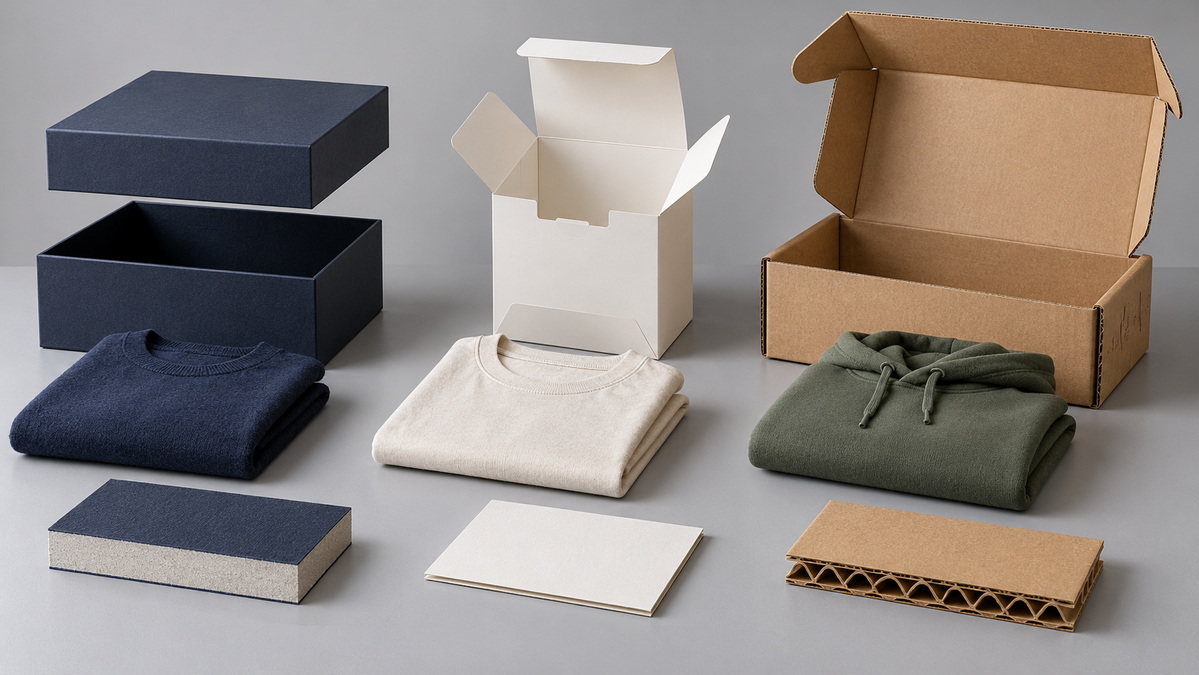
Match the Test to the Distribution Route
A retail presentation box and a parcel shipping package should not share an assumed performance standard.
ISTA Procedure 3A addresses individual packaged products shipped through parcel delivery systems at weights of 150 lb or 70 kg or less. It evaluates the packaged product rather than an empty decorative box in isolation. The appropriate procedure should be selected according to the actual distribution environment.
For apparel shipments, submit the complete proposed configuration for evaluation: garments, tissue, inserts, presentation box, outer packaging, and closure method.
Use Relevant Compliance Evidence
ISO 9001 certification concerns an organization's quality management system. Buyers should verify its active status and relevant scope rather than treat it as a guarantee that every delivered box meets their specification.
FSC provides searchable certification and licensing records. Buyers should match the supplier's certificate information to the company and sourcing documentation relevant to the order.
CE marking and RoHS should not be used as generic environmental credentials for an ordinary paper clothing box. CE marking applies only where specific product legislation requires it, while RoHS addresses hazardous substances in electrical and electronic equipment. A request for additional material testing should be tied to an actual product, destination-market, or customer requirement.
Buyer's Guide: From Supplier Screening to Delivery
1. Verify the Factory and Contracting Entity
Before paying a deposit, request a consistent documentary chain:
1. Registered legal name and business license.
2. Manufacturing address.
3. Quotation and contract entity.
4. Payment beneficiary.
5. Relevant certificates.
6. Disclosure of subcontracted processes.
Use a live factory walkthrough or independent audit when the order value and risk justify it. Ask to see the operations relevant to your box, not merely a printing press.
This is especially important where published company histories or addresses conflict, as observed on Xianda's reviewed homepage.
2. Approve Samples in Stages
Maituohong and Bonito both describe sample approval before mass production, providing a useful model for a controlled development process.
A buyer-controlled approval sequence should include:
- Structural sample: Confirm dimensions using actual garments.
- Printed sample: Review color, finishes, artwork placement, and surface appearance.
- Production-representative sample: Confirm the materials and processes intended for the order.
- Retained reference: Keep signed samples with both parties and any inspection provider.
State in writing whether the sample was digitally produced, hand assembled, or manufactured using the intended production process. Record any differences before approval.
3. Define Quality Acceptance Before Production
Create a defect list covering issues that matter to the product:
- Incorrect internal dimensions.
- Loose or poorly fitted lids.
- Visible glue marks.
- Damaged corners.
- Misaligned foil or embossing.
- Print rubbing.
- Incorrect inserts.
- Odor concerns.
- Packing-count errors.
Agree on measurement methods, sampling rules, remedies, and responsibility for replacement freight. "Match sample" is useful, but it should not be the entire quality agreement.
4. Compare Landed Cost, Not Only Factory Price
Require quotations to separate:
- Unit price.
- Sampling and tooling.
- Packing materials.
- Freight and insurance.
- Customs-related charges.
- Delivery to the destination warehouse.
- Storage implications.
- Expected write-offs and replacement arrangements.
For rigid clothing boxes, request packed carton dimensions and units per carton early. Compare assembled and collapsible designs using the same destination and shipment assumptions.
Have a customs broker confirm classification and applicable charges instead of assuming all paper boxes receive identical treatment.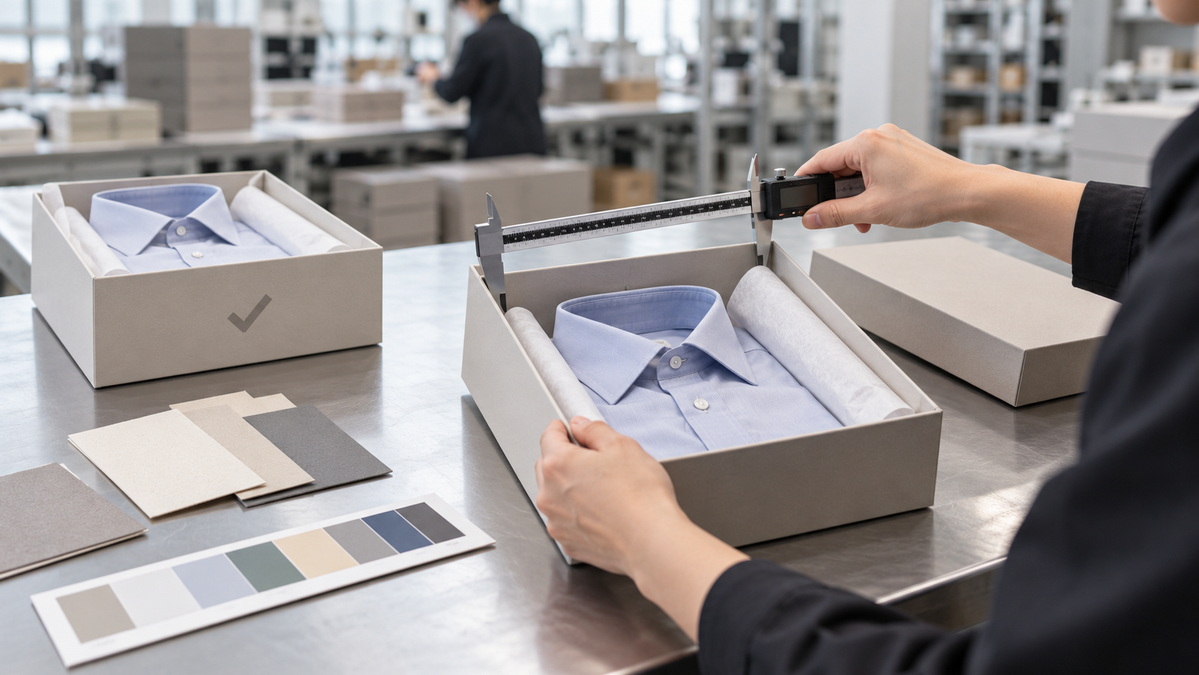
Common Procurement Problems—and How to Prevent Them
| Procurement problem | Why the quotation can be misleading | Buyer control |
| Material substitution | A generic board description leaves room for a different input | Lock material specifications and require written substitution approval |
| MOQ misunderstanding | The advertised minimum may apply only to selected structures | Confirm MOQ per size, artwork, material, and finish |
| Sample-to-bulk mismatch | A sample may use a different printing or assembly method | Document sample construction and approve production differences |
| Capacity overstatement | Factory size does not establish free capacity for your project | Request a process-level schedule and reserved production window |
| Certification confusion | A logo may refer to another entity, site, or scope | Verify the current record and order-specific applicability |
| Hidden logistics expense | Unit prices omit packed volume and destination charges | Compare complete delivered quotations |
These controls should become purchase-order requirements rather than remain informal email discussions.
An Often-Overlooked Trap: Approving the Empty Box
A practical inspection priority is lid fit after the box has been packed with the actual garment, tissue, and accessories.
An empty sample can appear satisfactory while leaving inadequate usable space once the complete presentation is assembled. Therefore, do not approve fit using external dimensions alone.
Ask the supplier to document:
- Internal usable dimensions.
- The agreed garment-folding method.
- Tissue and insert configuration.
- Lid clearance and closure behavior.
- Fit after relevant conditioning and handling.
Then assess transport performance using the complete packaged product. This is consistent with ISTA's system-level approach to distribution testing, although the exact test must match the shipment route.
Conclusion: Select the Supplier That Fits the Packaging Program
A useful shortlist separates presentation packaging from shipping protection and distinguishes Canadian manufacturing from overseas sourcing.
Madovar publishes a clear focus on Montréal-produced custom rigid packaging. Instabox and Boxmaster offer Canadian corrugated capabilities, while SupremeX provides a broader paper-based packaging portfolio.
For overseas development, Shenzhen XingKun Packing Products Co., Ltd., Xianda Printing Co., Ltd., Maituohong Packaging, and Bonito Packaging offer different combinations of custom structures, printing, accessories, and order flexibility. Their suitability depends on verified documents, production-representative samples, and project-specific commercial terms—not placement in a list.
To evaluate XingKun for your next clothing box program, submit the garment dimensions, proposed structure, quantity, artwork, finish requirements, and Canadian delivery location. Request a structural recommendation, itemized quotation, sample plan, current certification documents, and a production schedule before approving the order.
Frequently Asked Questions
1. How Can We Verify Whether a Supplier's ISO Certificate Has Expired?
Request the full certificate number, legal company name, manufacturing address, applicable standard, scope, and issuing certification body.
Search IAF CertSearch and review the status, scope, issuing body, and available date information. The platform distinguishes active, suspended, withdrawn, and expired certificates. If the record cannot be located or information conflicts, contact the issuer directly before relying on the certificate.
Also confirm that the certified organization and site correspond to the factory proposed for your order.
2. Does FSC Certification Prove That Every Clothing Box Contains Recycled Paper?
No single FSC logo should be treated as proof of a particular recycled-content percentage.
Use FSC's public search tools to confirm certification details, then ask the supplier to identify the exact sourcing claim applicable to the ordered product. A broad industry recycled-content statistic is not a substitute for order-specific documentation.
If your packaging brief requires a stated recycled percentage, put that requirement in the material specification and request supporting evidence.
3. Can a 100-Unit Trial Prove That a Supplier Can Handle 50,000 Units?
Not by itself.
Bonito advertises a 100-unit starting point and much larger order sizes, but those figures do not independently demonstrate the available capacity or production route for a particular clothing box.
Ask whether the trial and bulk order will use the same materials, printing process, tooling, assembly method, and inspection criteria. Before scaling, obtain a production-representative approval sample and a written schedule.
4. Should We Choose a Canadian Manufacturer or an Overseas OEM Partner?
Choose according to the complete operating requirement, not the supplier's country alone.
Compare the same specification across domestic and overseas quotations. Include replenishment frequency, inventory commitment, development support, freight, communication arrangements, and the cost of correcting defects.
Canada's published 2025 paperboard-container trade figures show that domestic production and imports both form part of the sourcing landscape. They do not establish which route is cheaper for a specific apparel brand.
5. How Do We Prevent a Supplier From Changing Materials After Sample Approval?
Attach a controlled material and construction specification to the purchase order.
Require advance written approval for changes to board, wrap paper, inks, coatings, adhesives, inserts, or manufacturing location. Link inspection to the approved specification and retained sample, and agree on remedies before production begins.
Documented inspection stages—such as the incoming, in-process, final, and outgoing checks described by Maituohong—provide a useful starting point, but buyers should request actual records applicable to their order.
References
- Innovation, Science and Economic Development Canada — Canadian Industry Statistics, paperboard container manufacturing; includes 2025 trade information. [ised-isde.canada]
- Paper and Paperboard Packaging Environmental Council — Research library and recycled-content survey publications. [ppec-paper]
- Paper and Paperboard Packaging Environmental Council — Environmental issues outlook for 2025. [ppec-paper]
- FSC — Public certification and licensing search. [search.fsc]
- IAF CertSearch — Accredited certificate verification and status checks. [iafcertsearch]
- International Safe Transit Association — Distribution test procedures and selection guidance. [ista]
- European Commission — Official guidance on CE marking applicability. [europa]
- European Commission — RoHS Directive scope and requirements. [environment.ec.europa]


