Content Menu
● What Are Custom Product Hang Tags?
● Why Custom Hang Tags Matter for Product Branding
>> A hang tag can do four jobs at once
● Custom Product Hang Tags vs. Labels
● Key Benefits of Custom Printed Hang Tags
>> 1. Improve perceived product value
>> 2. Create stronger brand recognition
>> 3. Help retailers manage products
>> 4. Support customer education
● Choosing the Right Hang Tag Material
>> Paper and cardstock hang tags
>> Sustainability claims need evidence
● Selecting Hang Tag Size, Shape, and Format
>> Common tag formats
>> How to choose a practical size
● Printing Methods and Premium Finishes
>> Common printing options for custom hang tags
>> Finishes that add perceived value
● How to Design Custom Product Hang Tags That Convert
>> Start with a message hierarchy
>> Use the front and back strategically
>> Make text readable at real-life distance
● A Professional Pre-Production Checklist
>> 1. Confirm product and market requirements
>> 2. Define the physical specification
>> 3. Prepare production-ready artwork
>> 4. Approve a proof before bulk production
● Common Custom Hang Tag Mistakes to Avoid
>> Using generic marketing language
>> Adding too much information
>> Forgetting the attachment method
>> Ignoring compliance until the final artwork stage
>> Treating the sample as optional
● Expert Insight: Build a Modular Hang Tag System
● Why Work With XingKun for Custom Product Hang Tags?
● Conclusion
● FAQ
>> 1. What information should be included on custom product hang tags?
>> 2. What is the best paper thickness for custom hang tags?
>> 3. Can custom product hang tags include QR codes?
>> 4. Are hang tags legally required for clothing products?
>> 5. Can I use recycled paper or FSC paper for hang tags?
>> 6. What finishes make a hang tag look more premium?
>> 7. What should I send a custom hang tag manufacturer for a quotation?
● References
Custom product hang tags are far more than price labels. For apparel, accessories, gift products, cosmetics, home goods, toys, and retail packaging, they are a compact brand touchpoint that can communicate product value, product information, sustainability credentials, and a clear reason to buy.
At Shenzhen XingKun Packing Products Co., Ltd. (XingKun), we work with overseas brands, wholesalers, and manufacturers that need OEM and ODM custom packaging. From custom packaging boxes and printed books to stickers, playing cards, jigsaw puzzles, and custom product hang tags, our production perspective is simple: a hang tag should look premium, function reliably in the supply chain, and support the buyer's decision at the moment of purchase.
This guide explains how to plan, design, specify, and source custom printed hang tags that work for your product—not just for a product photo.
> Looking for a custom hang tag manufacturer in China? XingKun can support tailored materials, custom shapes, precision printing, special finishes, proof approval, and OEM/ODM production for global retail brands. [Request a custom hang tag quotation].
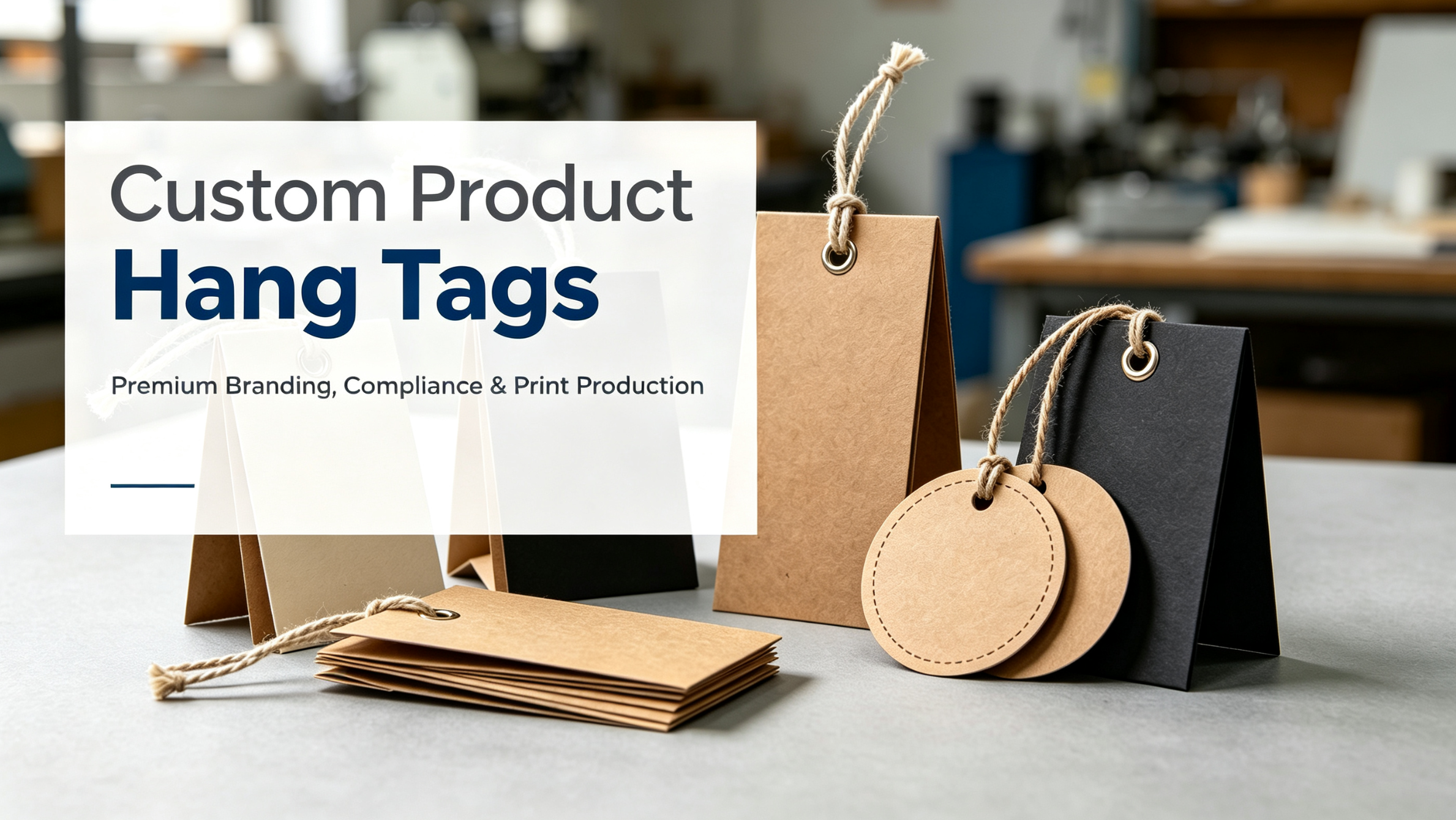
What Are Custom Product Hang Tags?
Custom product hang tags are removable printed tags attached to a product using string, ribbon, elastic cord, plastic fasteners, safety pins, or other attachment methods. They are commonly used on garments, footwear, bags, jewelry, accessories, candles, bottles, gifts, and retail-ready packaged products.
Unlike a permanently sewn-in care label or a regulatory label, a product hang tag gives brands flexible space to tell a story. It can include:
- Brand name and logo
- Product name and collection
- Price, SKU, barcode, or QR code
- Material composition
- Care instructions
- Country-of-origin information
- Product benefits or usage guidance
- Sustainability statements
- Social-media handles or website details
- Promotional offers, loyalty messages, or warranty information
A well-designed tag helps a product appear intentional, credible, and shelf-ready. A poorly made tag can do the opposite: weak paper, inaccurate colors, hard-to-read copy, badly positioned holes, or impractical fastening choices can make even a high-quality product look unfinished.
For that reason, the best custom product hang tags are designed as part of the overall packaging system—not as an afterthought.
Why Custom Hang Tags Matter for Product Branding
Retail buyers make rapid visual judgments. Before a customer reads a product description online or speaks to a sales associate, they may touch the product, see its packaging, and read its hang tag. The tag becomes a physical bridge between your product and your brand promise.
A hang tag can do four jobs at once
| Function |
What the tag communicates |
Example |
| Brand building |
Identity, style, quality level, story |
A minimalist black tag with blind embossing for a premium leather accessory |
| Product information |
Size, SKU, materials, care, features |
A folded apparel tag containing fabric composition and fit notes |
| Retail operations |
Barcode, price, product code, inventory data |
A back-panel EAN/UPC barcode and internal SKU |
| Customer engagement |
Website, QR code, campaign, social proof |
A QR code linking to product care, warranty registration, or origin story |
A tag does not need to contain every possible message. In fact, too much copy often reduces clarity. The goal is to decide what the customer must know before purchase, what the retailer needs for operations, and what can be delivered digitally after a QR-code scan.
GS1 Digital Link is one standard-based method for connecting a 2D barcode with product identifiers and digital content such as instructions, certifications, traceability information, and product details. This makes a QR-enabled hang tag useful beyond simple website traffic. [gs1]
Custom Product Hang Tags vs. Labels
Although buyers sometimes use the terms interchangeably, product hang tags and product labels have different roles.
| Feature |
Custom product hang tag |
Permanent product label |
| Attachment |
String, cord, pin, loop, ribbon, or fastener |
Adhesive, sewn-in, heat-transfer, or permanently fixed |
| Typical purpose |
Branding, pricing, storytelling, promotions, product details |
Compliance, care, composition, warnings, traceability |
| Customer experience |
Designed to be held, read, and sometimes removed |
Designed to remain with the product |
| Design flexibility |
High; can use unusual shapes, folds, layers, and finishes |
Often constrained by available surface area and durability |
| Best use |
Retail presentation and product differentiation |
Long-term required information and use instructions |
For apparel, the distinction is especially important. In the United States, most textile and wool products require disclosures including fiber content, country of origin, and the identity of the manufacturer or other responsible business; garments also generally need care instructions under the FTC Care Labeling Rule. [ftc]
A removable hang tag can support these disclosures, but brands should not assume it substitutes for a required permanent label. Requirements differ by product category and destination market, so the importer, brand owner, or legal/compliance team should verify the final labeling plan before production.
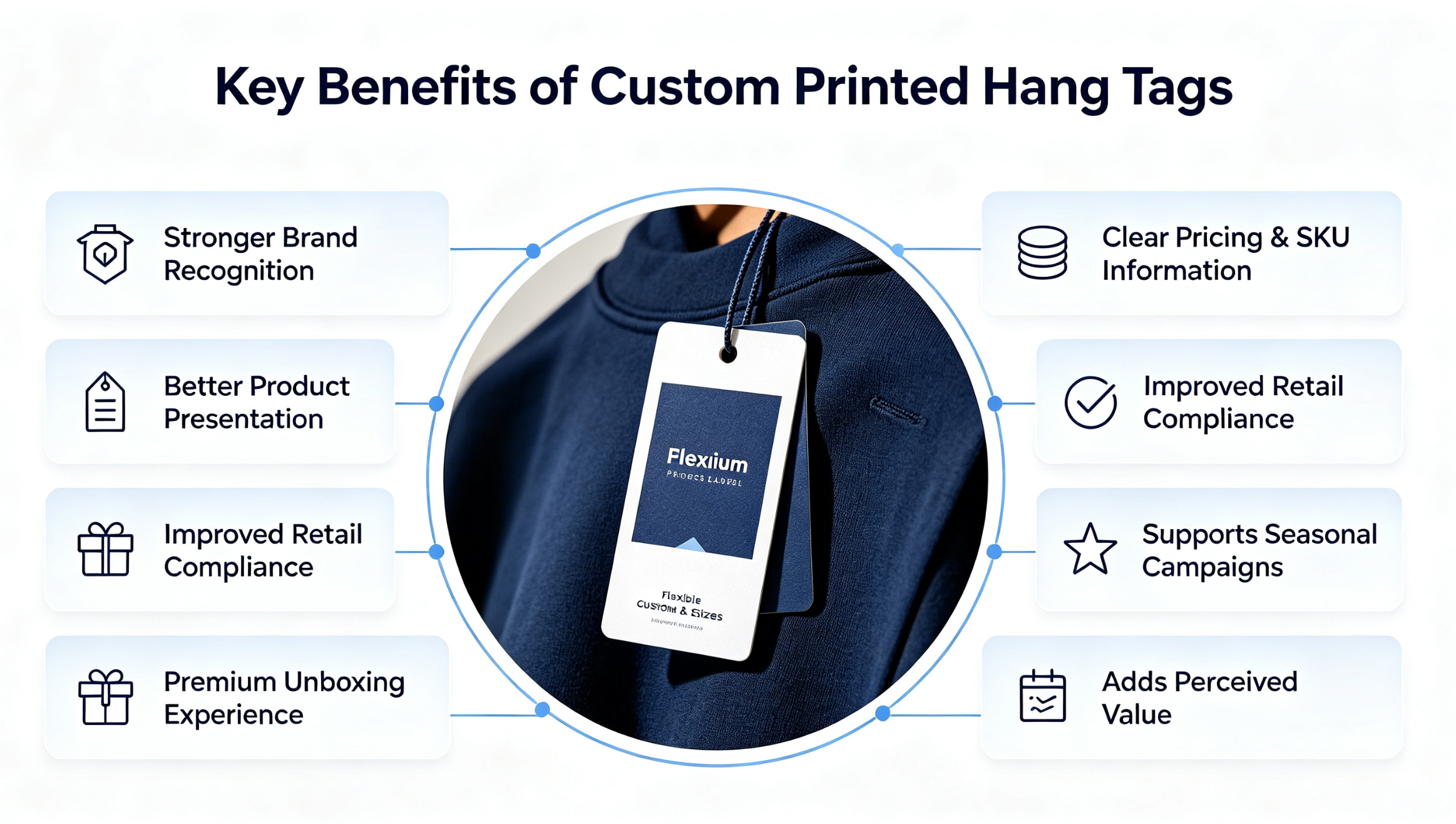
Key Benefits of Custom Printed Hang Tags
1. Improve perceived product value
A heavier uncoated paper stock, a refined embossing detail, or a carefully selected cord can make an ordinary product feel more premium. This is not about adding decoration for its own sake. It is about ensuring that the tactile experience matches the price point and brand position.
For example:
- A natural skincare brand may use recycled uncoated paper, restrained ink coverage, and cotton string.
- A luxury jewelry brand may choose thick black cardstock, gold foil stamping, and a soft-touch laminated finish.
- A children's product brand may use bright colors, rounded corners, and an easy-to-scan QR code for product instructions or activity content.
- An outdoor brand may select durable synthetic stock where moisture resistance matters.
2. Create stronger brand recognition
A consistent tag system helps buyers recognize products across seasonal collections and sales channels. Use recurring visual signals such as:
- Brand colors
- Logo placement
- Typography
- Tag shape
- Material texture
- Illustration style
- Icon system
- Attachment style
Consistency does not mean every tag needs to look identical. A collection can have different colors or graphics while preserving the same core layout, logo position, and product-information hierarchy.
3. Help retailers manage products
Wholesale customers and retail teams often need readable product identifiers. A professional tag layout makes operational information easy to find without damaging the front-of-pack appearance.
Useful retail details can include:
- SKU
- Style number
- Size or color
- UPC, EAN, or GTIN barcode
- Price field
- Batch number, if applicable
- Country of origin
- Collection or season code
Always test a barcode after printing. The code may be technically present but still difficult to scan if the quiet zone is too small, the contrast is weak, the image is distorted, or a glossy finish creates reflection.
4. Support customer education
For many categories, customers need confidence before they purchase. A tag can answer the questions that slow down conversion:
- What is this product made of?
- How do I use or care for it?
- Why is it different from alternatives?
- Is it a gift-ready item?
- Does it use verified sustainable materials?
- Where can I learn more?
The strongest messages are specific. Instead of writing "high quality," explain the relevant benefit: "Made with 400 gsm rigid board," "Printed with soy-based ink," "Includes a QR-linked assembly guide," or "Designed for hand-wash care."
Choosing the Right Hang Tag Material
The material determines how a custom product hang tag feels, prints, folds, survives handling, and supports your sustainability or premium-positioning message.
Paper and cardstock hang tags
Paper-based hang tags are the most common option because they offer broad design freedom and cost flexibility.
| Material option |
Best for |
Key characteristics |
| Coated cardstock |
Bright graphics, fashion, promotional retail tags |
Smooth surface, sharp image reproduction, suitable for gloss or matte lamination |
| Uncoated cardstock |
Premium, organic, artisan, stationery brands |
Natural texture, writable surface, understated appearance |
| Kraft paper |
Eco-oriented, handmade, rustic, natural brands |
Warm brown tone, visible fibers, works well with simple dark inks |
| Recycled paper |
Sustainability-led branding |
Supports an environmental narrative when claims are accurately substantiated |
| Specialty textured paper |
Luxury products, invitations, gift items |
Adds tactile differentiation and visual depth |
| Synthetic paper or plastic |
Wet, outdoor, or high-abrasion environments |
Better moisture resistance and durability than paper |
At XingKun, standard paper options can include 300 gsm cardstock, recycled paper, kraft paper, and plastic-based options for applications where water resistance or extended durability is important. The final material should be selected based on the product environment, desired visual effect, and finishing method—not on thickness alone. [xkdisplay]
Sustainability claims need evidence
Eco-oriented materials can be valuable, but sustainability claims should be clear and supportable. If a brand says a tag contains recycled content, it should be able to substantiate that the content was recovered or diverted from the waste stream. [pierceatwood]
Likewise, an FSC claim is not merely a design badge. FSC Chain of Custody is intended to provide a documented, auditable path for certified forest-based material through the supply chain. If a final product is to carry an FSC claim, the certification and claim language must be managed correctly by the relevant certified businesses. [groundedpackaging]
Practical rule: Never print "eco-friendly," "recyclable," "FSC," "plastic-free," or "compostable" simply because the phrase sounds good. Confirm the material, market conditions, certification status, and approved wording first.
Selecting Hang Tag Size, Shape, and Format
There is no single "standard" size for custom product hang tags. The right dimensions depend on the amount of information, the product size, the retail channel, and whether the tag is designed mainly for branding or operations.
Common tag formats
- Rectangle tags: Efficient, versatile, easy to print and die-cut
- Square tags: Modern and balanced; suitable for compact branding
- Round or oval tags: Softer visual effect; popular for beauty, gifts, and accessories
- Die-cut tags: A custom silhouette that reinforces identity
- Folded hang tags: Add information space without making the tag visually oversized
- Bottle-neck tags: Designed to hang around beverage, cosmetic, or jar necks
- Multi-layer tags: Separate brand storytelling from price, barcode, or care information
How to choose a practical size
Use the smallest format that keeps all critical text legible. If you need to include a barcode, multiple languages, care information, or a QR code, forcing it all onto a small single-sided tag will usually hurt usability.
A folded tag can be a better solution because it separates messages:
- Front: Brand logo, product name, key visual
- Inside: Product benefits, usage notes, materials, story
- Back: Barcode, SKU, compliance details, QR code, contact information
For a clothing brand, a compact rectangular tag may work well for basic visual branding, while a folded custom garment hang tag may be better for a new collection with a material story and retailer-specific operational data.
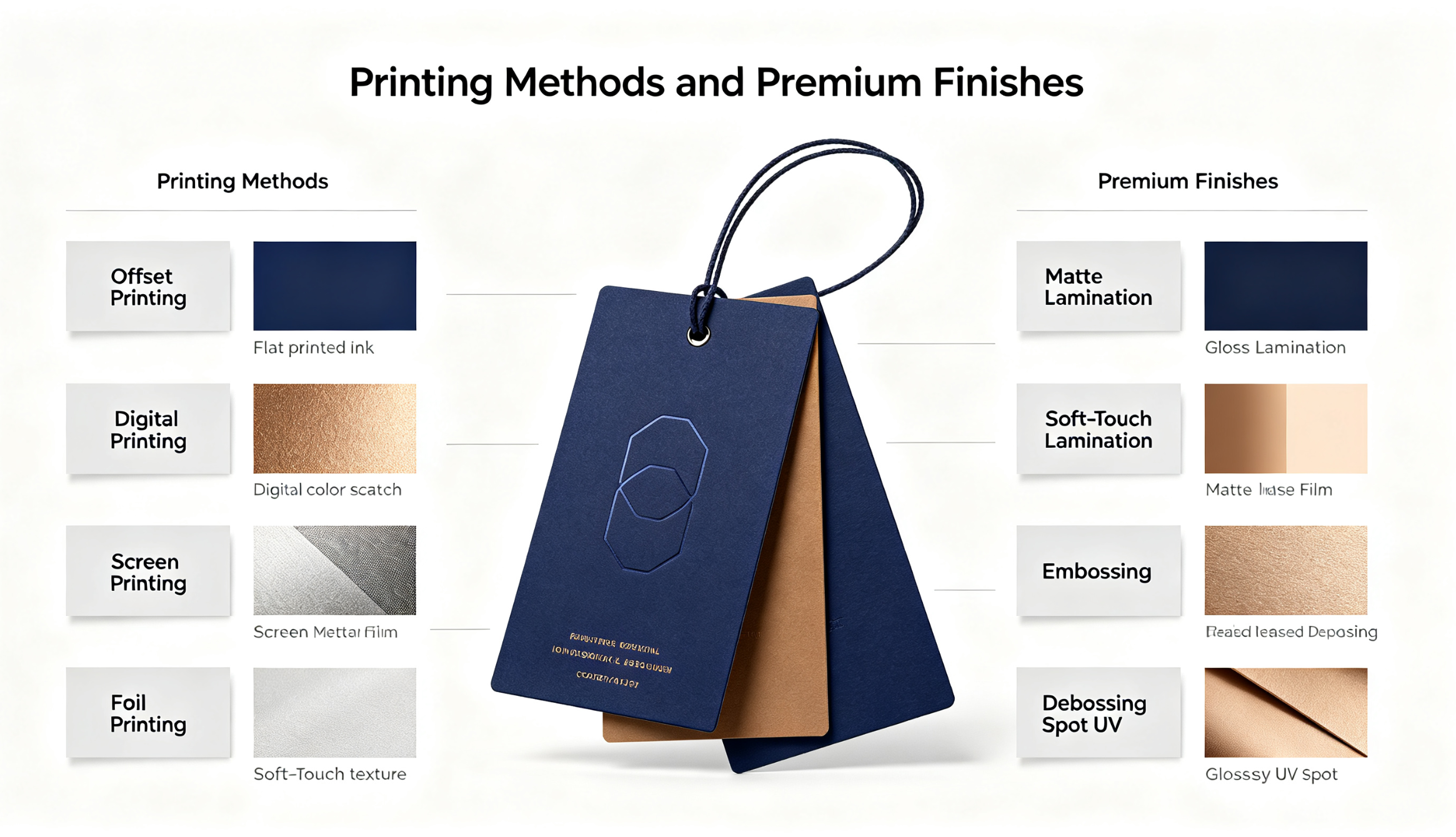
Printing Methods and Premium Finishes
The design file is only one part of a successful result. The print method and post-press finishing affect color consistency, readability, texture, and cost.
Common printing options for custom hang tags
| Production option |
Best for |
Considerations |
| Digital printing |
Shorter runs, variable data, fast sampling, multiple designs |
Efficient for flexibility; color should be checked against approved proof expectations |
| Offset printing |
Larger-volume runs and consistent brand-color reproduction |
Strong option for premium quality and scale |
| CMYK printing |
Full-color images and complex artwork |
Best for photographic or multi-color graphics |
| Pantone/spot-color printing |
Strict brand-color control |
Useful where logo color consistency is crucial |
| Variable-data printing |
Different SKUs, barcodes, serial numbers, or price data |
Requires disciplined file and data management |
Finishes that add perceived value
- Matte lamination: Smooth, restrained, premium appearance
- Gloss lamination: Brighter surface and added protection
- Soft-touch lamination: Velvet-like tactile feel for premium products
- Foil stamping: Metallic accents for logos, borders, or collection names
- Embossing: Raised elements that customers can feel
- Debossing: Recessed texture with a subtle luxury effect
- Spot UV: High-gloss emphasis on selected areas
- Die-cutting: Custom external shapes or internal cut-outs
- Rounded corners: Softer, safer look and reduced corner wear
- Eyelets/grommets: Reinforce holes for heavier products or repeated handling
XingKun's hang tag production capabilities include digital printing, die-cutting, foil stamping, embossing, and debossing. These options can be combined, but the design should be built around the end use. For instance, an intricate die-cut may be visually striking but may not suit a high-speed tagging process or a very small tag size. [xkdisplay]
How to Design Custom Product Hang Tags That Convert
A beautiful tag is not automatically an effective tag. The best custom product hang tag design guides the reader through information in the right order.
Start with a message hierarchy
Before selecting colors or finishes, decide what the buyer should notice first, second, and third.
A practical hierarchy is:
1. Brand recognition: Logo, brand name, signature color, or visual style
2. Product identification: Product name, collection, model, size, or variant
3. Primary reason to buy: One strong, specific benefit or short message
4. Operational information: Barcode, SKU, price, origin, compliance details
5. Next action: QR code, website, social account, warranty registration, or care page
Use the front and back strategically
The front is not a storage area for every fact. Keep it focused.
Front-side example for a premium organic cotton T-shirt:
> Brand logo
> Essential Cotton Tee
> 100% Cotton
> Everyday softness. Built for repeat wear.
Back-side example:
> Size: M
> Style: CT-2026-08
> Scan for care and product story
> Barcode
> Country of origin
> Brand website
This structure works because it separates the emotional purchase message from operational information.
Make text readable at real-life distance
Avoid judging a hang tag only at 200% zoom on a computer screen. Print it at actual size and ask:
- Can the customer read the smallest text comfortably?
- Does the QR code scan on different phones?
- Is the barcode sufficiently sharp and contrasted?
- Are icons understandable without relying on color alone?
- Is the hole safely positioned away from important text?
- Does the string cover any key information when the tag hangs naturally?
A tag should remain usable under normal retail conditions: handling, friction, transport, stacking, and imperfect attachment placement.
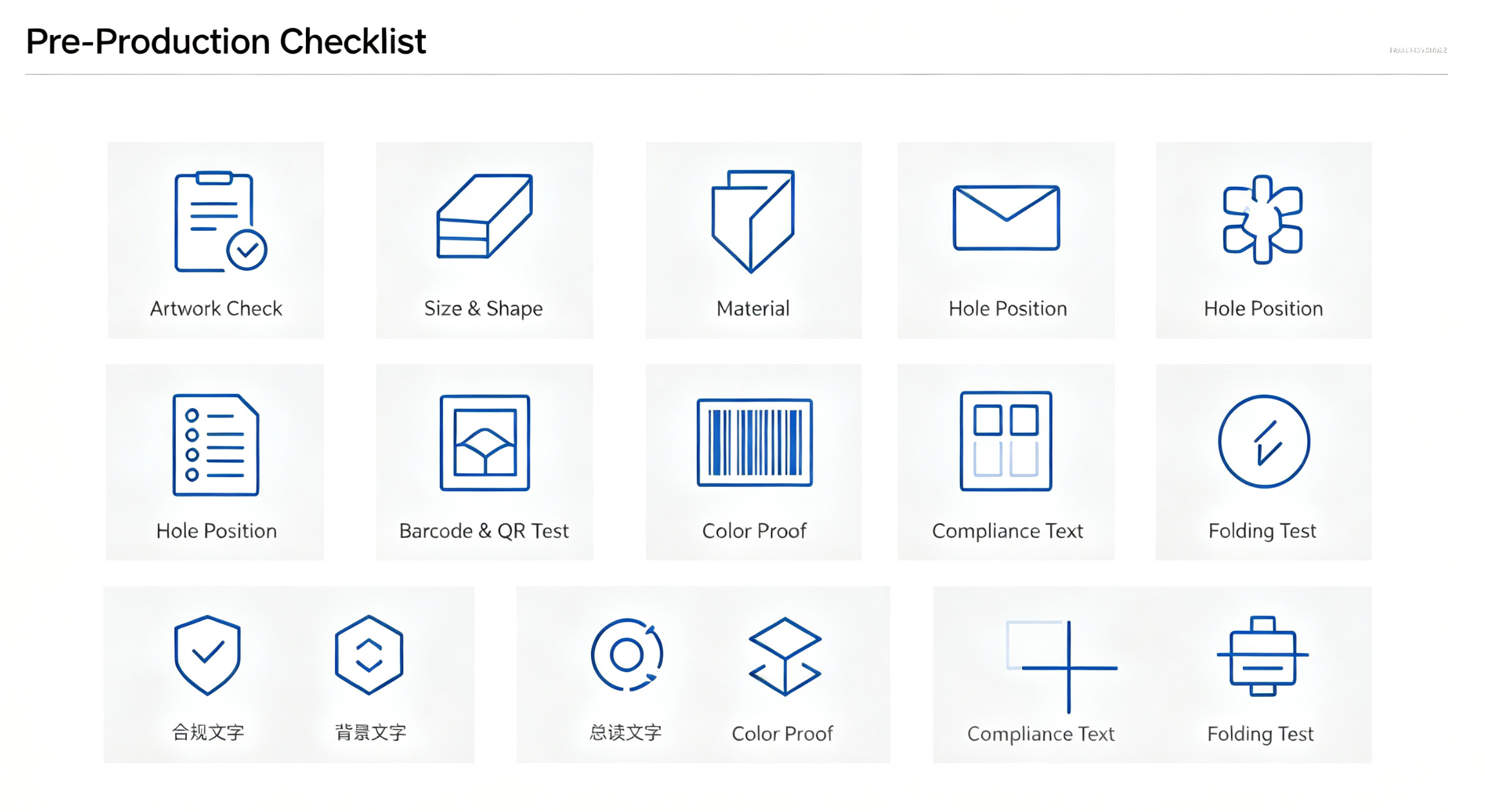
A Professional Pre-Production Checklist
Before submitting artwork for custom printed hang tags, align the brand, buying, and production teams on the details below.
1. Confirm product and market requirements
- Product category and use environment
- Destination country or region
- Mandatory labeling or warning information
- Required languages
- Retailer barcode or packaging requirements
- Whether a permanent label is also required
For EU textile products, Regulation (EU) No 1007/2011 requires fibre composition to be labelled or marked using fibre names and percentages by weight in descending order. In the United States, textile-label requirements also cover information such as fiber content, country of origin, and the responsible business; care instructions are generally required for covered garments. [ftc]
2. Define the physical specification
- Final width and height
- One-sided, two-sided, or folded format
- Paper type and target thickness
- Hole diameter and location
- Rounded corners, custom die-cut, or internal cut-out
- String, ribbon, elastic cord, pin, or plastic fastener
- Special finish requirements
- Quantity per SKU and total order quantity
3. Prepare production-ready artwork
- Use vector logos and graphics where possible
- Convert or outline fonts as appropriate for the production workflow
- Set images at suitable print resolution
- Include bleed around trim edges
- Keep critical text inside the safe area
- Clearly identify spot colors or Pantone references if required
- Supply barcode artwork according to retailer or barcode-provider requirements
- Include a QR destination that will remain live after launch
4. Approve a proof before bulk production
Proofing is a quality-control step, not a formality. Check:
- Spelling, grammar, and translated content
- Product codes and size details
- Barcode digits and scan quality
- Brand color accuracy
- Material appearance
- Finish placement
- Hole position
- Fold orientation, if applicable
- Legal and environmental claims
At XingKun, the standard custom hang tag workflow includes concept development, material selection, proofing, printing, finishing, and preparation for delivery. Proof approval before production helps reduce the risk of expensive rework. [xkdisplay]
Common Custom Hang Tag Mistakes to Avoid
Using generic marketing language
Words such as "premium," "sustainable," and "high quality" are not persuasive by themselves. Replace them with verifiable details.
Instead of:
> Premium quality materials.
Use:
> Printed on thick uncoated cardstock with a matte protective finish.
Instead of:
> Eco-friendly packaging.
Use:
> Printed on recycled-content paper, subject to confirmed material documentation and approved claim language.
Adding too much information
When everything is important, nothing is easy to find. Keep the front focused and move detailed instructions into a folded format, product insert, packaging box, or digital QR destination.
Forgetting the attachment method
A 2 mm hole may work for a thin string but not for a wide ribbon. A heavy tag can bend a delicate garment. A sharp metal fastener may not suit a children's item. Attachment is part of the product experience.
Ignoring compliance until the final artwork stage
Do not wait until after design approval to identify required disclosures. Compliance content affects tag size, layout, languages, and sometimes whether information belongs on a removable tag or permanent label.
Treating the sample as optional
A physical sample reveals issues that an on-screen file cannot: actual color, board stiffness, foil registration, cord quality, edge cleanliness, folding behavior, and scan performance.
Expert Insight: Build a Modular Hang Tag System
For brands with multiple SKUs, seasonal releases, or international markets, a modular tag system is often more efficient than designing every tag from zero.
Create fixed and variable elements.
| Fixed elements |
Variable elements |
| Logo placement |
Product name |
| Typography rules |
Size and color |
| Tag dimensions |
Barcode and SKU |
| Brand color palette |
Price |
| Hole location |
Collection message |
| QR-code style rules |
Country-specific content |
| Core material and finish |
Language or compliance information |
This approach improves brand consistency, speeds up artwork preparation, and reduces proofing errors. It is particularly useful for wholesalers and manufacturers managing many product variants.
For example, a footwear brand may use one 55 × 90 mm tag template with a consistent front layout. The back uses a controlled variable-data field for size, color, model number, barcode, and local-market information. The result looks cohesive while remaining operationally practical.
Why Work With XingKun for Custom Product Hang Tags?
Choosing a hang tag supplier is not only about finding the lowest unit price. The right manufacturer should understand printing limitations, material behavior, finishing tolerances, export communication, and the relationship between the tag and the larger packaging system.
XingKun supports global buyers with custom packaging and printed-product manufacturing, including:
- Custom product hang tags
- Clothing and garment hang tags
- Die-cut hang tags
- Circle, rectangular, folded, and specialty tag formats
- Custom packaging boxes
- Product stickers and labels
- Printed books and inserts
- Playing cards and jigsaw puzzle packaging
- OEM and ODM packaging development
Our hang tag service supports customization across material, shape, size, print method, and finishing details. Available material directions include standard paper, recycled paper, kraft paper, and plastic options; production techniques include digital printing, die-cutting, foil stamping, embossing, and debossing. [xkdisplay]
Most importantly, we encourage buyers to discuss the full use case early: product weight, attachment method, market, retail channel, compliance needs, desired finish, order quantity, and delivery schedule. This prevents a common sourcing problem—receiving a tag that looks good as a flat sample but does not perform well on the final product.
> Need custom product hang tags for apparel, accessories, retail goods, gifts, or packaged products? Send XingKun your artwork, quantity, target size, material preference, and finishing requirements to begin a tailored OEM/ODM quotation. [Contact XingKun's custom hang tag team].
Conclusion
Custom product hang tags are small, but they have a large influence on product presentation, retail usability, and brand credibility. The most effective tags do not rely on decoration alone. They combine clear information hierarchy, suitable materials, accurate print execution, practical attachment, verified claims, and market-aware compliance planning.
Whether you are launching an apparel collection, building a gift brand, preparing retail-ready accessories, or upgrading product packaging for wholesale distribution, treat the hang tag as a deliberate part of your customer experience. A carefully specified tag can reinforce quality before the customer even opens the package.
For brands sourcing from China, XingKun can help transform a concept into production-ready custom printed hang tags designed around your product, branding, and supply-chain requirements.
FAQ
1. What information should be included on custom product hang tags?
At minimum, include the brand name, product name, and the details customers or retailers need to identify the item. Depending on the category and market, this may include size, material, SKU, barcode, price, country of origin, care information, warnings, QR code, and contact details. Keep the most important purchase message on the front and move operational content to the back or inside a folded tag.
2. What is the best paper thickness for custom hang tags?
There is no universal best thickness. A standard 300 gsm cardstock is a practical starting point for many retail tags because it provides a solid feel while remaining easy to print, die-cut, and attach. Luxury products may require thicker specialty board, while lightweight goods may use lower-weight stock. The final choice should consider tag size, finish, hole reinforcement, attachment method, and product weight. XingKun lists 300 gsm standard paper among its hang tag material options. [xkdisplay]
3. Can custom product hang tags include QR codes?
Yes. QR codes can direct customers to product instructions, care pages, authentication, product registration, videos, sustainability documentation, or brand campaigns. Test the printed QR code on multiple phone models and ensure the linked page is mobile-friendly. GS1 Digital Link offers a standardized approach for connecting product identifiers in 2D barcodes with digital product information. [gs1]
4. Are hang tags legally required for clothing products?
Requirements depend on the destination market and the type of information involved. In the United States, most textile and wool products must disclose fiber content, country of origin, and a responsible business, while covered garments also require care instructions. However, a removable hang tag may not replace any required permanent label. Always verify current legal and retailer requirements with qualified compliance professionals before printing. [ftc]
5. Can I use recycled paper or FSC paper for hang tags?
Yes, subject to material availability and correct claim management. Recycled-content claims should be supported by evidence of recycled material, and FSC claims require appropriate supply-chain certification and approved claim use. Avoid generic green claims unless your documentation and marketing language support them. [pierceatwood]
6. What finishes make a hang tag look more premium?
Popular premium options include matte or soft-touch lamination, foil stamping, embossing, debossing, spot UV, thick textured paper, custom die-cut shapes, and reinforced eyelets. The right choice depends on your brand position. A luxury brand may use foil and embossing, while a natural brand may gain more value from uncoated recycled paper and a simple blind-debossed logo.
7. What should I send a custom hang tag manufacturer for a quotation?
Send the final or draft artwork, dimensions, material preference, paper thickness, printing colors, one- or two-sided format, fold details, special finishes, hole size and location, attachment method, quantity, number of SKU versions, destination country, and required delivery date. If you do not have a finished design, provide your logo, brand guidelines, product details, and design direction so the manufacturer can advise on a suitable specification.
References
1. XingKun — Design Hang Tags Manufacturer in China. Product-page information on available hang tag types, material options, production workflow, customization, and printing/finishing technologies. [https://www.xkdisplay.com/design-hang-tags.html] [xkdisplay]
2. U.S. Federal Trade Commission — Threading Your Way Through the Labeling Requirements Under the Textile and Wool Acts. Guidance on U.S. labeling disclosures for most textile and wool products, including fiber content, country of origin, and responsible company identification. [https://www.ftc.gov/business-guidance/resources/threading-your-way-through-labeling-requirements-under-textile-wool-acts] [ftc]
3. U.S. Federal Trade Commission — Clothes Captioning: Complying with the Care Labeling Rule. FTC guidance stating that manufacturers and importers must attach care instructions to covered garments. [https://www.ftc.gov/business-guidance/resources/clothes-captioning-complying-care-labeling-rule] [ftc]
4. European Union — Regulation (EU) No 1007/2011 on textile fibre names and related labelling. Official EU regulation addressing textile fibre composition labelling and the use of fibre names and percentages by weight. [https://eur-lex.europa.eu/eli/reg/2011/1007/oj/eng] [eur-lex.europa]
5. GS1 — GS1 Digital Link. Official overview of a standardized method for encoding product identifiers in 2D barcodes and linking them to digital product information, traceability data, certifications, and instructions. [https://www.gs1.org/standards/gs1-digital-link] [gs1]
6. Forest Stewardship Council concepts — FSC Chain of Custody overview. Explanation of traceability through the supply chain for FSC-certified forest-based materials and finished packaging claims. [https://www.groundedpackaging.co/blog/fsc-certification-explained-what-it-means-for-paper-packaging] [groundedpackaging]
7. FTC Green Guides discussion — Recycled-content claim substantiation. Overview of the need for marketers to support recycled-content claims with evidence that materials were recovered or diverted from the waste stream. [https://www.pierceatwood.com/alerts/earth-day-reminder-are-your-environmental-advertising-claims-compliant-ftcs-green-guides] [pierceatwood]


