Content Menu
● Quick Comparison: Magnetic vs Adhesive Name Plates
● What Are Magnetic Name Plates?
>> Best Uses for Magnetic Name Plates
>> Key Advantages of Magnetic Name Plates
>> Limitations of Magnetic Name Plates
● What Are Adhesive Name Plates?
>> Best Uses for Adhesive Name Plates
>> Key Advantages of Adhesive Name Plates
>> Limitations of Adhesive Name Plates
● Magnetic Name Plates vs Adhesive Name Plates: Detailed Comparison
>> 1. Surface Compatibility
>> 2. Reusability and Information Changes
>> 3. Holding Strength and Security
>> 4. Installation and Replacement
>> 5. Outdoor and Industrial Performance
>> 6. Cost Considerations
● How to Choose the Right Name Plate
>> Step 1: Identify the Mounting Surface
>> Step 2: Define the Required Service Life
>> Step 3: Review Environmental Exposure
>> Step 4: Determine Whether the Information Changes
>> Step 5: Test Before Mass Production
● Expert Recommendation by Application
● Why Material Matching Matters More Than Design Alone
● Custom Name Plate Options from XingKun
● Final Verdict
● FAQ
>> 1. Can magnetic name plates stick to stainless steel?
>> 2. Are adhesive name plates permanent?
>> 3. Can magnetic name plates be used outdoors?
>> 4. What is the best material for industrial adhesive name plates?
>> 5. Do adhesive name plates leave residue after removal?
>> 6. Which is better for warehouse organization: magnetic or adhesive name plates?
>> 7. Can adhesive name plates include barcodes and QR codes?
>> 8. How do I prevent adhesive name plates from peeling?
● References
Choosing between magnetic name plates and adhesive name plates is not simply a question of appearance or unit price. The right option depends on the mounting surface, how often the information changes, environmental exposure, required service life, brand presentation, and whether the identification must remain permanently attached.
At Shenzhen XingKun Packing Products Co., Ltd., we have spent more than 20 years producing custom stickers, labels, name plates, packaging, and printed products for brands and distributors in more than 30 countries and regions. From practical production experience, the key question is this: Do you need a name plate that can be moved, or one that must stay in place for years?
Magnetic name plates provide fast repositioning on compatible metal surfaces. Adhesive name plates provide stronger, more permanent identification on a much wider range of materials. This guide compares both options in detail, helping purchasing teams, product managers, facility operators, and distributors choose the most suitable custom name plate solution.
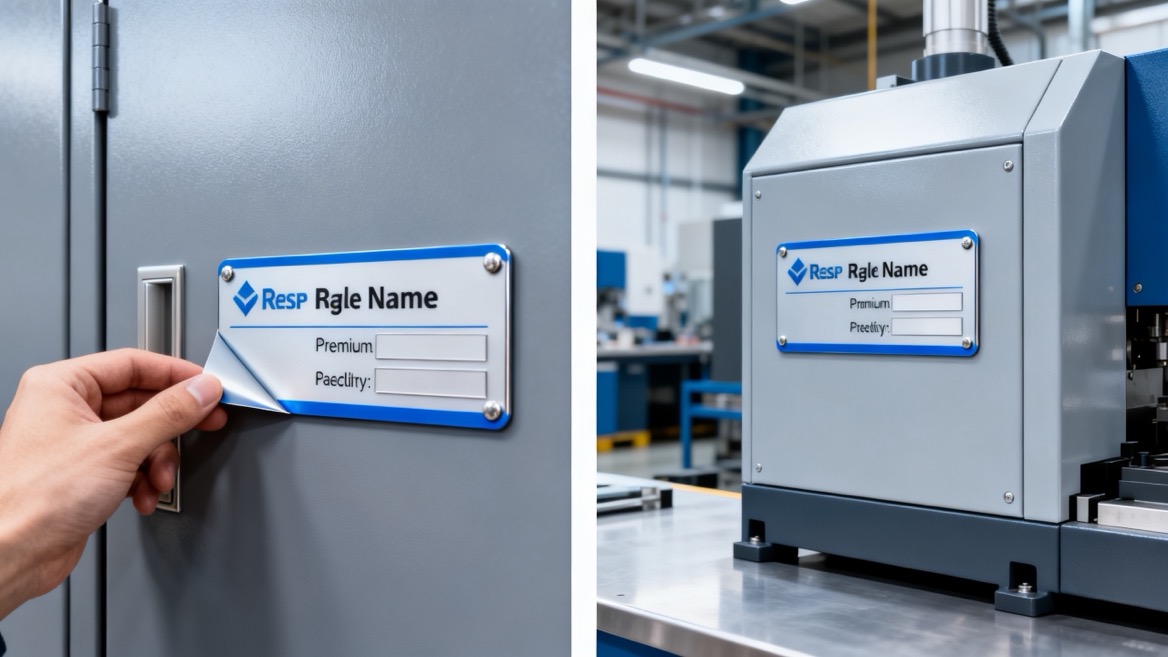
Quick Comparison: Magnetic vs Adhesive Name Plates
| Feature | Magnetic Name Plates | Adhesive Name Plates |
| Attachment method | Magnetic attraction to ferrous metal | Pressure-sensitive, heat-activated, or specialty adhesive |
| Reusability | High | Usually low; generally designed for one-time application |
| Repositioning | Easy | Limited after application |
| Suitable surfaces | Steel, iron, and other magnetic metal surfaces | Metal, plastic, glass, painted surfaces, cartons, wood, and more |
| Permanent identification | Not ideal | Excellent when the correct adhesive is selected |
| Installation speed | Very fast | Fast, but surface preparation is important |
| Resistance to vibration | Moderate to low, depending on magnet strength | High with an appropriate adhesive system |
| Outdoor use | Possible with suitable materials, but wind and surface conditions matter | Possible with weather-resistant face stock, ink, laminate, and adhesive |
| Information changes | Ideal for frequent updates | Better for fixed information |
| Typical uses | Warehouse shelving, office doors, production boards, vehicle signage | Product labels, equipment identification, warning labels, asset tags, branded packaging |
Simple decision rule: choose magnetic name plates for flexible, temporary, and reusable identification on metal surfaces. Choose adhesive name plates for durable, secure, and versatile identification across products, packaging, machinery, and industrial environments.
What Are Magnetic Name Plates?
Magnetic name plates are printed or engraved identification plates with a flexible magnetic backing. They attach to ferrous metal surfaces without screws, glue, drilling, or permanent alteration of the surface.
A common construction includes a printed PVC, paperboard, PET, acrylic, or laminated face material combined with flexible magnetic sheeting. Flexible magnetic materials are available in different thicknesses, often ranging from approximately 0.18 mm to 1.52 mm, depending on the required flexibility and holding strength.
Best Uses for Magnetic Name Plates
Magnetic name plates work well when the displayed information changes often or when users need to move identifiers between locations.
Typical applications include:
- Employee name plates for office doors and lockers
- Warehouse shelf labels and inventory location markers
- Production scheduling boards
- Machine-status tags, such as "Under Maintenance" or "Quality Hold"
- Reusable rack identification
- Metal cabinet labels
- Short-term promotional signs
- Fleet and vehicle graphics for temporary campaigns
- Classroom, hospital, laboratory, and conference-room identification
For example, a manufacturing plant may use color-coded magnetic name plates to show the status of workstations. A green magnetic plate can indicate "Ready," yellow can mean "Waiting for Inspection," and red can signal "Maintenance Required." Workers can update the board immediately without removing old adhesive residue or ordering new labels every time the production schedule changes.
Key Advantages of Magnetic Name Plates
Reusable and movable. A magnetic plate can be lifted, repositioned, stored, and reused when operational information changes.
No adhesive residue. This is valuable for rented facilities, leased machinery, office furniture, display cabinets, and metal shelving.
Fast installation. Operators do not need to measure, peel liners, or wait for adhesive bonding. They simply place the plate on a clean magnetic surface.
Low commitment for changing data. Magnetic name plates are ideal for shift assignments, temporary instructions, job locations, employee names, or inventory categories.
Professional appearance. Custom printing, lamination, rounded corners, die-cut shapes, and color coding can make reusable magnetic plates look organized and premium.
Limitations of Magnetic Name Plates
Magnetic name plates are not a universal solution. Their primary limitation is obvious but often overlooked: they only work on magnetic surfaces.
Stainless steel, aluminum, plastic, glass, wood, and many coated surfaces may not attract magnets. Even some steel surfaces may have coatings, textures, curvature, or spacing conditions that reduce holding strength.
Other limitations include:
- They can shift or fall if vibration is strong.
- They are less suitable for high-speed vehicles or outdoor locations exposed to wind.
- Dirt, oil, rust, dust, and moisture may reduce contact between the magnet and the metal.
- Thinner magnetic materials may curl at corners or provide lower holding force.
- Frequent removal can scratch delicate painted surfaces if grit becomes trapped underneath.
- They are not the preferred choice for permanent safety warnings or legally required product information.
For demanding industrial conditions, flexible magnetic material thickness, magnetic energy, surface contact area, and lamination should be evaluated before production. Higher-energy flexible magnetic sheeting is available for applications requiring stronger holding force.

What Are Adhesive Name Plates?
Adhesive name plates are identification products that use an adhesive layer to bond to a surface. They may be produced from paper, vinyl, PET, PP, PVC, polyester, aluminum foil, acrylic, or other specialty materials.
The adhesive may be permanent, removable, high-tack, low-tack, freezer-grade, heat-resistant, chemical-resistant, or designed specifically for difficult substrates. Pressure-sensitive adhesives are especially common because they activate when sufficient pressure is applied during installation.
Unlike magnetic products, adhesive name plates can be applied to a much wider variety of surfaces. This flexibility makes them a standard solution for product identification, packaging, asset tracking, equipment marking, warning labels, and branded retail applications.
Best Uses for Adhesive Name Plates
Adhesive name plates are usually the better choice when information must remain fixed, legible, and securely attached.
Common applications include:
- Equipment model and serial-number labels
- Product identification labels
- Warning and safety labels
- Electrical and appliance markings
- Asset tags
- Barcode labels
- Industrial machinery labels
- Cosmetic, food, and beverage packaging labels
- Consumer electronics labels
- Medical-device identification labels
- Logistics and shipping labels
- Promotional stickers and branded decals
For a manufacturer selling equipment internationally, an adhesive name plate may carry the product model, serial number, voltage, production batch, warning information, and distributor contact details. In this case, the label needs strong adhesion and long-term readability. A reusable magnetic label would create an unnecessary risk because critical product information could be removed, lost, or placed on the wrong unit.
Key Advantages of Adhesive Name Plates
Broad surface compatibility. Adhesive name plates can be engineered for metal, plastic, glass, cardboard, painted surfaces, powder-coated equipment, and many other substrates.
Strong long-term attachment. With a properly matched adhesive, the name plate can remain securely bonded during normal use, transport, temperature changes, handling, and cleaning.
More material choices. Buyers can select clear films, metallic finishes, textured paper, waterproof vinyl, polyester, tamper-evident materials, holographic films, and many other constructions.
Better for compliance-oriented marking. Permanent product labels often need to remain legible and attached throughout the intended life of the product. UL's marking and labeling program covers labels, nameplates, markers, label materials, and related products evaluated for permanence-of-marking performance requirements.
Higher design flexibility. Adhesive name plates can be printed in complex shapes, small sizes, transparent formats, metallic finishes, serialized versions, QR codes, and variable-data formats.
Limitations of Adhesive Name Plates
The biggest challenge with adhesive name plates is that their performance depends on the complete label system, not just the sticker material.
A good-looking label can fail if:
- The surface is oily, dusty, wet, or contaminated.
- The adhesive is not designed for the substrate.
- Application takes place below the recommended temperature.
- The product surface is rough, curved, textured, or low-energy plastic.
- The label is exposed to chemicals, UV light, abrasion, heat, moisture, or freezer conditions beyond its design limits.
- The operator applies insufficient pressure during installation.
- The label is repositioned after initial application.
For permanent product identification, face stock, ink, printing method, laminate, adhesive, substrate, and real operating conditions should be evaluated together. This system-based approach is especially important for safety-related labels and nameplates.
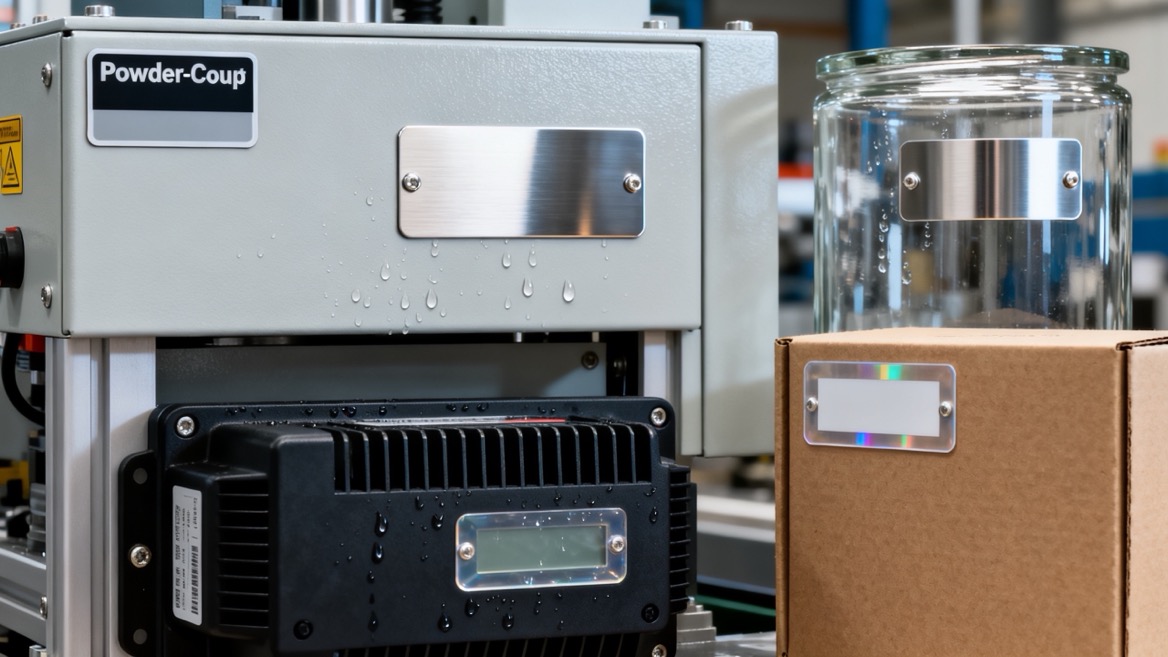
Magnetic Name Plates vs Adhesive Name Plates: Detailed Comparison
1. Surface Compatibility
Magnetic name plates require ferrous metal. This normally includes iron and many steel surfaces, but not aluminum, copper, brass, wood, plastic, glass, or most non-magnetic stainless-steel grades.
Adhesive name plates are more versatile. They can work on almost any surface if the correct adhesive is selected and the surface is properly prepared.
Winner: Adhesive name plates.
If your application involves mixed materials, including plastic housings, painted equipment, cartons, glass bottles, or aluminum products, adhesive name plates are usually the more reliable choice.
2. Reusability and Information Changes
Magnetic name plates are designed for repeated removal and reuse. They are ideal where names, locations, production status, work orders, or inventory categories change frequently.
Adhesive name plates are normally intended for long-term use. Although removable adhesives exist, most adhesive name plates should not be treated as reusable. Once removed, they may stretch, curl, lose adhesive strength, or leave residue.
Winner: Magnetic name plates.
Use magnets when the label's value comes from flexibility. Use adhesive when the label's value comes from permanence.
3. Holding Strength and Security
Adhesive name plates can offer excellent bond strength when the adhesive matches the surface and environment. They are generally more secure than magnets under vibration, impact, frequent handling, outdoor exposure, and transport.
Magnetic name plates can be sufficiently strong for indoor boards, cabinets, shelves, and machine panels. However, their strength varies according to magnet thickness, material formulation, contact area, surface cleanliness, and the weight of the printed plate.
Winner: Adhesive name plates.
For equipment labels, warning labels, serial-number labels, or product labels that cannot be allowed to detach, adhesive options are normally more appropriate.
4. Installation and Replacement
Magnetic name plates are the fastest to install and replace. There is no liner to peel and no permanent bond to manage.
Adhesive name plates require more discipline. The installer should clean the surface, align the label carefully, apply firm pressure, and allow the bond to develop as required by the adhesive specification.
Winner: Magnetic name plates for speed; adhesive name plates for permanent placement.
5. Outdoor and Industrial Performance
Both options can be used in demanding settings, but they behave differently.
A laminated magnetic name plate may perform well indoors or in protected outdoor applications. However, wind, heat, moisture, vehicle speed, curved surfaces, and vibration create risks.
A properly engineered adhesive name plate can be designed for outdoor exposure, chemicals, water, UV, abrasion, and temperature variation. Polyester-based label materials, for instance, are commonly selected for durable industrial identification applications. Some UL-compliant polyester constructions are specified for service temperatures from -40°F to 302°F, though exact capability depends on the complete material system and application conditions.
Winner: Adhesive name plates.
6. Cost Considerations
The lowest unit cost is not always the true cost.
Magnetic name plates may cost more per piece because they include magnetic material. However, they can reduce replacement costs when the same plate is reused many times.
Adhesive name plates may offer a lower unit cost for high-volume product labeling. They are usually more economical when information remains unchanged and labels are applied once during manufacturing or packaging.
Consider these questions:
- How often will the information change?
- How many times will each name plate be reused?
- What does label failure cost in labor, rework, product returns, or safety risk?
- Is surface cleaning required before application?
- Will the label be exposed to heat, water, oil, abrasion, or chemicals?
- Does removal damage the product or leave residue?
Best value depends on the use case, not only the purchase price.
How to Choose the Right Name Plate
Use this practical five-step selection process before requesting a quotation.
Step 1: Identify the Mounting Surface
Ask whether the surface is steel, aluminum, plastic, glass, cardboard, painted metal, powder-coated metal, or another material.
If it is not magnetic metal, magnetic name plates are immediately ruled out.
Step 2: Define the Required Service Life
Will the name plate be used for one day, one month, one year, or the entire life of the product?
For short-term, changeable identification, select magnetic name plates. For permanent product information, select adhesive name plates.
Step 3: Review Environmental Exposure
Consider:
- Indoor or outdoor use
- Heat and cold
- Humidity and water
- Oil, solvents, cleaners, and chemicals
- UV exposure
- Vibration and impact
- Abrasion and frequent touching
- Curved or textured surfaces
The more demanding the environment, the more important it becomes to specify the complete adhesive-label construction rather than selecting only by material appearance.
Step 4: Determine Whether the Information Changes
Use magnetic name plates if names, assignments, production status, prices, inventory locations, or work instructions change frequently.
Use adhesive name plates for fixed data such as part numbers, serial numbers, warning messages, product specifications, barcodes, and regulatory information.
Step 5: Test Before Mass Production
For industrial, export, or compliance-sensitive applications, request samples and test them on the actual product surface.
A useful test plan may include:
1. Apply samples to real production surfaces.
2. Test application at the expected installation temperature.
3. Check adhesion after 24 hours, 72 hours, and one week.
4. Expose samples to cleaning agents, moisture, heat, cold, and handling where relevant.
5. Inspect printing clarity, edge lifting, curling, color change, and residue after removal.
6. Confirm that barcodes, QR codes, serial numbers, and small text remain readable.
This small validation step can prevent expensive label failure after thousands of units have been shipped.
Expert Recommendation by Application
11111
Why Material Matching Matters More Than Design Alone
A name plate can look premium on the day it is applied and still fail in real use. This is why experienced suppliers ask technical questions before recommending material.
For adhesive name plates, material selection should consider:
- Surface energy and texture
- Paint type or coating
- Application temperature
- Long-term service temperature
- Exposure to oil, alcohol, detergent, solvents, or salt
- Indoor versus outdoor use
- Required print durability
- Desired removal behavior
- Label size and shape
- Required compliance or documentation
For magnetic name plates, selection should consider:
- Whether the target surface is truly magnetic
- Magnet thickness and holding force
- Size and total weight of the plate
- Surface flatness and curvature
- Vibration level
- Risk of wind exposure
- Need for a protective laminate
- Frequency of removal and cleaning
For safety-related or permanent equipment labels, recognized marking and labeling systems are tested for adhesion, legibility, and resistance under defined conditions. This illustrates an important procurement principle: a name plate should be selected as a performance system, not merely as a printed item.
Custom Name Plate Options from XingKun
Shenzhen XingKun Packing Products Co., Ltd. supports customized stickers, labels, packaging products, and printed materials for international brands and distributors. With more than two decades of manufacturing experience, we understand that buyers need more than attractive printing. They need products that fit real application conditions.
Our custom name plate options can include:
- Magnetic name plates in custom sizes and shapes
- Adhesive name plates with permanent or removable adhesive
- Waterproof and oil-resistant label materials
- Matte, gloss, soft-touch, and laminated finishes
- Variable-data printing for serial numbers and barcodes
- QR codes and batch-code labeling
- Die-cut labels and custom-shaped name plates
- Transparent, white, metallic, and specialty materials
- Small-batch sampling before larger production runs
- Custom packaging for distributors, brands, and promotional programs
When requesting a quote, provide your target surface, product photos, size, quantity, artwork format, expected environment, and whether the name plate must be removable or permanent. This information helps us recommend a more reliable construction from the beginning.
Final Verdict
Choose magnetic name plates when you need reusable, movable, and fast-to-update identification on flat magnetic metal surfaces. They are highly effective for warehouse systems, office identification, production boards, metal cabinets, and short-term visual management.
Choose adhesive name plates when you need secure, durable, and permanent identification across a wide range of surfaces. They are the stronger option for products, machinery, asset tracking, safety information, branded packaging, barcodes, and outdoor or industrial applications.
The best choice is not about which product is universally better. It is about matching the name plate to the surface, environment, expected lifespan, and operational purpose.
Need custom magnetic name plates or adhesive name plates for your products, warehouse, machinery, packaging, or brand program? Contact Shenzhen XingKun Packing Products Co., Ltd. with your application requirements and artwork to receive tailored material recommendations, samples, and a competitive quotation.
FAQ
1. Can magnetic name plates stick to stainless steel?
Not always. Some stainless-steel grades are magnetic, while many are not. Test the actual surface before ordering. Magnetic name plates will not reliably attach to aluminum, plastic, glass, wood, or non-magnetic stainless steel.
2. Are adhesive name plates permanent?
They can be. Permanent adhesive name plates are designed to remain attached for long-term use, but real performance depends on the adhesive, surface condition, temperature, exposure, and installation method. For critical applications, test samples on the actual substrate.
3. Can magnetic name plates be used outdoors?
Yes, but carefully. Outdoor use requires adequate magnetic holding strength, a suitable protective finish, and protection from wind, vibration, moisture, and extreme temperature. Adhesive name plates are generally the safer choice for long-term outdoor identification.
4. What is the best material for industrial adhesive name plates?
Polyester, vinyl, aluminum, and specialty engineered materials are common choices. Polyester is frequently used for durable industrial labels because it can provide good print durability and resistance when paired with an appropriate adhesive and protective construction.
5. Do adhesive name plates leave residue after removal?
They may. Permanent adhesives can leave residue or damage certain surfaces when removed. If clean removal is important, specify a removable adhesive and test it on the actual surface before production.
6. Which is better for warehouse organization: magnetic or adhesive name plates?
Magnetic name plates are usually better for warehouse shelving and boards because locations, stock categories, and workflows often change. Adhesive name plates are better for fixed asset identification, permanent rack numbering, or safety markings.
7. Can adhesive name plates include barcodes and QR codes?
Yes. Adhesive name plates can include barcodes, QR codes, serial numbers, batch numbers, logos, warning symbols, and variable data. For scanning applications, ensure sufficient contrast, suitable code size, and a surface finish that does not interfere with readability.
8. How do I prevent adhesive name plates from peeling?
Clean the application surface thoroughly, choose an adhesive compatible with the substrate, apply within the recommended temperature range, use firm pressure, and allow adequate bonding time. For harsh environments, use materials designed for moisture, chemicals, UV exposure, or temperature extremes.
References
1. [UL Solutions — Marking and Labeling Systems Program]
2. [ANSI Webstore — UL 969 Ed. 6-2025: Marking and Labeling Systems]
3. [Magnum Magnetics — Adhesive Laminated Magnetic Sheeting]
4. [DuraLabel — UL 969 Compliant Poly Tape]
5. [In Compliance Magazine — Marking and Labeling]
6. [Metalphoto — UL 969 Marking and Labeling Systems]


