Content Menu
● Quick Comparison: Custom Office Name Plates vs Standard Name Tags
● What Are Custom Office Name Plates?
>> Common Types of Custom Office Name Plates
● What Are Standard Name Tags?
● The Main Difference: Fixed Identification vs Portable Identification
● Custom Office Name Plates: Advantages and Limitations
>> Advantages of Custom Office Name Plates
>> Limitations of Custom Office Name Plates
● Standard Name Tags: Advantages and Limitations
>> Advantages of Standard Name Tags
>> Limitations of Standard Name Tags
● Materials: Which Option Creates the Right Impression?
● Accessibility and Readability Considerations
>> Readability Checklist for Office Name Plates
● When to Choose Custom Office Name Plates
● When to Choose Standard Name Tags
● A Smarter Hybrid System for Growing Workplaces
● How to Order Custom Office Name Plates Successfully
● Final Decision: Custom Office Name Plates or Standard Name Tags?
● Request a Custom Office Name Plate Quote
● FAQ
>> 1. What is the difference between an office name plate and a name tag?
>> 2. Are custom office name plates more expensive than standard name tags?
>> 3. What material is best for desk name plates?
>> 4. Can office name plates include a company logo?
>> 5. What is the best option for offices with frequent employee changes?
>> 6. Do permanent room signs need special accessibility features?
>> 7. Can custom office name plates be ordered with individual names?
● References
Choosing between custom office name plates and standard name tags is not simply a question of printing a person's name. It affects workplace navigation, brand consistency, employee recognition, visitor experience, replacement costs, and the flexibility of your office signage system.
For more than 20 years, Shenzhen XingKun Packing Products Co., Ltd. has produced stickers, labels, packaging, and custom printed products for brands and distributors in over 30 countries and regions. From a production perspective, the best choice depends on how long the identification will be used, where it will be displayed, how often information changes, and whether the item must support a consistent visual identity.
This guide compares custom office name plates vs standard name tags in detail, helping facilities teams, office managers, distributors, schools, clinics, co-working operators, and corporate buyers make a more practical decision.
Quick Comparison: Custom Office Name Plates vs Standard Name Tags
| Feature | Custom Office Name Plates | Standard Name Tags |
| Primary use | Fixed or semi-permanent office, desk, door, room, or department identification | Temporary or portable personal identification |
| Typical placement | Desk, office door, reception area, cubicle, meeting room, wall, counter | Clothing, lanyard, badge holder, uniform, event table |
| Customization level | High: logo, title, department, color system, QR code, variable details | Usually limited: name, company, job title, basic logo |
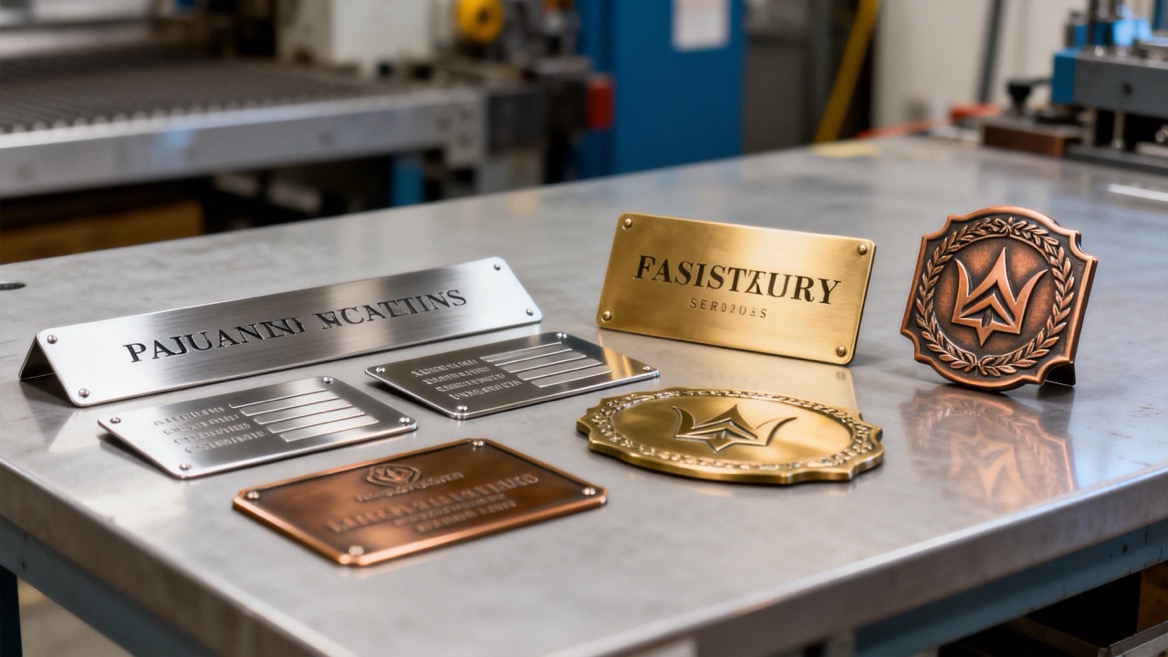
| Materials | Acrylic, aluminum, stainless steel, wood, PVC, engraved plastic, layered materials | Paper, vinyl, plastic, magnetic material, fabric, reusable inserts |
| Durability | Designed for long-term display | Often designed for short-term use or regular replacement |
| Branding impact | Strong visual contribution to workplace identity | Practical but generally lower visual impact |
| Change flexibility | Can be fixed, replaceable, or modular | Easy to replace or write by hand |
| Unit cost | Usually higher, especially for premium materials and small quantities | Usually lower, especially for large events |
| Best for | Offices, schools, clinics, hotels, government facilities, reception areas | Conferences, exhibitions, retail staff, training sessions, visitors |
In simple terms: choose custom office name plates when the information should look permanent, professional, and brand-aligned. Choose standard name tags when information changes frequently or people need to wear the identification.
What Are Custom Office Name Plates?
Custom office name plates are personalized identification signs made for a workplace environment. They are commonly installed on desks, doors, cubicles, reception counters, meeting-room entrances, lockers, or departmental areas.
A custom office name plate may include:
- Employee name
- Job title
- Department name
- Company logo
- Brand colors
- Room number
- Pronouns, professional credentials, or qualifications
- QR code or digital contact link
- Changeable name insert
- Directional arrow or room function
Unlike a disposable label, a personalized office name plate is usually treated as part of the workplace interior system. It should match the company's visual language, including typography, colors, finish, and overall tone.
For example, a law firm may prefer brushed metal desk name plates with engraved black text. A creative agency may choose layered acrylic name plates with bold colors. A medical office may need clean, easy-to-read room name plates with consistent department identifiers.
Common Types of Custom Office Name Plates
Desk name plates
These sit on desks, counters, reception tables, or workstations. They are often made with acrylic, aluminum, wood, or engraved plastic.
Door name plates
These identify private offices, meeting rooms, treatment rooms, classrooms, or departments. They can be mounted using adhesive backing, screws, standoffs, frames, or slide-in holders.
Changeable name plates
These use interchangeable inserts. They are especially useful in offices with employee turnover, hot-desking, rotating schedules, or shared rooms.
Engraved office name plates
Engraving creates a durable, permanent appearance. It works well for executive offices, professional institutions, universities, public service organizations, and long-term departmental signage.
Magnetic name plates
These are often used on metal doors, lockers, shelving, or whiteboards. They provide flexibility without leaving adhesive residue.
What Are Standard Name Tags?
Standard name tags are portable identifiers worn by people. They are common at exhibitions, corporate events, training programs, retail stores, hospitals, schools, conferences, and customer-facing workplaces.
They usually contain the wearer's name, company, role, event category, or access status. Some may also include barcodes, QR codes, photos, or security information.
Common formats include:
- Peel-and-stick paper name tags
- Printed badge inserts
- Lanyard badges
- Pin-back name tags
- Magnetic employee badges
- Reusable plastic name badges
- Vinyl name labels
- Write-on name tags
- Visitor labels
Standard name tags are practical because they can be distributed quickly. They are especially useful when attendee information changes at the last minute or when a company needs to identify visitors, contractors, trainees, or temporary staff.
However, standard name tags rarely create the same sense of permanence or workplace polish as customized office name plates.
The Main Difference: Fixed Identification vs Portable Identification
The most important difference is where the identity needs to live.
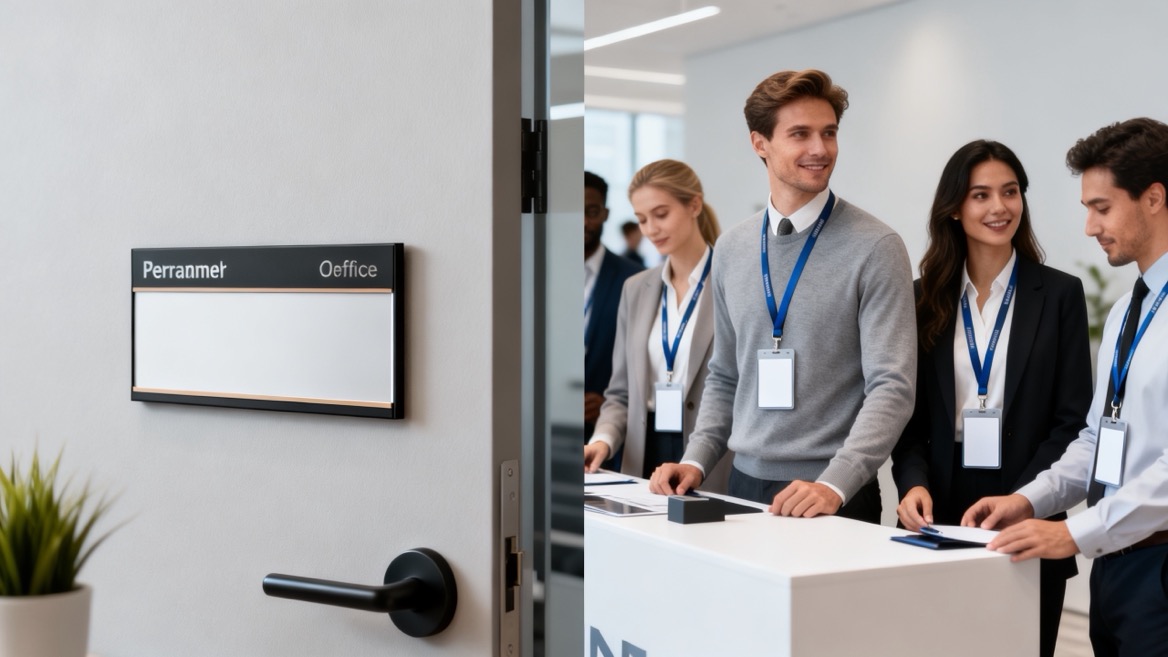
A custom office name plate identifies a place, workspace, office, or employee location. It tells people, "You have arrived at the correct desk, office, room, or department."
A standard name tag identifies a person who is moving through the space. It tells people, "This is who I am."
This distinction matters when planning an office identification system.
For example, imagine a visitor arriving at a large corporate office:
1. A door name plate helps them find "Marketing Department."
2. A room sign helps them locate "Conference Room B."
3. A desk name plate helps them identify "Emma Lee, Account Director."
4. Emma's wearable name tag helps the visitor recognize her during an event or site tour.
The strongest workplace experience often uses both products together rather than treating them as direct substitutes.
Custom Office Name Plates: Advantages and Limitations
Advantages of Custom Office Name Plates
Stronger brand presentation
A customized office name plate can become a small but visible part of your interior branding. Consistent materials, colors, logos, and typography make the office feel more organized and intentional.
This is especially important in visitor-facing spaces such as:
- Corporate headquarters
- Showrooms
- Clinics and healthcare facilities
- Hotels and hospitality offices
- Schools and universities
- Financial institutions
- Real estate offices
- Government service counters
- Shared workspaces
Long-term cost efficiency
A high-quality engraved or printed office name plate may cost more than a simple label initially. But when used for years, the cost per day can be very low. Durable materials also reduce the need for reprinting caused by peeling, fading, curling, or surface damage.
Better wayfinding
Clear room and door identification helps employees, visitors, service teams, and delivery personnel navigate a workplace. It can reduce interruptions at reception and make a large workplace easier to understand.
Industry guidance for office wayfinding recommends creating a destination inventory, standardizing location names, focusing signs at decision points, and testing the system with real users such as visitors, new employees, and facilities teams.
Premium employee recognition
Giving employees a professionally designed desk name plate can communicate belonging and role clarity. This is especially valuable for executives, customer service teams, reception staff, educators, consultants, and long-tenure employees.
More material and finishing options
Custom office name plates can be made with different visual and functional effects:
- Clear acrylic for a modern look
- Frosted acrylic for understated offices
- Brushed aluminum for a professional finish
- Stainless steel for durability
- Wood for hospitality or eco-oriented brands
- Layered plastic for contrast and tactile depth
- UV printing for full-color graphics
- Laser engraving for long-lasting text
- Domed labels for a raised, premium surface
- Removable vinyl inserts for changing information
Limitations of Custom Office Name Plates
Custom name plates require more planning than simple name tags. Buyers need to confirm dimensions, materials, mounting style, copy, logo files, color specifications, and quantity.
They may also need a replacement plan. A fixed engraved plate can become outdated when an employee changes roles, moves departments, or leaves the company. For offices with frequent personnel changes, an insert-based system is often more economical than individually engraved permanent plates.
Standard Name Tags: Advantages and Limitations
Advantages of Standard Name Tags
Fast and affordable
Standard name tags are ideal when you need hundreds or thousands of identifiers quickly. A conference organizer can print attendee labels, add names to inserts, and distribute them at registration.
Easy to update
Employee names, titles, schedules, access categories, and event details can change quickly. Standard name tags make it easier to produce updated information without replacing a wall-mounted sign system.
Suitable for temporary users
Visitors, contractors, event guests, interns, delivery partners, temporary workers, and training participants do not usually need a permanent office name plate. A printed visitor badge or adhesive name tag is often more suitable.
Useful for security and access management
Color-coded name tags can help staff distinguish among employees, visitors, vendors, media, speakers, VIP guests, and restricted-area personnel. QR codes or barcodes can also support check-in workflows when integrated with event systems.
Limitations of Standard Name Tags
Lower durability
Paper-based or adhesive name tags can tear, wrinkle, lose adhesion, or become unreadable. Even reusable plastic badges can scratch after repeated handling.
Less professional in permanent settings
A handwritten name label placed on an executive office door or reception desk may look temporary and inconsistent. This can weaken the visual quality of a professional environment.
Limited wayfinding value
A wearable name tag does not help someone locate the correct room, department, desk, or service counter. It identifies the person, not the destination.
Materials: Which Option Creates the Right Impression?
Material selection should reflect your usage period, environment, budget, and brand image.
| Material | Best for | Strengths | Watch-outs |
| Acrylic | Modern offices, reception desks, desk signs | Clean appearance, color flexibility, lightweight | Can scratch if not protected |
| Aluminum | Corporate offices, industrial workplaces | Professional look, durable, lightweight | May require specialized finishing |
| Stainless steel | Premium offices, hotels, high-traffic sites | Strong, refined, corrosion-resistant | Higher material and processing cost |
| Engraved plastic | Schools, clinics, offices, equipment labels | Durable, high contrast, practical | More functional than luxury |
| Wood | Boutique offices, hospitality, eco-focused brands | Warm, distinctive, natural | May not suit humid or highly sanitized areas |
| Paper or card stock | Events, training, conferences | Low cost, quick production | Short lifespan |
| Vinyl | Temporary staff labels, product-style stickers | Flexible, printable, adhesive options | Not ideal for premium desk presentation |
| Magnetic material | Metal doors, lockers, scheduling boards | Removable, reusable | Requires compatible metal surface |
For international buyers, material choice should also consider shipping conditions. Thin acrylic, metal plates, and rigid signage need suitable protective films, individual sleeves, edge protection, and export-ready carton packing to minimize scratches or breakage during transit.
Accessibility and Readability Considerations
Office name plates are not only decorative. In many environments, readability matters for safe and inclusive navigation.
In the United States, permanent room and space identification signs can be subject to accessibility requirements. The U.S. Access Board explains that signs identifying permanent rooms and spaces may require raised characters and Grade 2 Braille, as well as non-glare finishes and visual contrast. The guidance also specifies mounting parameters for tactile sign content.
This does not mean every employee desk name plate needs the same tactile treatment. The appropriate design depends on the sign's purpose, location, building type, and local requirements. Still, it is wise to separate two functions:
- Room identification signs for permanent spaces, such as restrooms, conference rooms, stairways, and mechanical rooms
- Employee or desk name plates for individuals, departments, temporary seating, or changing assignments
A practical approach is to use compliant permanent room signs where required, while using coordinated desk and door name plates to maintain brand consistency.
Readability Checklist for Office Name Plates
Before approving production, check the following:
- Use a clear font rather than highly decorative lettering.
- Maintain strong contrast between text and background.
- Avoid glossy surfaces when signs will be read under direct lighting.
- Use a text size appropriate for viewing distance.
- Keep titles shorter than names when space is limited.
- Leave enough blank space around the content.
- Use consistent abbreviations across all departments.
- Review spelling, titles, and capitalization before mass production.
- Confirm the mounting height and installation location.
- Order a physical sample before large-scale production when materials or colors are critical.
When to Choose Custom Office Name Plates
Choose customized office name plates when your business needs a durable, branded, and location-based identification solution.
They are a strong fit when:
- Employees have assigned desks or offices.
- Your workplace receives clients, patients, parents, students, or visitors.
- You want a consistent interior brand image.
- Room functions are stable over time.
- You need executive, receptionist, teacher, consultant, or department identification.
- You want to improve visitor navigation.
- You are opening a new office, clinic, showroom, school, or service center.
- You need premium employee gifts or recognition items.
- You want a reusable sign frame with replaceable printed inserts.
For example, a growing technology company may use brushed aluminum door name plates for leadership offices, slide-in acrylic desk name plates for staff workstations, and matching room signs for meeting spaces. This combination creates a coordinated look while keeping future changes manageable.
When to Choose Standard Name Tags
Choose standard name tags when identification must be temporary, wearable, low-cost, or easy to update.
They are a strong fit when:
- You are organizing a conference, exhibition, seminar, or training day.
- Staff members move between locations.
- Visitor identification is required.
- Employee information changes frequently.
- You need a short-term access-control method.
- You need fast on-site personalization.
- You are managing a large volunteer or event team.
- Your budget prioritizes volume and speed over permanence.
For recurring events, reusable plastic holders combined with replaceable printed inserts can offer a good balance between cost, speed, and a professional appearance.
A Smarter Hybrid System for Growing Workplaces
The most efficient choice is often not "custom office name plates or standard name tags." It is a hybrid identification system.
Use permanent or semi-permanent name plates for places that remain stable, and use standard name tags for people or information that changes frequently.
A hybrid system may include:
- Durable room name plates for meeting rooms and departments
- Modular desk signs with replaceable employee inserts
- Branded magnetic name badges for front-desk staff
- Visitor name tags for temporary guests
- QR-coded event badges for conferences
- Printed labels for temporary project rooms or hot-desking zones
This approach reduces waste because you do not need to replace every sign whenever staffing changes. It also gives your workplace a consistent visual system without forcing every application into the same material or format.
How to Order Custom Office Name Plates Successfully
A successful custom order begins with clear specifications. Before requesting a quotation, prepare the following information.
1. Application scenario
Explain whether the product will be used on desks, doors, walls, cubicles, lockers, counters, or uniforms.
2. Quantity and variable data
State the total quantity and the number of unique names, titles, room numbers, or departments.
3. Material preference
Choose acrylic, aluminum, stainless steel, wood, engraved plastic, magnetic material, paper, vinyl, or another suitable option.
4. Size and orientation
Specify width, height, thickness, and whether the plate is horizontal or vertical.
5. Printing or engraving method
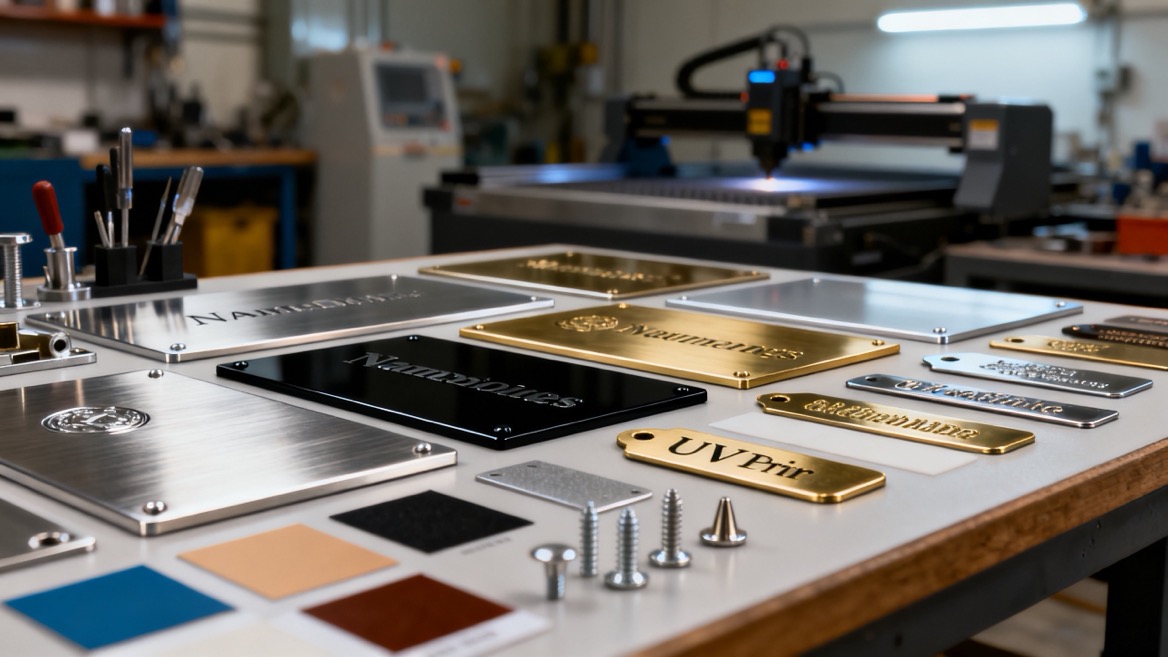
Confirm whether you prefer UV printing, screen printing, digital printing, laser engraving, foil stamping, doming, or another finish.
6. Mounting requirement
Options may include adhesive backing, magnetic backing, screw holes, standoffs, desk bases, slide-in frames, or lanyard holes.
7. Artwork files
Provide a vector logo when possible, along with brand colors, fonts, and text data in a spreadsheet.
8. Packaging needs
Confirm whether each item needs an individual protective bag, barcode label, instruction card, or customized retail packaging.
9. Sample approval
For large orders, review a pre-production sample or digital proof before full manufacturing begins.
At XingKun, a supplier should help buyers confirm these details early, especially when producing variable-data office name plates with many employee names, departments, or room numbers. Careful proofing before production is one of the most effective ways to avoid costly corrections later.
Final Decision: Custom Office Name Plates or Standard Name Tags?
Custom office name plates are the better choice when you want permanent workplace identity, stronger branding, better navigation, and a more polished professional environment.
Standard name tags are the better choice when you need portable, temporary, low-cost, and quickly updated identification.
For many organizations, the best answer is to use both:
- Use custom office name plates for desks, rooms, departments, and reception areas.
- Use standard name tags for employees on the move, visitors, events, and temporary personnel.
- Use modular or replaceable inserts where staff assignments change regularly.
A carefully planned system makes an office easier to navigate, easier to manage, and more memorable for employees and visitors.
Request a Custom Office Name Plate Quote
Looking for custom office name plates, desk signs, door plates, employee badges, printable labels, or branded workplace identification products?
Shenzhen XingKun Packing Products Co., Ltd. can support customized materials, printing methods, variable-name production, logo application, protective packaging, and international bulk orders. Share your quantity, dimensions, artwork, material preference, and installation method to receive a tailored solution for your workplace or distribution project.
FAQ
1. What is the difference between an office name plate and a name tag?
An office name plate is generally fixed to a desk, door, wall, or workstation to identify a place or assigned employee. A name tag is usually worn by a person and is designed for portable identification.
2. Are custom office name plates more expensive than standard name tags?
Usually, yes. Custom office name plates often use more durable materials and additional processes such as engraving, UV printing, cutting, mounting, or protective packaging. However, they may offer better long-term value when used for years.
3. What material is best for desk name plates?
Acrylic and aluminum are popular choices because they balance appearance, durability, and cost. For a more premium look, stainless steel, layered acrylic, or wood may be suitable.
4. Can office name plates include a company logo?
Yes. Custom office name plates can include logos, employee names, job titles, departments, room numbers, QR codes, brand colors, and other variable information.
5. What is the best option for offices with frequent employee changes?
Use a modular sign system with replaceable printed inserts, slide-in holders, magnetic panels, or removable labels. This allows the office to update names without replacing the entire plate.
6. Do permanent room signs need special accessibility features?
Depending on the location and applicable building requirements, permanent room identification signs may need tactile characters, Braille, contrast, non-glare finishes, and specific installation placement. Consult local building and accessibility requirements for your project.
7. Can custom office name plates be ordered with individual names?
Yes. Variable-data production allows each name plate to carry a different employee name, title, department, room number, or code while maintaining the same layout and branding.
References
1. U.S. Access Board. "[Chapter 7: Signs]." Guidance on sign requirements for permanent rooms and spaces, tactile characters, Braille, contrast, non-glare finishes, and mounting placement.
2. U.S. Access Board. "[ADA Guides Chapter 7: Signs PDF]." Technical accessibility guidance for visual and tactile signage.
3. Tactic. "[Workplace Wayfinding: A Practical Design Guide]." Workplace wayfinding recommendations covering destination inventories, standardized names, decision points, and user testing.
4. Gable. "[Wayfinding Signage: The Complete Guide to Workplace Navigation]." Overview of identification, directional, informational, and regulatory signage functions.
5. U.S. Access Board. "[Guide to the ADA Accessibility Standards]." Official resource for accessibility standards and implementation guidance.


