Content Menu
● Introduction: Why Heavy-Duty Display Stands Fail (And How to Avoid It)
● How to Make Display Stands Strong Enough for Heavy Products
● Understanding "Heavy Products" in Retail Display Design
● Material Choices: Cardboard vs. Other Substrates for Heavy-Duty Displays
>> Reinforced Corrugated Board as a Heavy-Load Workhorse
>> When to Consider Hybrid or Alternative Materials
● Structural Engineering Basics for Strong Display Stands
>> Load Distribution and Vertical Support
>> Joints, Locking Systems, and Anti-Sag Design
● Comparing Design Approaches: Lightweight vs. Heavy-Duty Display Stands
>> Key Design Trade-Offs
● Real-World Failure Modes and How to Prevent Them
>> Common Failure Scenarios with Heavy Products
>> Prevention Strategies Used by Experienced Manufacturers
● Step-by-Step: How to Design a Display Stand for Heavy Products
>> Step 1 – Define Load and Environment
>> Step 2 – Choose the Right Materials
>> Step 3 – Engineer the Structure
>> Step 4 – Prototype and Test
>> Step 5 – Prepare for Mass Production and Global Distribution
● Case-Style Scenario: Beverage Display Stand for Heavy Loads
● Comparative Table: Lightweight vs Heavy-Duty Display Stands
● Expert Insights from a Long-Term Display Manufacturer Perspective
● Practical Checklist for Your Next Heavy-Duty Display Project
● When to Partner with a Specialist Heavy-Duty Display Manufacturer
● Call to Action: Turn Your Heavy Products into Safe, High-Impact Displays
● FAQs: Heavy-Duty Display Stands
● References
Introduction: Why Heavy-Duty Display Stands Fail (And How to Avoid It)
If you sell heavy products – beverages, tools, cosmetics sets, electronics, automotive parts – a weak display stand is more than an eyesore. It can damage products, hurt shoppers, and erode retailer trust. For a manufacturer like Shenzhen XingKun Packing Products Co., Ltd., with over 20 years in printing and packaging, making display stands strong enough for heavy products is both an engineering task and a brand-protection strategy. [xkdisplay]
In this guide, I will look at heavy-duty display stands from two angles: the structural strength of the display itself and the real-world retail conditions that test that strength every day. Drawing on practical manufacturing experience and current retail display practices, we will break down how to design, test, and optimize display stands that safely carry heavy loads while still looking premium at the point of sale. [xkdisplay]
 x
x
How to Make Display Stands Strong Enough for Heavy Products
Designing strong display stands for heavy products starts long before printing and cutting. It begins with understanding the load, the retail environment, and the material behavior under stress. A well-engineered display stand integrates material selection, structural design, and finishing processes so that branding and strength work together instead of fighting each other. [xkdisplay]
For brands and distributors working across more than 30 countries and regions, consistency is critical. A stand that performs well in a climate-controlled European supermarket must also hold up in a humid Asian convenience store or a high-traffic North American warehouse club. [xingkun.yingfanzhileng]
Understanding "Heavy Products" in Retail Display Design
Not all "heavy" products are equal. A single 10 kg tool set stresses a stand differently than fifty 200 g beverage cans stacked on multiple shelves. [xkdisplay]
From an engineering and UX perspective, you should think in three dimensions:
- Total load: The maximum weight the display must carry when fully stocked.
- Point loads: Localized weight, such as a single heavy item pressing on a small area.
- Dynamic loads: Extra force from shoppers pulling, pushing, or restocking.
A manufacturer with extensive experience in custom POP displays typically starts by quantifying these loads and mapping them to suitable materials and structures. This prevents the common failure mode where the top shelf looks great in design but collapses when a staff member overfills it during a promotion. [xkdisplay]
Material Choices: Cardboard vs. Other Substrates for Heavy-Duty Displays
Reinforced Corrugated Board as a Heavy-Load Workhorse
For many retailers, corrugated cardboard remains the primary choice because it is printable, cost-effective, and recyclable. However, not all corrugated board is suitable for heavy products. Key factors include: [xkdisplay]
- Flute type and combination (e.g., double-wall or triple-wall)
- Paper grammage (higher GSM for greater compression strength)
- Moisture resistance (coatings or lamination for humid environments)
Experienced packaging printers like Shenzhen XingKun can optimize flute combinations and liner choices to balance strength, cost, and print quality, especially for high-impact branding at retail. [xingkun.yingfanzhileng]
When to Consider Hybrid or Alternative Materials
In some scenarios, cardboard alone is not enough for ultra-heavy or high-risk products. Then you might enhance the design with: [xkdisplay]
- Internal metal or plastic supports hidden within the board structure
- Reinforced base platforms for pallet-style displays
- Foam, EVA, or rigid inserts that distribute weight more evenly
Manufacturers who already produce multiple printed items and custom inserts can integrate these supports without sacrificing visual design or print alignment. [xkdisplay]
Structural Engineering Basics for Strong Display Stands
Load Distribution and Vertical Support
The single most important design principle for strong displays is load distribution. Instead of letting shelves carry weight only at the front edge, you want:
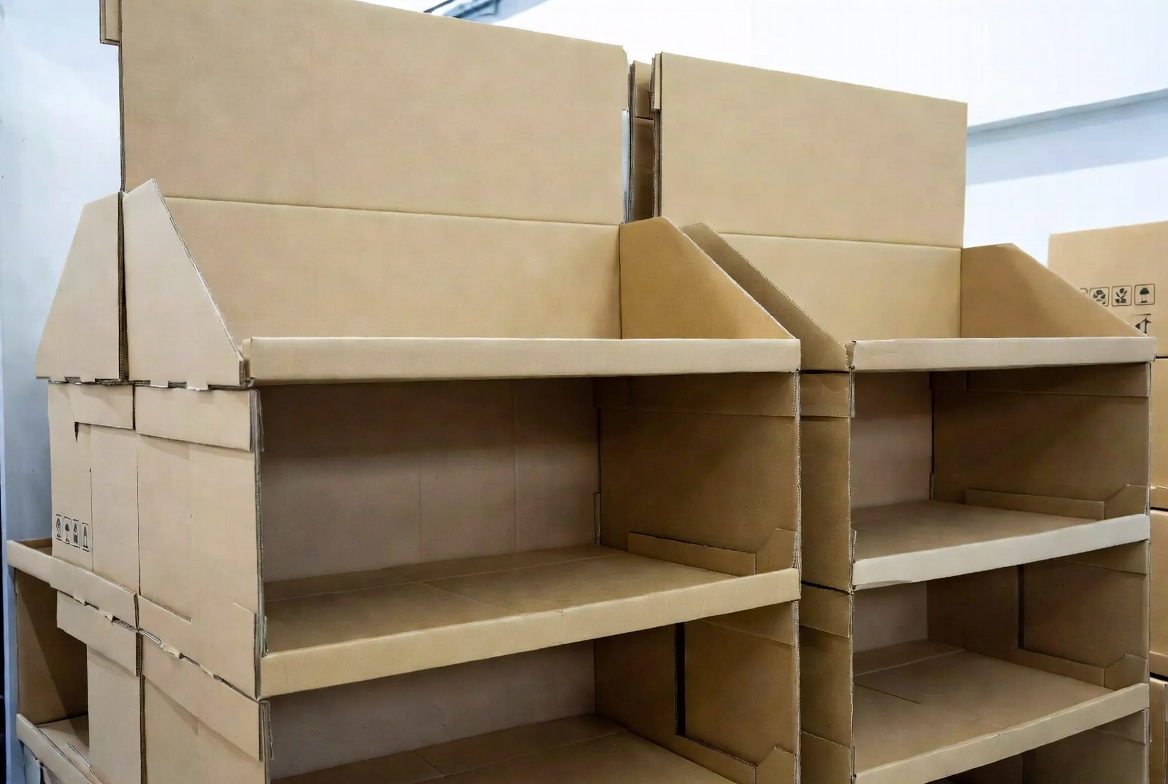
- Vertical columns or sidewalls that transfer load directly to the base
- Integrated ribs or gussets under each shelf
- Interlocking tabs to prevent twisting and racking
In practice, high-performance display stand manufacturers model these supports so that each shelf has at least two or three solid load paths to the floor, rather than relying on face panels alone. [xkdisplay]
Joints, Locking Systems, and Anti-Sag Design
Weak joints are responsible for many collapsed displays. To make displays strong enough for heavy products, pay extra attention to:
- Locking tabs and slots that resist pull-out and spreading
- Glue areas that are long enough and properly aligned
- Double-layered shelf fronts to prevent sag when fully loaded
A common expert tactic is to over-spec critical joints based on worst-case loading and retailer handling behavior, instead of idealized test conditions. [xkdisplay]
Comparing Design Approaches: Lightweight vs. Heavy-Duty Display Stands
The tension between "lightweight" and "heavy-duty" display stands shows up in real projects. Many brands want a stand that is easy to ship and assemble but still strong enough for heavy products. [xkdisplay]
Key Design Trade-Offs
- Material thickness vs. logistics cost: Thicker board improves strength but increases weight and shipping volume. [xkdisplay]
- Component count vs. assembly complexity: More internal supports mean more parts, which can slow store staff.
- Visual openness vs. structural bracing: Open designs showcase products better but leave fewer surfaces for load-bearing structures.
The most successful heavy-duty display projects balance these factors using proven structural templates adapted to specific product weights and retailer constraints. [xkdisplay]
Real-World Failure Modes and How to Prevent Them
Common Failure Scenarios with Heavy Products
From a manufacturer's perspective, real-world feedback usually highlights a few recurring problems:
- Shelf sagging after a few weeks of full load
- Base crushing when the display is dragged instead of lifted
- Tearing at hand-holes or cutouts due to repeated grabbing
- Tilt or collapse when customers lean on the stand
These issues often arise when the theoretical load capacity does not account for human behavior and store practices. [xkdisplay]
Prevention Strategies Used by Experienced Manufacturers
Manufacturers with two decades of display experience typically build safety margins into every heavy-duty design. Practical measures include: [xingkun.yingfanzhileng]
- Designing for 1.5–2 times the expected load to handle misuse
- Adding base reinforcement for pallet jacks and dragging
- Reinforcing cutouts and stress points with extra layers or alternative die-lines
- Providing clear loading instructions printed inside or on the assembly manual
By treating each display as a system, not just a printed object, it becomes much more robust in unpredictable retail environments. [xkdisplay]
Step-by-Step: How to Design a Display Stand for Heavy Products
Below is a practical process you can follow with your display stand supplier to ensure structural strength and retail usability:
Step 1 – Define Load and Environment
1. List all SKUs and their individual weights.
2. Calculate maximum shelf load when fully stocked in the most aggressive promotion scenario.
3. Determine environmental conditions: humidity, temperature, in-store handling, and display duration. [xkdisplay]
4. Specify safety margin (for heavy products, at least 1.5x recommended).
Step 2 – Choose the Right Materials
1. Select corrugated strength and flute combination suitable for the target market and logistics chain. [xkdisplay]
2. Decide whether you need coating or lamination for moisture and scuff resistance.
3. Evaluate whether to include hidden supports such as metal tubes, thicker base boards, or foam inserts.
Step 3 – Engineer the Structure
1. Design vertical supports under every heavy shelf.
2. Add gussets and cross braces to reduce lateral movement.
3. Reinforce joints, tabs, and shelf fronts in line with load calculations.
4. Optimize die-lines for both strength and efficient material usage.
Step 4 – Prototype and Test
1. Produce full-size prototypes using the chosen materials.
2. Perform static load tests at 1.5–2 times the expected weight. [xkdisplay]
3. Simulate dynamic stresses: restocking, pushing, dragging, and shopper interaction.
4. Adjust the structure where any sagging, bending, or tearing is observed.
Step 5 – Prepare for Mass Production and Global Distribution
1. Validate assembly instructions so store staff can quickly set up the stand.
2. Confirm packaging and palletization so the displays themselves are protected during shipment.
3. Align with the manufacturer on quality control checkpoints to keep global batches consistent. [xingkun.yingfanzhileng]

Case-Style Scenario: Beverage Display Stand for Heavy Loads
To illustrate how this plays out, imagine a multi-layer beverage display for large bottles or cans. Such displays must carry a high load but still invite shoppers to interact freely. [xkdisplay]
A manufacturer with 20+ years in display engineering may:
- Use double-wall corrugated board for shelves and side panels. [xkdisplay]
- Integrate reinforced base pallets to support stacked weight.
- Place hidden columns under each shelf and behind branding panels.
- Apply moisture-resistant coatings to handle condensation and spills.
Prototyping and stress testing confirm that the structure can maintain shape and safety over the whole campaign period, even under frequent restocking. [xkdisplay]
Comparative Table: Lightweight vs Heavy-Duty Display Stands
Below is a simplified comparison to highlight why specific design choices matter when you deal with heavy products:
| Aspect | Lightweight Promotional Stand | Heavy-Duty Stand for Heavy Products |
| Typical material | Single-wall corrugated, lower GSM paper (xkdisplay) | Double or triple-wall corrugated, higher GSM; optional hidden metal/plastic supports (xkdisplay) |
| Load capacity | Low to moderate; suitable for light items | High; engineered for dense or heavy SKUs |
| Structural features | Minimal bracing, basic tabs | Multiple vertical columns, gussets, reinforced bases, double-layer fronts (xkdisplay) |
| Assembly time | Very quick, few components | Slightly longer; more parts but still tool-free |
| Durability in store | Short-term, light handling | Medium to long-term; designed for restocking and shopper interaction (xkdisplay) |
| Best use cases | Seasonal flyers, light snacks, small cosmetics | Bottled drinks, tools, electronics, multi-pack sets, premium kits (xkdisplay) |
Expert Insights from a Long-Term Display Manufacturer Perspective
From the perspective of a manufacturer serving brands and distributors in more than 30 countries and regions, three expert insights stand out. [xingkun.yingfanzhileng]
1. Standardize tested structures
Over time, successful display suppliers develop a library of proven structural templates for heavy products, which can be adapted quickly to new campaigns. This reduces risk and speeds up development. [xkdisplay]
2. Co-engineer with brand and retailer
The strongest displays emerge when the manufacturer participates early in discussions with brand owners and retailers, aligning load expectations, in-store handling, and visual goals. [xkdisplay]
3. Invest in testing and continuous improvement
Ongoing feedback from global projects feeds into incremental structural improvements, better coatings, and more efficient packaging, enhancing both strength and sustainability. [xkdisplay]
Practical Checklist for Your Next Heavy-Duty Display Project
Use this quick checklist when you brief your display stand supplier for heavy products:
- Have you calculated maximum shelf and total load with a safety margin?
- Did you specify environment, campaign duration, and handling conditions?
- Are materials and flute profiles chosen explicitly for heavy loads? [xkdisplay]
- Does the structure include vertical supports, gussets, and reinforced joints?
- Have you planned prototype testing at up to 2x the expected load? [xkdisplay]
- Are assembly instructions and packaging optimized for global rollout? [xingkun.yingfanzhileng]
If you can positively answer each point, you are far more likely to end up with a display stand that performs reliably in real stores.
When to Partner with a Specialist Heavy-Duty Display Manufacturer
Heavy products amplify the cost of any design mistake. That is why many brands choose to work with specialists that combine printing quality, structural engineering, and global project experience. [xkdisplay]
A partner with decades of experience in printing, packaging design, and catalogue binding can help you:
- Translate brand guidelines into structurally sound display concepts. [cn.linkedin]
- Optimize for one-stop service – from design to production and packing – saving time and coordination cost. [cn.linkedin]
- Scale the same design reliably across multiple regions while meeting local retail and logistics requirements. [xingkun.yingfanzhileng]
Call to Action: Turn Your Heavy Products into Safe, High-Impact Displays
If you are planning a new campaign for heavy or high-value products, this is the ideal moment to rethink your display stands. Instead of accepting generic, under-engineered displays, work with a specialist heavy-duty display manufacturer to co-create stands that are visually striking, safe, and durable in real-world stores. [xkdisplay]
Define your load requirements, share your retailer constraints, and ask your manufacturing partner to propose a tested structural solution tuned to your products and markets. With the right collaboration, your display stands will do much more than hold weight – they will actively protect your brand, drive sales, and build retailer confidence over the long term. [xkdisplay]
FAQs: Heavy-Duty Display Stands
1. How much weight can a cardboard display stand safely hold?
A well-engineered corrugated display stand using double or triple-wall board can often support loads well above 40–60 kg per unit when designed and tested correctly, but the exact capacity depends on material specifications and structural design. [xkdisplay]
2. Are cardboard display stands suitable for very humid environments?
Yes, but they require moisture-resistant coatings or lamination and sometimes material upgrades to prevent softening or warping over time in high humidity. [xkdisplay]
3. What tests should I request from my display supplier for heavy products?
You should ask for static load testing at 1.5–2 times the expected weight, plus simple dynamic simulations such as restocking, pushing, and dragging to replicate real in-store behavior. [xkdisplay]
4. Can heavy-duty display stands still be flat-packed for efficient shipping?
Most heavy-duty designs are still engineered to be flat-packed and tool-free to assemble, using smart die-cutting and lock systems to achieve both strength and logistics efficiency. [xkdisplay]
5. Why work with a specialized display manufacturer instead of a generic printer?
Specialized manufacturers bring proven structural templates, global retail experience, and integrated services that reduce risk, shorten timelines, and ensure the stand's strength matches your heavy product requirements. [cn.linkedin]
References
1. XINGKUN – Display stand manufacturing overview. Available at: [https://www.xkdisplay.com/zh-CN/display-stand.html]
2. Shenzhen XingKun Packing Products Co., Ltd – Company profile and history. Available at: [http://xingkun.yingfanzhileng.com/]
3. XINGKUN – Expert guide to POP display stands (high-impact retail displays). Available at: [https://www.xkdisplay.com/el/the-expert-guide-to-pop-display-stands-how-to-choose-high-impact-retail-displays-that-actually-sell]
4. XINGKUN – Designing high-impact beverage display stands: strategies from a 20+ year display manufacturer. Available at: [https://www.xkdisplay.com/el/designing-high-impact-beverage-display-stands-expert-strategies-from-a-20-year-display-manufacturer]
5. XingKun Packing Products Co Ltd – Company information. Available at: [https://cn.linkedin.com/company/xingkun-printing-products]
6. XINGKUN – Top display stand manufacturers in China: why choose them. Available at: [https://www.xkdisplay.com/top-display-stand-manufacturers-in-china-why-choose-them.html]
7. Additional XINGKUN product and project pages on heavy-duty display stands and printed items. Available at: [https://www.xkdisplay.com]


 x
x


