Content Menu
● Why Packaging Boxes Crush During Shipping
>> Stacking Loads and Unsupported Panels
>> Moisture, Impacts, and Movement
● Presentation Boxes vs. Shipping Cartons: Different Jobs
● Single-Wall vs. Double-Wall Corrugated Boxes
>> When Single-Wall Construction May Be Suitable
>> When to Evaluate Double-Wall Construction
● How to Choose Crush-Resistant Packaging Boxes
>> Specify the Complete Shipment
>> Right-Size Without Eliminating Cushioning
● Cushioning vs. Reinforcement: Understand the Difference
● Seal Packaging Boxes Without Creating Weak Points
● Prevent Crushing During Palletized Shipping
>> Keep Cartons Within the Pallet Footprint
>> Compare Column and Interlocking Stacking
● Protect Corrugated Packaging from Moisture
● A Practical Framework for Diagnosing Crushed Boxes
● Test the Complete Package Before Scaling Production
>> Use Production-Representative Samples
>> Include the Hazards That Matter
● An Illustrative Redesign: Protecting Premium Gift Boxes
● Measure Protection by Delivered Cost
● Build a Better-Protected Packaging System with XingKun
● Frequently Asked Questions
>> 1. What is the best way to prevent packaging boxes from crushing?
>> 2. Are double-wall boxes always necessary?
>> 3. Can bubble wrap stop a box from collapsing?
>> 4. Should rigid gift boxes ship without an outer carton?
>> 5. How much cushioning should fragile products have?
>> 6. Does a "Fragile" label prevent crushing?
● References
To prevent packaging boxes from crushing during shipping, combine a correctly specified corrugated carton with fitted internal protection, secure sealing, controlled stacking, and shipment testing. Simply choosing thicker cardboard is not enough: a strong box can still fail when it is oversized, exposed to moisture, or unsupported on a pallet.
At Shenzhen XingKun Packing Products Co., Ltd., our perspective comes from more than 20 years in printing and packaging, serving brands and distributors across more than 30 countries and regions. We approach transit protection as a complete packaging-system decision—not just a choice of paper.
This guide compares presentation boxes with shipping cartons, cushioning with structural reinforcement, and single-wall with double-wall construction. It also explains how to identify the actual cause of crushing before investing in a redesign.
Why Packaging Boxes Crush During Shipping
Crushing occurs when external forces exceed the package's ability to resist them. However, the visible damage does not always reveal the original problem.
Stacking Loads and Unsupported Panels
Cartons near the bottom of a stack carry the weight above them. Long storage periods, uneven loading, and misaligned corners can make that pressure harder to withstand.
Oversized boxes create another vulnerability. Large, unsupported panels may buckle even when the product inside remains undamaged.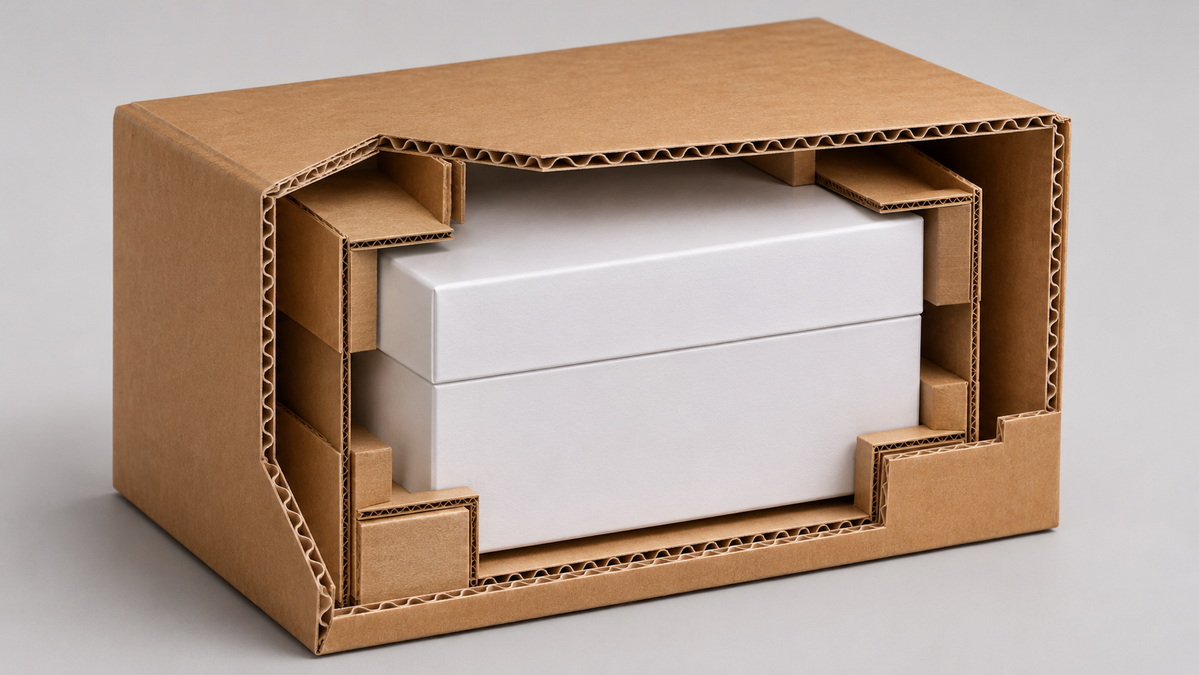
Moisture, Impacts, and Movement
Corrugated board strength is affected by its moisture content. A carton that performs well in dry conditions may behave differently after exposure to a humid distribution environment.
Drops and vibration can also damage corners, loosen contents, or weaken the package before stacking pressure causes visible collapse.
A practical diagnosis should therefore consider four interacting hazards:
- Compression from stacking and handling.
- Shock from drops and impacts.
- Vibration during transportation.
- Atmospheric exposure, particularly moisture.
Presentation Boxes vs. Shipping Cartons: Different Jobs
An attractive retail box and a protective transport carton are not automatically interchangeable.
| Packaging type | Primary purpose | Main limitation | Practical shipping approach |
| Folding carton | Product presentation and information | Limited resistance to demanding transit loads | Place inside a suitable corrugated shipper |
| Rigid gift box | Premium appearance and presentation | Decorative surfaces and corners remain vulnerable | Use an outer carton with fitted protection |
| Corrugated mailer | Combined presentation and delivery | Performance depends on construction and contents | Validate the complete packed configuration |
| Corrugated master carton | Transporting grouped products | Can fail through poor stacking or inadequate specification | Match strength to the shipment and distribution route |
Carrier guidance recommends placing chipboard gift or shoe boxes inside corrugated outer packaging.
For premium products, separate the responsibilities: let the inner box protect presentation quality, while the outer shipper manages handling and transportation hazards.
Single-Wall vs. Double-Wall Corrugated Boxes
Double-wall construction can be useful for heavier or more demanding shipments, but it is not automatically the best choice for every product.
When Single-Wall Construction May Be Suitable
A properly specified single-wall carton may work well for lighter products, shorter distribution routes, or packages with effective internal support.
Its potential advantages include:
- Lower material consumption.
- Reduced package weight.
- Easier handling and storage.
- Adequate protection when correctly designed and tested.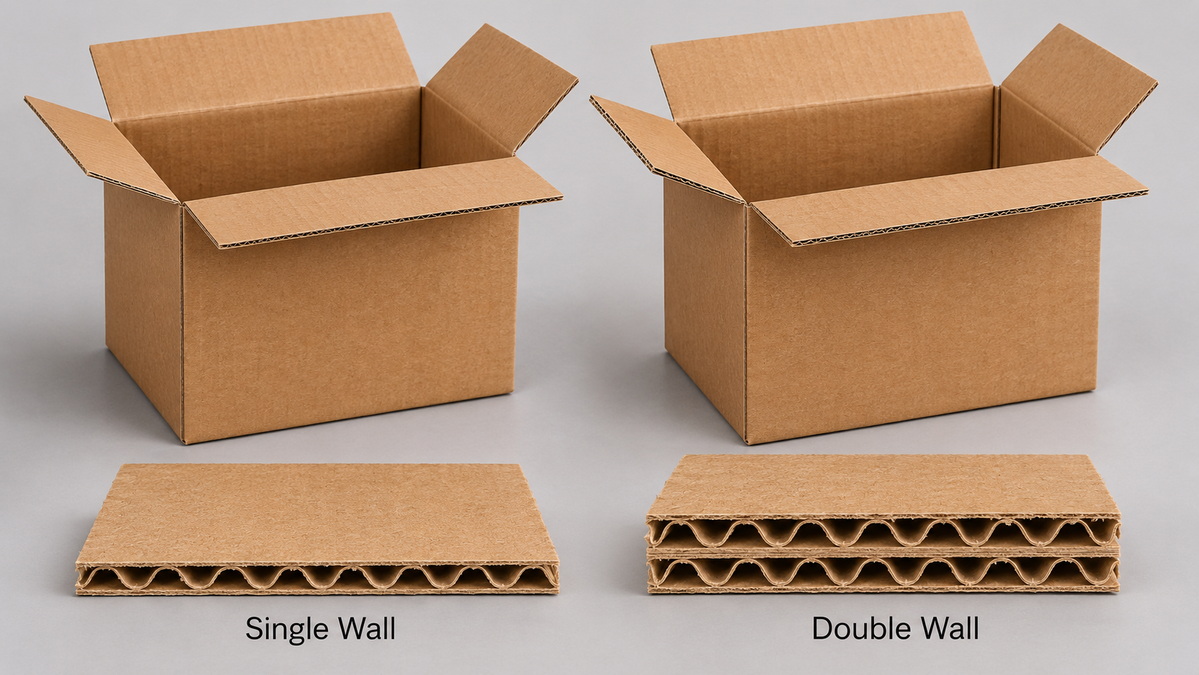
When to Evaluate Double-Wall Construction
Consider double-wall cartons when shipping heavier contents, vulnerable products, or loads exposed to demanding handling and stacking conditions.
However, wall count alone does not establish performance. Paper properties, dimensions, converting quality, closures, and internal packaging all influence the result.
Ask suppliers to explain how the proposed construction addresses your actual failure mode. "Stronger cardboard" is not a sufficiently precise purchasing specification.
How to Choose Crush-Resistant Packaging Boxes
Specify the Complete Shipment
Before requesting a quotation, provide:
1. Product dimensions and weight.
2. Total packed weight.
3. Quantity and arrangement per carton.
4. Shipping method and destination.
5. Expected stacking and storage conditions.
6. Acceptable cosmetic and functional damage limits.
Photographs of previous failures are especially useful. A collapsed sidewall requires a different response from a damaged decorative corner.
Right-Size Without Eliminating Cushioning
The best-fitting carton is not necessarily the smallest possible carton.
Allow sufficient room for protective materials, but avoid unnecessary empty space. Underfilled boxes can crush, while overfilled cartons may bulge and place stress on closures.
The objective is a stable package in which the product does not shift and the panels remain properly formed.
For multiple products, use dividers or fitted inserts rather than relying entirely on loosely packed filler.
Cushioning vs. Reinforcement: Understand the Difference
Cushioning reduces shock and limits movement. Structural reinforcement helps carry or distribute loads. These functions overlap, but they are not identical.
| Material or component | Main function | Important limitation |
| Air-cellular wrap | Cushioning and surface separation | Not a substitute for a compression-resistant carton |
| Crumpled paper | Void filling and movement control | Performance depends on packing consistency |
| Fitted foam | Cushioning and product restraint | Density and geometry must suit the product |
| Corrugated partitions | Separation and positioning | Structural contribution depends on design |
| Engineered corner supports | Load distribution and edge protection | Must be correctly positioned and validated |
A useful design question is: where does the load travel?
Ideally, external pressure should pass through suitable carton walls and engineered supports—not through a fragile bottle cap, display window, or decorative lid.
Avoid assuming that adding more loose filler will solve panel collapse. The package may need better geometry or a deliberate structural support system instead.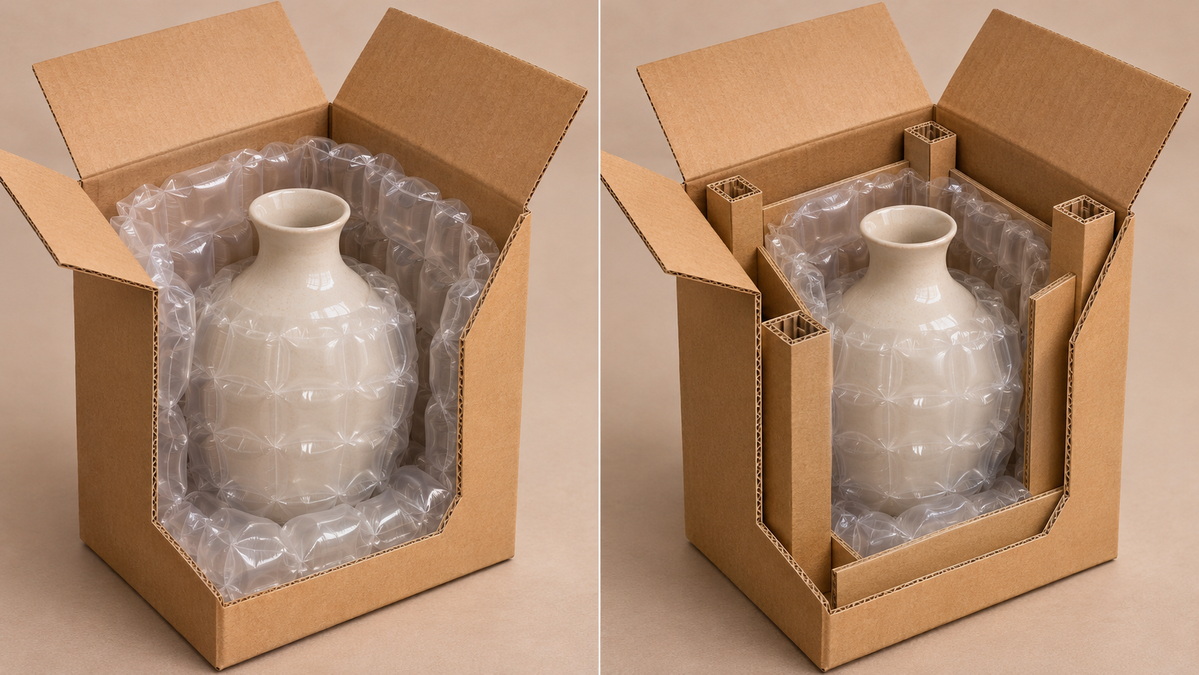
Seal Packaging Boxes Without Creating Weak Points
H-taping closes the main seam and the two edge seams on both the top and bottom of a standard corrugated carton.
Carrier guidance recommends purpose-made shipping tape at least 5 cm wide. Suitable options include pressure-sensitive plastic tape and appropriately specified water-activated tape.
Follow a consistent process:
1. Square the carton before loading.
2. Keep flaps aligned and free from outward pressure.
3. Close the center seam.
4. Seal both edge seams.
5. Repeat on the opposite face.
6. Check tape adhesion before dispatch.
Do not use household cellophane tape or masking tape as shipping closures.
Extra tape cannot compensate for an unsuitable carton, and a package that needs force to close should be reviewed for overpacking.
Prevent Crushing During Palletized Shipping
Keep Cartons Within the Pallet Footprint
Pallet overhang leaves part of the carton unsupported. FedEx warns that overhang can reduce package compression strength by as much as 32 percent.
Treat that figure as a warning, not a universal prediction. The actual effect depends on the package and loading arrangement.
Choose pallet dimensions and carton layouts together rather than fitting finished cartons onto whatever pallet is available.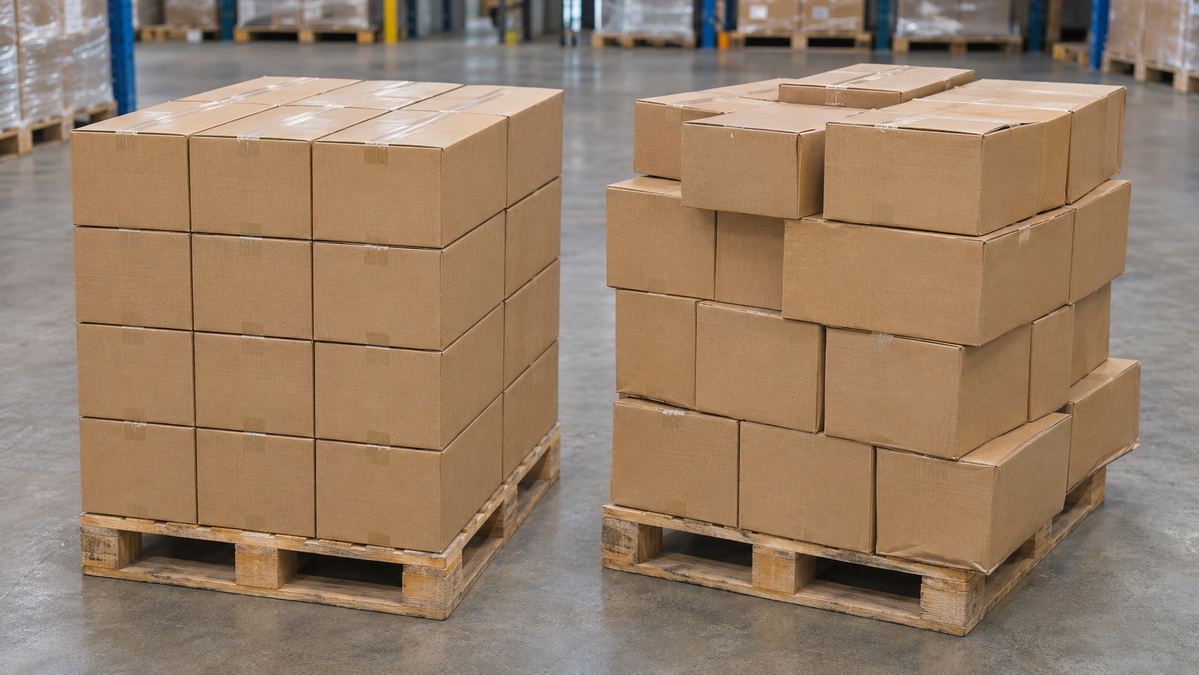
Compare Column and Interlocking Stacking
Column stacking aligns cartons vertically and generally favors top-to-bottom compression strength.
Interlocking arrangements can help load stability, but their effect on compression performance must be considered. The strongest-looking pallet pattern is not necessarily the best structural arrangement.
Use an approved stacking diagram and evaluate:
- Carton alignment.
- Pallet condition.
- Load stability.
- Unsupported edges.
- Stretch-wrap pressure and edge protection.
Do not assume tightly applied wrapping can correct an unstable or poorly supported load.
Protect Corrugated Packaging from Moisture
For international shipments, evaluate the entire storage and transport environment.
Keep unused cartons dry, inspect them before packing, and avoid dispatching boxes with softened panels or visible water damage.
Where moisture exposure is plausible, discuss board selection, protective barriers, and shipment conditioning with your packaging supplier and testing laboratory.
Desiccants may help manage moisture inside an appropriately designed enclosure, but they do not restore the strength of a wet outer carton.
The important distinction is between protecting the product from moisture and maintaining the structural performance of the shipping package.
A Practical Framework for Diagnosing Crushed Boxes
Before redesigning everything, classify the damage.
| Observed damage | Possible cause to investigate | First corrective direction |
| Top panel caves inward | Unsupported space or concentrated loading | Review sizing and internal support |
| Corners collapse | Impact, misalignment, or inadequate strength | Review handling exposure and carton structure |
| Bottom cartons buckle | Excessive stacking load or moisture exposure | Review stack height and conditioning |
| Flaps open | Closure failure or overpacking | Correct fit and sealing |
| Inner gift box dents | Inadequate separation from outer hazards | Improve cushioning and restraint |
| Pallet-edge cartons fail | Overhang or poor support | Correct pallet layout |
These are diagnostic starting points, not definitive conclusions.
Record the carton specification, packing arrangement, shipment route, and damage location. Otherwise, unrelated failures may be grouped together and produce the wrong redesign decision.
Test the Complete Package Before Scaling Production
ISTA 3A is a general simulation procedure for individual packaged products shipped through parcel delivery systems within its published scope. It covers different package categories, including standard, small, flat, and elongated packages.
Palletized and freight shipments may require different procedures.
Use Production-Representative Samples
Test the actual product or a justified equivalent together with the intended:
- Carton construction.
- Inserts and cushioning.
- Closure materials.
- Packing arrangement.
- Labels and protective accessories.
Define acceptance criteria before testing. A functioning product inside a visibly crushed premium box may still represent a commercial failure.
Include the Hazards That Matter
A test evaluates only the hazards it represents. Passing a procedure without an appropriate warehouse-stacking assessment does not establish resistance to every storage condition.
Discuss humidity conditioning, sustained loads, drops, and vibration with the laboratory according to the real distribution route.
Retest when material, dimensions, product weight, or packing configuration changes materially.
An Illustrative Redesign: Protecting Premium Gift Boxes
Consider a hypothetical brand shipping premium gift boxes inside oversized outer cartons. Customers report dented lids, but the products remain functional.
Replacing the outer carton with heavier board might help, yet it would not necessarily stop the inner boxes from moving.
A more focused redesign would:
1. Reduce unnecessary outer-carton space.
2. Add fitted protection that restrains the gift boxes.
3. Keep decorative surfaces away from load-bearing contact points.
4. Standardize packing and sealing.
5. Test the revised configuration.
6. Compare pilot-shipment results with the original design.
This is an illustrative workflow, not a reported XingKun customer case. Its lesson is straightforward: correct the damage mechanism before increasing material consumption.
Measure Protection by Delivered Cost
The lowest carton price does not necessarily produce the lowest shipment cost.
Compare packaging alternatives using:
- Materials and packing labor.
- Freight implications.
- Damage and replacement rates.
- Return handling.
- Customer-service costs.
Track cosmetic box damage separately from product damage. Both matter, but they often require different solutions.
For a useful pilot, compare similar products and routes, record shipment quantities, and report the number of affected deliveries—not just isolated complaints.
Build a Better-Protected Packaging System with XingKun
Preventing crushed packaging requires coordination between presentation design, carton structure, packing methods, and distribution conditions.
Send Shenzhen XingKun Packing Products Co., Ltd. your product dimensions, packed weight, destination markets, shipping method, and photographs of existing damage. Request a packaging review and sample-development discussion focused on protecting both your products and their presentation before your next production run.
Frequently Asked Questions
1. What is the best way to prevent packaging boxes from crushing?
Use a correctly specified corrugated carton, control internal movement, seal it properly, and validate it against expected transport and stacking conditions. No single material solves every failure.
2. Are double-wall boxes always necessary?
No. A well-designed single-wall package may be adequate. Double-wall construction should address a demonstrated requirement rather than serve as an automatic upgrade.
3. Can bubble wrap stop a box from collapsing?
It can cushion products and limit contact, but it does not replace adequate carton strength or engineered structural support.
4. Should rigid gift boxes ship without an outer carton?
Do not assume they can. Evaluate the complete design; an outer corrugated carton is often appropriate for protecting decorative surfaces and corners.
5. How much cushioning should fragile products have?
Requirements vary. FedEx's breakables guidance recommends approximately 3 inches of cushioning for specified fragile-item and double-boxing arrangements. Confirm suitability through testing.
6. Does a "Fragile" label prevent crushing?
A label does not provide physical protection. Carton strength, restraint, cushioning, and validated packing remain essential.
References
1. FedEx. "General Packaging Guidelines." Guidance on corrugated outer cartons, gift-box protection, cushioning, shipping tape, and H-taping. [fedex]
2. FedEx. "How to Pack a Parcel: Boxing, Cushioning and Tape." Practical recommendations on carton fit, avoiding bulging, cushioning, and sealing. [fedex]
3. FedEx. "How to Ship Using Pallets." Guidance on column stacking, pallet overhang, load support, and the potential reduction in compression strength. [fedex]
4. International Safe Transit Association. "Guidelines for Selecting and Using ISTA Test Procedures and Projects." Technical guidance on distribution hazards, moisture content, conditioning, and the limitations of test coverage. [ista]
5. International Safe Transit Association. "Test Procedures." Descriptions and scope of parcel, freight, and unitized-load testing procedures. [ista]
6. FedEx. "Packing Breakables 101." Recommendations for fragile-item cushioning, double-boxing, and carton sealing. [fedex]


