Content Menu
● How We Evaluate Clothing Box Suppliers
● Why Source Clothing Boxes Through Germany?
>> An Established Packaging Supply Base
>> What Recent Industry Reports Actually Show
● Seven Clothing Box Manufacturers and Suppliers to Consider
>> 1. Shenzhen XingKun Packing Products Co., Ltd.
>>> Flexible International OEM Development for Growing Brands
>> 2. Xianda Printing Co., Ltd.
>>> Custom Gift-Box Structures for Apparel Presentation
>> 3. Maituohong Packaging
>>> Coordinated Apparel Packaging and Documented Inspection Stages
>> 4. Bonito Packaging
>>> Lower-Volume Custom Apparel Packaging
>> 5. Karl Knauer KG
>>> Established German Paperboard and Gift-Packaging Expertise
>> 6. RISSMANN GmbH
>>> Premium Paper Boxes and Coordinated Brand Presentation
>> 7. PROCOS GmbH
>>> German-Headquartered Luxury Packaging Coordination
● Supplier Comparison: Capacity, MOQ, and Certification
● Clothing Box Technical Specifications Buyers Should Control
>> Select the Structure Before Comparing Prices
>> Define Materials Beyond "Premium Cardboard"
>> Convert Appearance into Acceptance Criteria
● Compliance: What Matters for Germany in 2026?
>> Ordinary Clothing Boxes Do Not Normally Require CE Marking
>> Check the Packaging Rules That Actually Apply
● Buyer's Guide: From Factory Verification to Delivery
>> 1. Verify the Contracting Entity and Production Site
>> 2. Use a Three-Stage Approval Process
>> 3. Compare Delivered Cost
>> 4. Put Reorder Controls in Writing
● An Often-Overlooked Procurement Trap: The Perfect Sample
● Conclusion: Choose the Partner That Fits Your Operating Model
● Frequently Asked Questions
>> 1. How Can I Verify Whether a Supplier's ISO Certificate Is Still Valid?
>> 2. Does an FSC-Certified Factory Mean Every Clothing Box Is FSC-Certified?
>> 3. Can I Require All Boxes to Be Manufactured in Germany?
>> 4. What Should I Do If the Supplier's Company Name Differs from Its Website Brand?
>> 5. Who Handles German Packaging Obligations When Boxes Are Imported?
● References
Germany is a valuable sourcing market for clothing boxes, combining established paper-converting expertise, premium print finishing, packaging development, and access to European retail distribution. For fashion brands, however, selecting the right supplier requires more than choosing a German business address. The decisive factors are material consistency, production-site transparency, dependable delivery, and the ability to translate a brand concept into repeatable manufacturing specifications.
This guide examines seven clothing box manufacturers and suppliers relevant to buyers serving Germany. It distinguishes German-headquartered businesses from international alternatives rather than presenting overseas factories as domestic manufacturers.
The first four companies are international sourcing options, included in the requested editorial order. The remaining three are German-headquartered suppliers. This is a commercial shortlist, not an independently audited ranking by market share.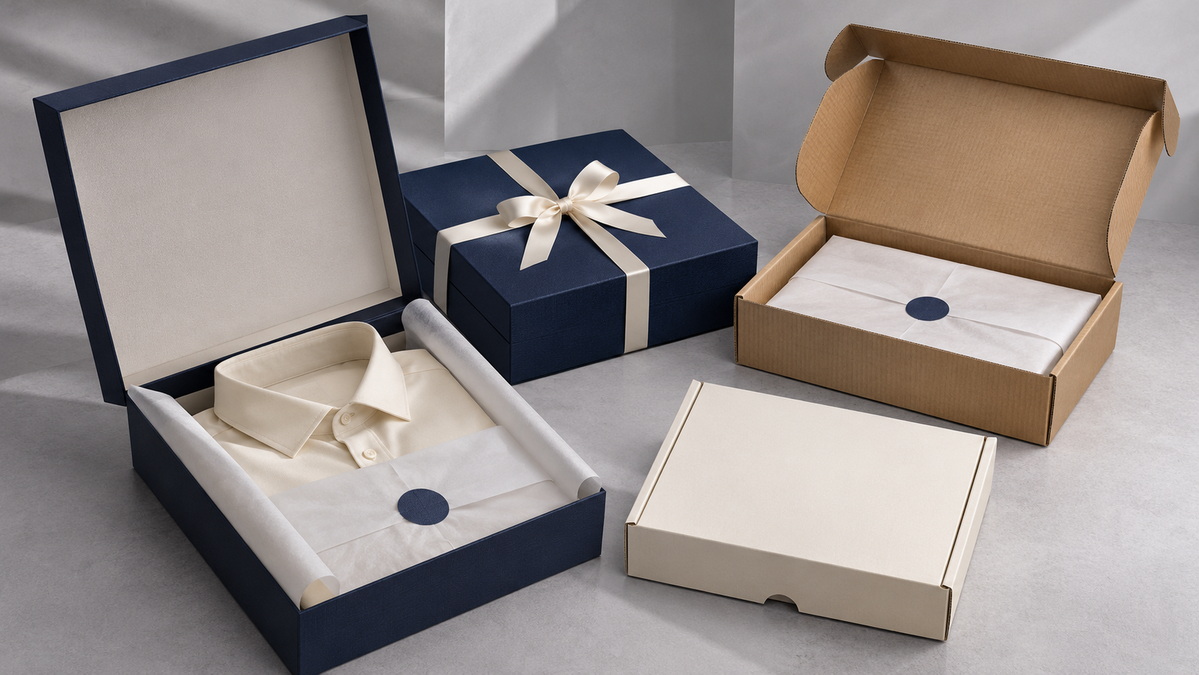
How We Evaluate Clothing Box Suppliers
A useful supplier assessment starts with evidence, not promotional language. The companies below were reviewed using publicly available company information, product portfolios, and relevant industry and regulatory sources. No factory visits or independent production audits were performed for this article.
For procurement teams, the following evaluation framework provides a practical starting point:
| Assessment Area | Suggested Weight | Evidence to Request |
| Manufacturing and quality control | 25% | Factory identity, equipment list, inspection records, defect handling |
| Product development | 20% | Structural prototypes, material alternatives, artwork support |
| Delivery reliability and available capacity | 20% | Production schedule, peak-season loading, subcontracting disclosure |
| Compliance and material traceability | 20% | Current certificates, material declarations, packaging weight data |
| Commercial service and flexibility | 15% | Itemized quotation, communication responsibilities, reorder controls |
These weights are a proposed purchasing framework, not scores awarded to the listed suppliers.
An important distinction runs through this guide: published factory size, employee numbers, or total annual output do not establish available clothing box capacity. Buyers should confirm the production allocation for their particular structure, finish, and delivery window.
Why Source Clothing Boxes Through Germany?
An Established Packaging Supply Base
Germany offers a broad packaging ecosystem rather than one single clothing-box manufacturing cluster. The shortlist illustrates several regional capabilities: paperboard conversion in Baden-Württemberg, presentation packaging in Nuremberg, and international luxury packaging management from Munich. These locations represent different sourcing models, not interchangeable production capabilities.
For buyers, this diversity supports three distinct needs:
- Retail clothing boxes that must integrate with packing operations.
- Premium apparel gift boxes where surface appearance and construction matter.
- Coordinated packaging programs covering boxes, bags, tissue, and accessories.
A German headquarters can simplify communication and regional project management. It does not, by itself, mean that every box is manufactured in Germany.
What Recent Industry Reports Actually Show
A 2025 market overview published by FACHPACK reported German packaging industry revenue of approximately €30.52 billion for 2024, compared with €32.5 billion in the previous year. This figure covers the wider packaging industry; it is not a clothing box market estimate.
The German folding-carton association's May 2025 report provides another useful perspective. Its comparable-member analysis showed 2024 production volume 17.6% below 2021, while production value was 6.4% higher. The report warns about changes in statistical coverage, so buyers should avoid combining incompatible historical series.
These figures reinforce a practical lesson: an established national industry does not eliminate supplier-specific commercial or operational risk. Verify current workload, financial terms, and delivery performance rather than relying on reputation alone.
Seven Clothing Box Manufacturers and Suppliers to Consider
1. Shenzhen XingKun Packing Products Co., Ltd.
Flexible International OEM Development for Growing Brands
Shenzhen XingKun Packing Products Co., Ltd. was established in 2004 and operates from Shenzhen, China. Its company profile reports a 3,000-square-meter facility, annual output exceeding 10 million across its product range, and exports to more than 30 countries. These are supplier-published figures, not independently verified clothing-box capacity measurements.
Its portfolio includes custom paper boxes, display stands, labels, printed products, and related packaging. The company lists Heidelberg CD102 four-color and XL75 six-color printing equipment, supporting its positioning as a printing and packaging partner rather than simply a stock-box reseller.
For small and medium-sized fashion brands, XingKun's relevant proposition is flexibility: its published service model includes low-volume orders, design consultation, and full OEM and ODM support. This can suit buyers developing branded clothing boxes alongside matching labels, inserts, and other printed components.
- Established: 2004.
- Main markets: Domestic and international customers; more than 30 export countries reported.
- Core strengths: Custom printing, coordinated packaging development, flexible project scope.
- OEM/ODM scope: Tailored packaging design, print execution, and production support.
- Buyer verification point: Confirm material specifications, numerical MOQ, project-specific lead time, and current ISO 9001 and FSC documentation.
XingKun publishes a 7–15-day production and delivery statement. Buyers should clarify its starting point, applicable products, and whether it excludes international freight. Its potential cost advantage should be assessed through landed quotations, not assumed from factory location.
2. Xianda Printing Co., Ltd.
Custom Gift-Box Structures for Apparel Presentation
The website associated with Xianda identifies the business as Xianda Printing Co., Ltd. and describes custom paper packaging for clothing, jewelry, cosmetics, and other consumer products. Its offering includes design support, sampling, printing, and gift-box production.
The published company history needs clarification: the homepage states 2006 in multiple sections but also contains a 2014 establishment statement. It likewise refers to different production locations. Buyers should therefore verify the registered contracting entity and actual manufacturing site before approving a purchase order.
- Established: Website states both 2006 and 2014; unresolved.
- Main markets: Export-oriented customers across multiple consumer-product sectors; regional sales shares are not disclosed.
- Core strengths: Gift-box development, varied presentation formats, sampling support.
- OEM/ODM scope: Custom dimensions, artwork, structural development, and decorative packaging.
- Buyer verification point: Reconcile the company history, legal identity, and site details.
Xianda reports a 15,000-square-meter factory area, 175 staff, and sample development within 3–5 days. Treat these as preliminary screening information and request a schedule tied to the actual apparel box specification.
3. Maituohong Packaging
Coordinated Apparel Packaging and Documented Inspection Stages
Maituohong Packaging presents itself as a Shenzhen-based custom paper packaging manufacturer with more than 15 years of experience. Its reviewed homepage does not clearly establish an incorporation year or a complete registered legal entity name; both should be requested before contracting.
Its range includes magnetic boxes, collapsible rigid boxes, drawer boxes, lid-and-base boxes, folding cartons, mailers, bags, and inserts. Apparel is specifically identified among its served industries.
- Established: More than 15 years of experience claimed; exact incorporation year unconfirmed.
- Main markets: North America, Europe, and international customers.
- Core strengths: Broad structural options and coordinated packaging components.
- OEM/ODM scope: Structure, dimensions, materials, printing, finishes, inserts, and closure details.
- Buyer verification point: Obtain the registered company name and confirm which operations are performed in-house.
Maituohong reports a 15,000-square-meter facility, more than 200 workers, and ISO 9001 and FSC certification. It also describes incoming, in-process, final, and outgoing inspection stages. Request completed inspection records to establish how these controls operate in practice.
4. Bonito Packaging
Lower-Volume Custom Apparel Packaging
Bonito Packaging's website specifically offers custom apparel boxes alongside folding cartons, rigid boxes, gift boxes, and retail packaging. It reports more than a decade of paper-packaging manufacturing experience and customers in over 20 countries and regions. Its exact incorporation year is not established by the reviewed company pages.
Its public positioning emphasizes support for different business stages, including orders starting from 100 units for certain projects. That entry quantity should not be interpreted as a universal MOQ for every clothing box construction or finish.
- Established: Exact incorporation year unconfirmed.
- Main markets: Global brands, retailers, and online businesses.
- Core strengths: Low-volume entry options and coordinated custom packaging development.
- OEM/ODM scope: Structural design, artwork support, material selection, finishing, sampling, and production.
- Buyer verification point: Confirm the full registered entity name, manufacturing location, and structure-specific MOQ.
The website lists ISO 9001, FSC, BSCI, and REACH-related claims. These categories are not equivalent: management-system certification, forestry chain of custody, social-audit evidence, and chemical-compliance documentation require different checks. Request the relevant underlying documents rather than accepting a combined badge list.
5. Karl Knauer KG
Established German Paperboard and Gift-Packaging Expertise
Founded in 1938, Karl Knauer KG is headquartered in Biberach/Baden, Germany. It develops and manufactures paperboard, corrugated-board, and paper packaging, including gift packaging and promotional products. Its operations include production in Germany and Poland.
For apparel buyers, Karl Knauer is worth evaluating where clothing boxes form part of a broader retail, promotional, or gift-packaging program. Procurement teams should still request examples matching the intended garment dimensions and presentation requirements.
- Established: 1938.
- Main markets: European and international packaging customers.
- Core strengths: Packaging development, paper conversion, gift packaging, and production integration.
- OEM/ODM scope: Bespoke structural and printed packaging development.
- Buyer verification point: Identify the manufacturing site and applicable certificate coverage for each order.
Its download center provides site-specific FSC documentation and ISO 9001 and ISO 14001 certificates. This is useful procurement evidence, but certificate validity and scope still need checking at the time of purchase.
6. RISSMANN GmbH
Premium Paper Boxes and Coordinated Brand Presentation
RISSMANN GmbH is based in Nuremberg and describes a business history extending more than 160 years. The reviewed company profile does not state a precise founding year, so an exact date should not be inferred from that description.
Its portfolio covers boxes, paper carrier bags, and accessories. Published examples include finished presentation boxes and a CollarBox format, making the company relevant to premium apparel and accessory packaging briefs.
- Established: More than 160 years of history reported; precise year unconfirmed here.
- Main markets: Regional production and global business; detailed geographic sales figures undisclosed.
- Core strengths: Paper selection, premium finishing, and coordinated packaging appearance.
- OEM/ODM scope: Individually designed boxes, bags, and accessories.
- Buyer verification point: Confirm production allocation, repeat-order controls, and delivery schedules.
RISSMANN states that it is FSC-certified and works with certified partners. Buyers requiring an FSC claim should confirm that the specific order and sales documentation carry the appropriate claim.
7. PROCOS GmbH
German-Headquartered Luxury Packaging Coordination
PROCOS GmbH was founded in 1998 and is headquartered in Munich. Its packaging range includes rigid and folding boxes, shopping bags, garment covers, pouches, tissue, ribbons, and other accessories.
The company describes a production network spanning Asia, Europe, and the Americas, supported by local development teams and international offices. It should therefore be evaluated as a German-headquartered global packaging partner, not assumed to manufacture every order domestically.
- Established: 1998.
- Main markets: International luxury brands, including fashion, beauty, jewelry, and other premium categories.
- Core strengths: Coordinated luxury packaging programs and international project management.
- OEM/ODM scope: Custom boxes, bags, textile packaging, accessories, and complete packaging concepts.
- Buyer verification point: Require production-country disclosure and site-specific compliance evidence.
PROCOS is particularly relevant when a fashion brand needs consistent packaging across multiple markets rather than a single isolated box order.
Supplier Comparison: Capacity, MOQ, and Certification
The following table compares disclosed indicators, not independently audited available capacity. "Not established" means the reviewed sources did not substantiate the information; it does not mean the supplier lacks the capability.
| Supplier | Capacity Indicator | Published MOQ Position | Certification Evidence to Check |
| Shenzhen XingKun Packing Products Co., Ltd. | Reports over 10 million annual output across its portfolio | Low-volume support; numerical MOQ not established | Supplier claims ISO 9001 and FSC |
| Xianda Printing Co., Ltd. | Reports 15,000 m² and 175 staff | Confirm by structure and finish | Obtain current, site-matched documents |
| Maituohong Packaging | Reports 15,000 m² and 200+ workers | Project-dependent | Supplier claims ISO 9001 and FSC |
| Bonito Packaging | Advertises projects from 500 to 500,000+ units; not an audited annual capacity | From 100 units for applicable projects | Verify listed ISO/FSC claims and separate audit/compliance evidence |
| Karl Knauer KG | German and Polish production operations | Custom quotation required | Published site-specific FSC, ISO 9001, ISO 14001 documents |
| RISSMANN GmbH | Regional production and global business described | Custom quotation required | FSC claim published; verify order coverage |
| PROCOS GmbH | International production network | Custom quotation required | Request documents for the assigned site and materials |
Supplier-published evidence supports the table; none of these figures guarantees reserved production space for a particular clothing box order.
Clothing Box Technical Specifications Buyers Should Control
Select the Structure Before Comparing Prices
A folding carton, a rigid presentation box, and a corrugated apparel mailer solve different problems. Comparing their unit prices without defining the use case produces misleading quotations.
For each request, specify:
- Garment type, folded dimensions, and packed weight.
- Internal usable dimensions rather than exterior dimensions alone.
- Retail presentation, gifting, storage, or parcel-delivery requirements.
- Flat-packed or assembled delivery.
- Packing-line assembly expectations.
- Required opening, closing, and return-use functions.
Use a physical garment during prototype approval. Fabric bulk, accessories, and folding methods can change the necessary clearance.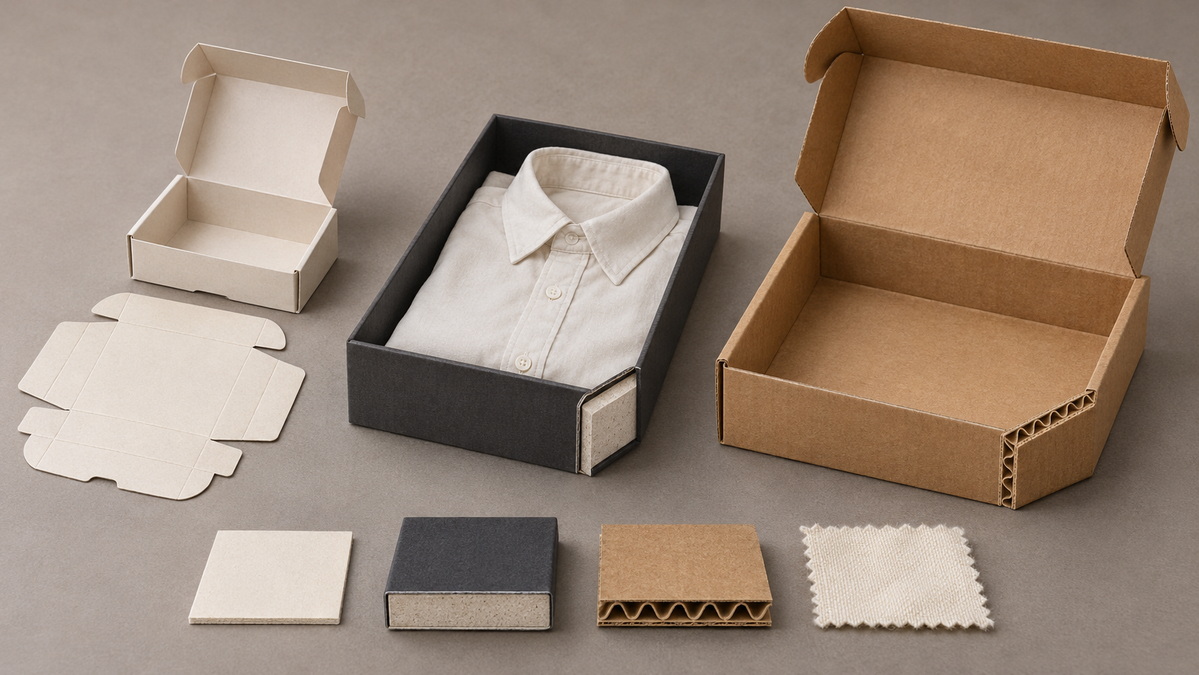
Define Materials Beyond "Premium Cardboard"
Ask suppliers to identify the board grade, manufacturer or approved equivalent, grammage, caliper, surface paper, and permitted tolerances.
For folding cartons, specify the intended paperboard grade and printing surface. For rigid boxes, distinguish the structural board from the outer wrapping paper. For corrugated mailers, define flute construction and the performance needed for the packed product.
Do not approve material substitution solely because the replacement has similar thickness. Require evidence that it preserves the agreed appearance, stiffness, folding behavior, and shipping performance.
Convert Appearance into Acceptance Criteria
Terms such as "luxury finish" are difficult to inspect consistently. Replace them with approved physical references and written limits covering:
- Color measurement and viewing conditions.
- Foil registration and edge definition.
- Visible glue, wrinkles, exposed board, and corner gaps.
- Surface scratching and rubbing.
- Lid fit, closure alignment, and assembly performance.
- Odor and potential transfer onto light-colored garments.
These should be negotiated project specifications, not presented as universal industry tolerances.
Compliance: What Matters for Germany in 2026?
Ordinary Clothing Boxes Do Not Normally Require CE Marking
CE marking applies only where specific product legislation requires it. An ordinary paper clothing box should not be marketed as "CE-certified" merely to suggest general packaging quality. RoHS primarily concerns electrical and electronic equipment, so it is not a general certification requirement for plain paper apparel boxes. Packaging incorporating electronic functions requires a separate scope assessment.
Check the Packaging Rules That Actually Apply
The EU Packaging and Packaging Waste Regulation entered into force on February 11, 2025, and generally began applying on August 12, 2026. Individual requirements have different transition dates, so buyers should not assume that every future design or labeling obligation became applicable simultaneously.
For Germany, identify the party holding extended producer responsibility and establish the applicable LUCID registration, system-participation, and reporting obligations. The responsible party depends on the supply arrangement; buying empty boxes from a compliant supplier does not automatically settle the brand's obligations for packaged goods.
Request component-level material and weight data early. German reporting guidance specifically requires packaging material and mass information.
Buyer's Guide: From Factory Verification to Delivery
1. Verify the Contracting Entity and Production Site
Match the quotation, business registration, bank beneficiary, factory address, and certificate holder. Ask which printing, finishing, and assembly operations are subcontracted.
A supplier can be legitimate while relying on external production partners. The risk lies in undisclosed outsourcing and unclear accountability.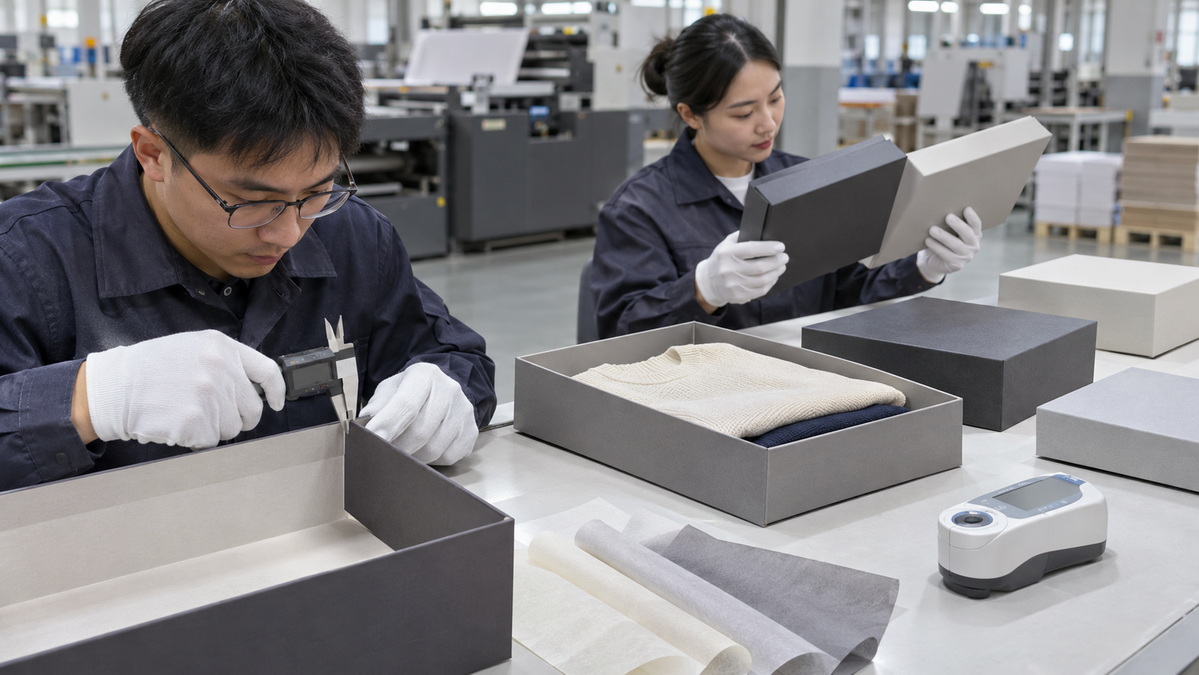
2. Use a Three-Stage Approval Process
A practical sequence is:
1. Structural prototype for garment fit and assembly.
2. Printed pre-production sample for materials, color, and finishing.
3. Production-run samples for comparison against the approved standard.
Retain signed reference samples with both parties. Record sample revisions so an outdated prototype cannot become the accidental production standard.
3. Compare Delivered Cost
Request separate prices for tooling, samples, packaging, freight, inspection, and other applicable charges. Clarify the delivery term, named destination, customs responsibilities, and tax treatment.
For assembled boxes, obtain master-carton dimensions and loading quantities. For collapsible boxes, test assembly labor and operator consistency before assuming that lower freight volume produces a lower total cost.
4. Put Reorder Controls in Writing
Require written approval for changes to board, wrapping paper, coatings, adhesives, production site, and subcontractors. Define how obsolete artwork, damaged tooling, rejected goods, and replacement shipments will be handled.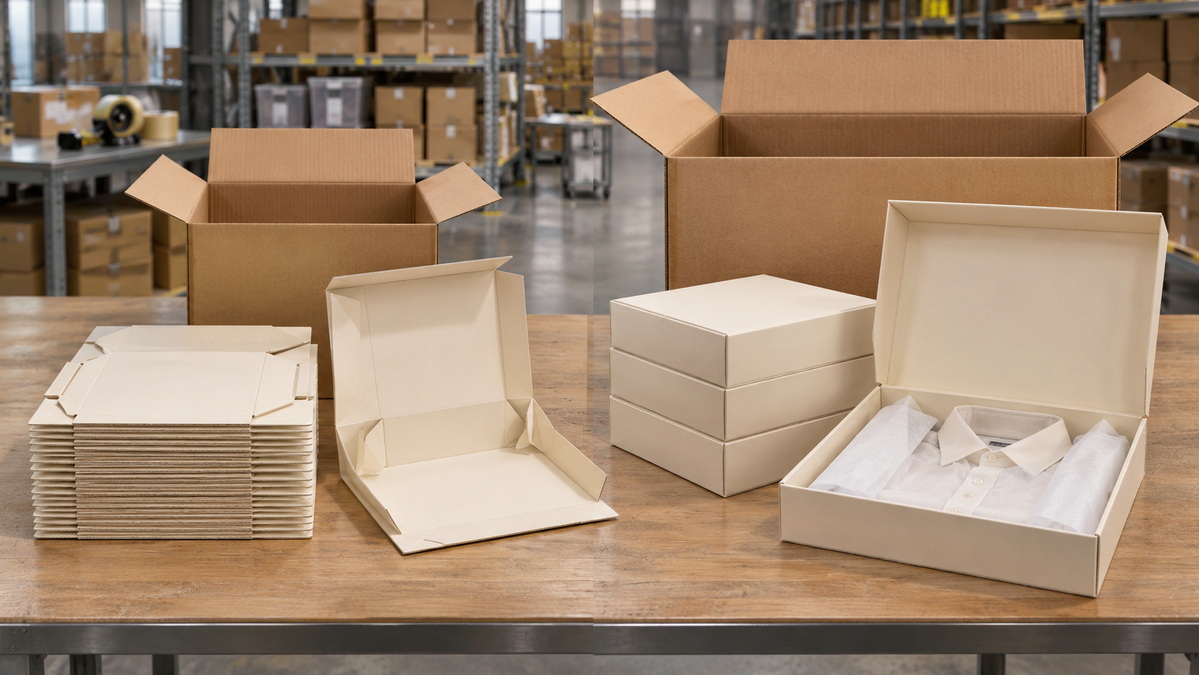
An Often-Overlooked Procurement Trap: The Perfect Sample
A presentation sample can look excellent without proving that a production run will perform equally well. A carefully hand-finished prototype may not reveal the variation introduced by routine wrapping, gluing, assembly, and packing.
The practical safeguard is to approve the process, not just the sample:
- Ask whether the prototype uses production-intended materials.
- Identify any hand-finishing steps that will change in bulk production.
- Inspect randomly selected units from the actual run.
- Check boxes after packing and shipment, not only immediately after assembly.
- Include garment contact, surface rubbing, odor, and closure fit in the inspection brief.
This is a proposed purchasing control rather than a claim that any listed supplier uses misleading samples.
The same principle helps prevent material substitution: an approved specification sheet and traceable material records provide stronger protection than a photograph of an attractive box.
Conclusion: Choose the Partner That Fits Your Operating Model
German-headquartered suppliers offer different combinations of regional manufacturing, premium development, and international project coordination. Overseas manufacturers add alternatives for customized printing, flexible development, and potentially competitive delivered costs.
For brands considering Shenzhen XingKun Packing Products Co., Ltd., the appropriate next step is a documented development brief—not a generic price request. Submit garment dimensions, box style, quantities, destination, material requirements, and target delivery date. Request a structural prototype, itemized quotation, production-site confirmation, and relevant certification evidence before approving bulk production.
A dependable clothing box supplier should make the buying decision easier to verify, not merely easier to advertise.
Frequently Asked Questions
1. How Can I Verify Whether a Supplier's ISO Certificate Is Still Valid?
Check the certificate number, legal entity, factory address, scope, issue date, and expiry date. Then confirm its current status with the certification body through an independently located contact or verification service.
A future expiry date alone does not establish that a certificate remains active. Also distinguish management-system certification from proof that an individual production batch meets your specifications.
2. Does an FSC-Certified Factory Mean Every Clothing Box Is FSC-Certified?
Do not assume so. Request an order-specific FSC claim and verify that the supplier's certification covers the relevant activity and site. Confirm how the claim will appear on the quotation, invoice, and any approved label artwork.
Supplier-level forestry claims should not replace order-level documentation. Several companies in this guide publish FSC-related information, but buyers must verify their particular purchase.
3. Can I Require All Boxes to Be Manufactured in Germany?
Yes, as a contractual sourcing condition, but define it precisely. State which conversion and finishing operations must take place domestically and whether imported paperboard or accessories are permitted.
Request site identification and written approval before production transfers. This is particularly important when a supplier operates across several countries.
4. What Should I Do If the Supplier's Company Name Differs from Its Website Brand?
Resolve the difference before payment. Request the registered legal name, registration details, production entity, and explanation of the relationship between them.
Do not invent a corporate suffix from a trading name. This guide deliberately leaves unverified legal names and incorporation years unresolved rather than treating promotional wording as registration evidence.
5. Who Handles German Packaging Obligations When Boxes Are Imported?
Determine responsibility from the actual transaction and distribution model, including own-brand and import arrangements. Current German guidance identifies circumstances in which domestic retailers assume responsibility for own-brand and imported packaging.
Have the responsible party confirm registration, system participation, and reporting requirements before distribution. Obtain packaging weight and material information from the supplier to support that assessment.
References
- FACHPACK, 2025 German packaging market overview: industry-wide revenue context, not clothing-box-specific market size. [fachpack]
- Fachverband Faltschachtel-Industrie, May 2025 association report: folding-carton production trends and statistical comparability limitations. [ffi]
- European Commission, packaging and packaging waste: regulation scope, entry into force, and general application date. [environment.ec.europa]
- European Union, CE marking guidance: when marking is required and when it must not be used. [europa]
- European Commission, RoHS Directive: restrictions concerning electrical and electronic equipment. [environment.ec.europa]
- Zentrale Stelle Verpackungsregister, registration and system participation guidance. [verpackungsregister]
- Zentrale Stelle Verpackungsregister, own-brand/import responsibility and packaging data requirements. [verpackungsregister]


