Content Menu
● Why Puzzle Piece Count Matters
● Quick Piece Count Guide
● Choose by Player Age
>> Toddlers: 2 to 12 Pieces
>> Preschoolers: 12 to 48 Pieces
>> Children Ages 6 to 8: 50 to 100 Pieces
>> Children Ages 8+: 100 to 300 Pieces
● Choose by Adult Skill Level
>> Beginner Adults: 300 to 500 Pieces
>> Casual and Intermediate Adults: 500 to 1,000 Pieces
>> Advanced Puzzlers: 1,500 to 2,000+ Pieces
● Evaluate Image Complexity First
>> Easy Image + Higher Piece Count
>> Difficult Image + Lower Piece Count
● Match Piece Count to Puzzle Size
● Select by Product Purpose
>> Promotional and Corporate Puzzles
>> Retail Art and Hobby Puzzles
>> Educational Puzzles
>> Custom Photo Puzzles
● A Practical Selection Framework
>> 1. Define the Main User
>> 2. Set the Desired Completion Time
>> 3. Score the Artwork
>> 4. Confirm Physical Specifications
>> 5. Test Before Full Production
● Custom Manufacturing Considerations
● Common Piece Count Mistakes
● Conclusion
● FAQ
>> 1. What is the best jigsaw puzzle piece count for beginners?
>> 2. Is a 500-piece or 1,000-piece puzzle better for adults?
>> 3. How many pieces should a puzzle have for a 5-year-old?
>> 4. Does a higher piece count always mean a harder puzzle?
>> 5. What piece count is best for a custom photo puzzle?
>> 6. What jigsaw puzzle piece count is best for corporate gifts?
>> 7. Can XingKun produce custom jigsaw puzzles with different piece counts?
● References
Choosing the right jigsaw puzzle piece count is not simply a matter of making a puzzle easier or harder. For brands, wholesalers, and product developers, the piece count affects the target age group, finished puzzle size, artwork suitability, perceived value, packaging format, safety considerations, repeat purchase potential, and production cost.
At XingKun, we work with custom puzzle buyers who need more than a generic "500-piece or 1,000-piece" answer. The best choice depends on who will assemble the puzzle, how long the experience should last, how detailed the artwork is, and how the puzzle will be sold or used. This guide explains how to choose the right jigsaw puzzle piece count for children's puzzles, family games, promotional products, retail collections, photo puzzles, and premium adult puzzle lines.
Why Puzzle Piece Count Matters
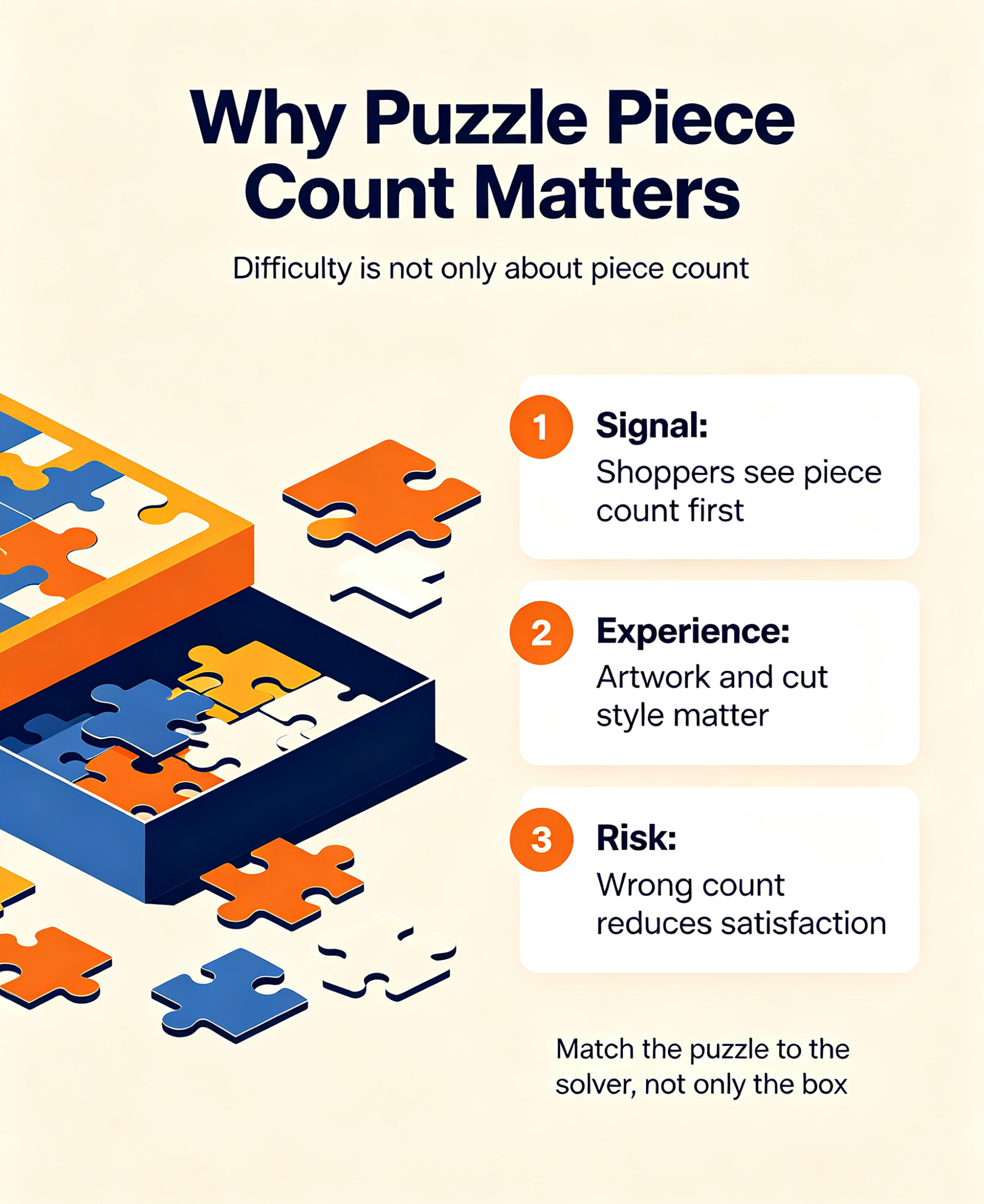
A jigsaw puzzle's piece count is the first difficulty signal that shoppers see on a product page or retail box. It helps customers quickly decide whether the puzzle is appropriate for their age, experience level, available time, and desired challenge.
However, piece count alone does not determine puzzle difficulty. A 500-piece puzzle with large, colorful objects can be easier than a 300-piece puzzle featuring a low-contrast forest, a blue sky, repetitive flowers, or a monochrome illustration. Image complexity, piece size, cut style, material quality, and color separation all influence the solving experience. [piecehouse.co]
For a custom puzzle brand, choosing the wrong count can lead to avoidable problems:
- A children's puzzle may feel frustrating because pieces are too small.
- A premium adult puzzle may feel too simple for its price point.
- A promotional puzzle may take too long for a casual user to complete.
- A photo puzzle may become difficult when faces, dark areas, or similar background colors are divided into too many small pieces.
- A beautiful design may lose visual impact if the finished puzzle size is too small.
- A box may not adequately communicate age suitability, challenge level, or finished dimensions.
The right piece count turns printed artwork into a satisfying product experience. It helps a buyer feel that the puzzle was designed specifically for them rather than produced as a one-size-fits-all item.
Quick Piece Count Guide
The table below provides a practical starting point for selecting a custom jigsaw puzzle piece count.
| Piece count | Typical user | Difficulty level | Common uses | Key production consideration |
| 2–12 pieces | Toddlers | Very easy | Early-learning boards, chunky puzzles | Use large, durable pieces and age-appropriate safety design |
| 12–48 pieces | Preschool children | Easy | Educational puzzles, gifts, cartoon puzzles | Bright artwork and large visual areas work best |
| 50–100 pieces | Young children | Easy to moderate | School activities, character puzzles, travel games | Piece size should remain easy for small hands |
| 100–300 pieces | Older children and families | Moderate | Family gifts, souvenirs, educational products | A strong entry-level custom puzzle range |
| 500 pieces | Casual adults | Moderate | Photo puzzles, corporate gifts, travel retail | Good balance of challenge, cost, and retail appeal |
| 750–1,000 pieces | Adult hobbyists | Challenging | Art puzzles, branded collections, premium gifts | Requires detailed artwork and strong packaging communication |
| 1,500–2,000+ pieces | Experienced puzzlers | Advanced | Collector editions, specialty retail, art licensing | Needs robust board quality, accurate cutting, and larger finished size |
As a general market reference, manufacturers commonly offer custom puzzles from approximately 24 pieces for young children through 2,000 pieces or more for dedicated adult puzzlers. The 1,000-piece format is widely used in adult retail puzzle ranges, while 1,500- and 2,000-piece products are usually positioned as advanced or premium projects. [custom-jigsaw-puzzle]
Choose by Player Age
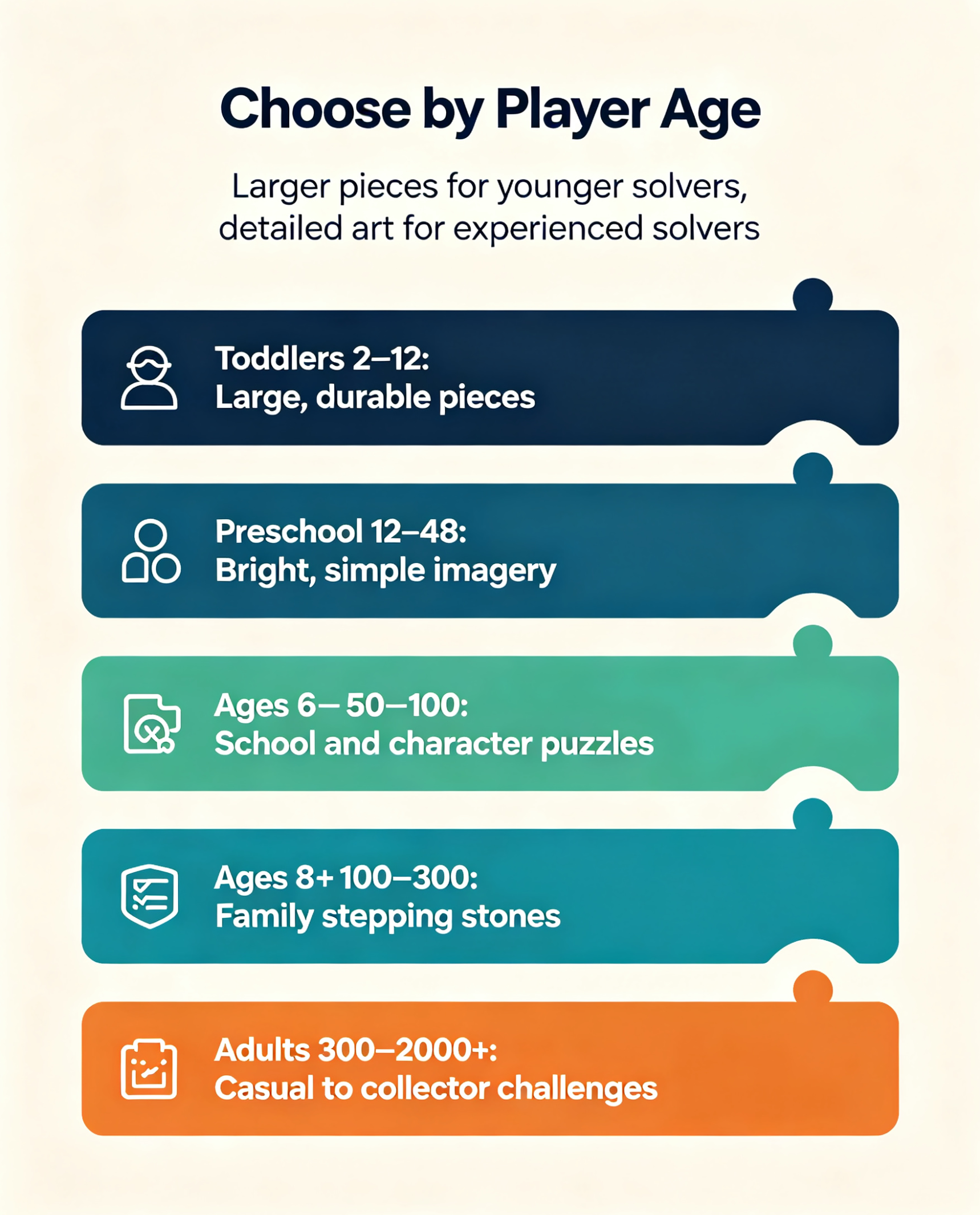
Age is usually the most important starting point for children's jigsaw puzzles. Still, age recommendations should be treated as guidance rather than an absolute rule. A child's previous puzzle experience, hand coordination, attention span, and interest in the subject matter can all change the appropriate level.
Toddlers: 2 to 12 Pieces
For toddlers, prioritize large pieces, durability, and simple imagery over high piece counts. Early puzzles often use board-style formats, inset pieces, knobs, or thick components that are easier to grasp.
Suitable themes include:
- Animals
- Vehicles
- Alphabet and numbers
- Fruit and food
- Simple household objects
- Bright cartoon characters
Avoid artwork with too much background detail. A toddler does not need a complex scenic image. They need clear visual recognition and pieces that are comfortable to hold.
Preschoolers: 12 to 48 Pieces
For children around ages three to five, a 12-, 24-, 36-, or 48-piece jigsaw puzzle can create a manageable challenge. Industry age guides commonly place 12–24-piece puzzles around the preschool stage and 24–48-piece formats around the next learning stage, although individual ability varies. [rgsgroup.co]
For this category, choose:
- Large, easy-to-handle puzzle pieces
- High-contrast colors
- Distinct objects and outlines
- Simple visual storytelling
- Thick board material that resists bending
For example, a 24-piece dinosaur puzzle with clearly separated characters, colorful terrain, and a simple sky is likely to be more enjoyable than a 24-piece image with dark jungle foliage and similar green tones.
Children Ages 6 to 8: 50 to 100 Pieces
A 50- to 100-piece custom puzzle suits many school-age children who have already developed basic sorting and matching skills. This range works well for educational products, licensed character-style collections, museum gift shops, and family activity kits.
A 100-piece puzzle can also become a strong branded product because it feels more substantial than a beginner puzzle while remaining achievable within one or two sessions. Some custom photo-puzzle suppliers position larger 100-piece formats for children roughly ages seven to twelve, while noting that exact safety and age labeling should always match the specific product design. [giftenova]
Children Ages 8+: 100 to 300 Pieces
For older children, 100, 180, 200, 250, and 300 pieces are useful stepping-stone formats. They create a more immersive activity without requiring the time commitment of a 500-piece adult puzzle.
This range is effective for:
- Geography and science puzzles
- Educational publishers
- School fundraising products
- Family-oriented souvenirs
- Customized children's gifts
- Brand storytelling projects
Some puzzle guidance notes that children with more experience may move into 200-piece puzzles at around the upper-primary level, and capable eight-year-olds may manage much higher counts depending on design complexity and previous experience. [activepuzzles]
Choose by Adult Skill Level
Adult puzzle buyers are diverse. A first-time adult puzzler, a family looking for a weekend activity, and a collector seeking an advanced project should not receive the same recommendation.
Beginner Adults: 300 to 500 Pieces
For an adult who is new to jigsaw puzzles, 300 to 500 pieces is often a practical starting point. It gives the user enough pieces to feel accomplished while avoiding the intimidation of a large, multi-session project.
Choose this range for:
- First-time hobby puzzles
- Corporate gifts
- Branded promotional puzzles
- Tourist destination products
- Custom photo puzzles
- Family game nights
- Subscription box products
A 500-piece count is particularly versatile. It supports a reasonably detailed image, fits common retail expectations, and is usually easier to complete within a weekend than a 1,000-piece puzzle.
Casual and Intermediate Adults: 500 to 1,000 Pieces
For casual puzzlers, 500 to 1,000 pieces creates a stronger sense of challenge and value. Industry guidance commonly identifies 500 pieces as moderately difficult and 1,000 pieces as a more demanding format because smaller pieces create more possible placements and extend completion time. [piecehouse.co]
A 1,000-piece custom puzzle is ideal when a brand wants to create a premium-feeling product with:
- Detailed illustrations
- Travel photography
- Art reproductions
- Botanical scenes
- Cityscapes
- Food and lifestyle images
- Limited-edition packaging
- Collector-oriented themes
Before choosing 1,000 pieces, review the artwork carefully. A detailed city map may work well. A pale beach photograph with large areas of sand and sky may cause unnecessary frustration unless that difficulty is intentional.
Advanced Puzzlers: 1,500 to 2,000+ Pieces
A 1,500-, 2,000-, or higher-piece puzzle is a specialty product. It is appropriate for consumers who actively enjoy long projects, sophisticated artwork, and high challenge levels.
These formats are commonly suited to enthusiast and collector markets, where puzzle completion may take many sessions and sometimes weeks. One recent difficulty guide estimates that 1,500–3,000-piece puzzles can require approximately 15–50+ hours, while 4,000-piece puzzles may become long-term projects. Actual completion time varies widely with image complexity and solver experience. [sparkspuzzles]
For advanced products, quality becomes especially important. Weak interlocking, inaccurate cuts, inconsistent thickness, or excessive puzzle dust can damage the experience more severely because customers spend far more time handling the pieces.
Evaluate Image Complexity First
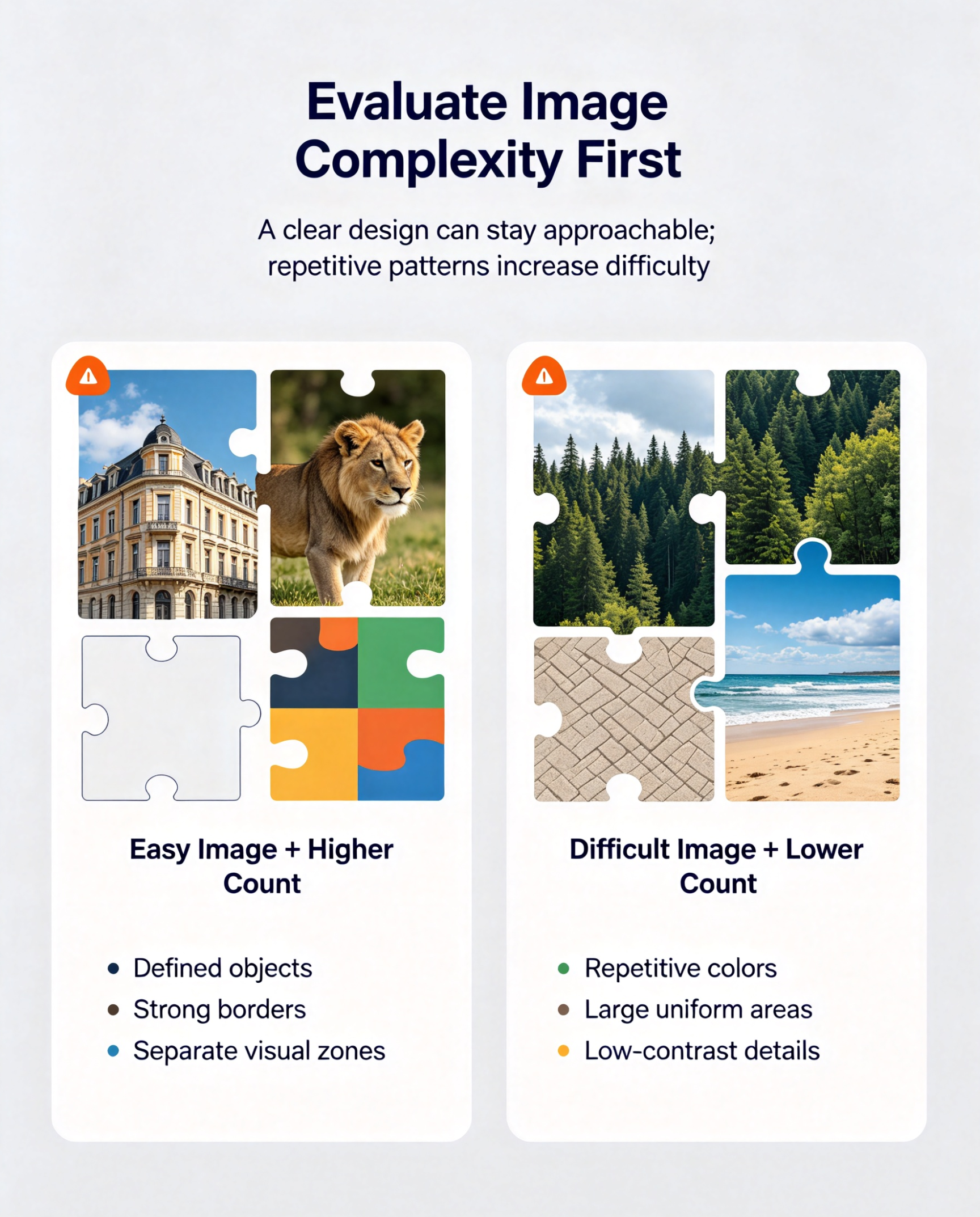
One of the biggest information gaps in generic "how many puzzle pieces should I choose?" articles is that they treat piece count as the only measure of difficulty. In product development, the artwork can matter as much as the piece count.
A puzzle's visual complexity depends on several factors:
- Number of distinct objects
- Color contrast between areas
- Repetition in the image
- Amount of fine detail
- Large areas of one color
- Gradients, shadows, and low-contrast photography
- Similar textures, such as leaves, grass, ocean waves, clouds, or bricks
Research and puzzle-industry guidance agree that repetitive patterns, similar colors, abstract designs, and images with subtle visual differences increase difficulty. By contrast, highly recognizable objects, distinct color zones, and strong visual separation make sorting easier. [piecehouse.co]
Easy Image + Higher Piece Count
A 1,000-piece illustration may remain approachable when it includes:
- Clearly defined buildings
- Different colored clothing
- Strong borders and outlines
- Distinct animals or objects
- Separate visual zones
- A broad color palette
Difficult Image + Lower Piece Count
A 500-piece puzzle may feel advanced when it includes:
- Dense foliage
- Repeating floral patterns
- A mostly blue sky
- Snow scenes
- Dark nighttime photography
- Abstract color gradients
- Similar architectural windows
- Close-up texture photography
A practical rule for product teams is simple: if the image is visually repetitive, reduce the piece count, enlarge the piece size, or clearly label the puzzle as an advanced challenge.
Match Piece Count to Puzzle Size
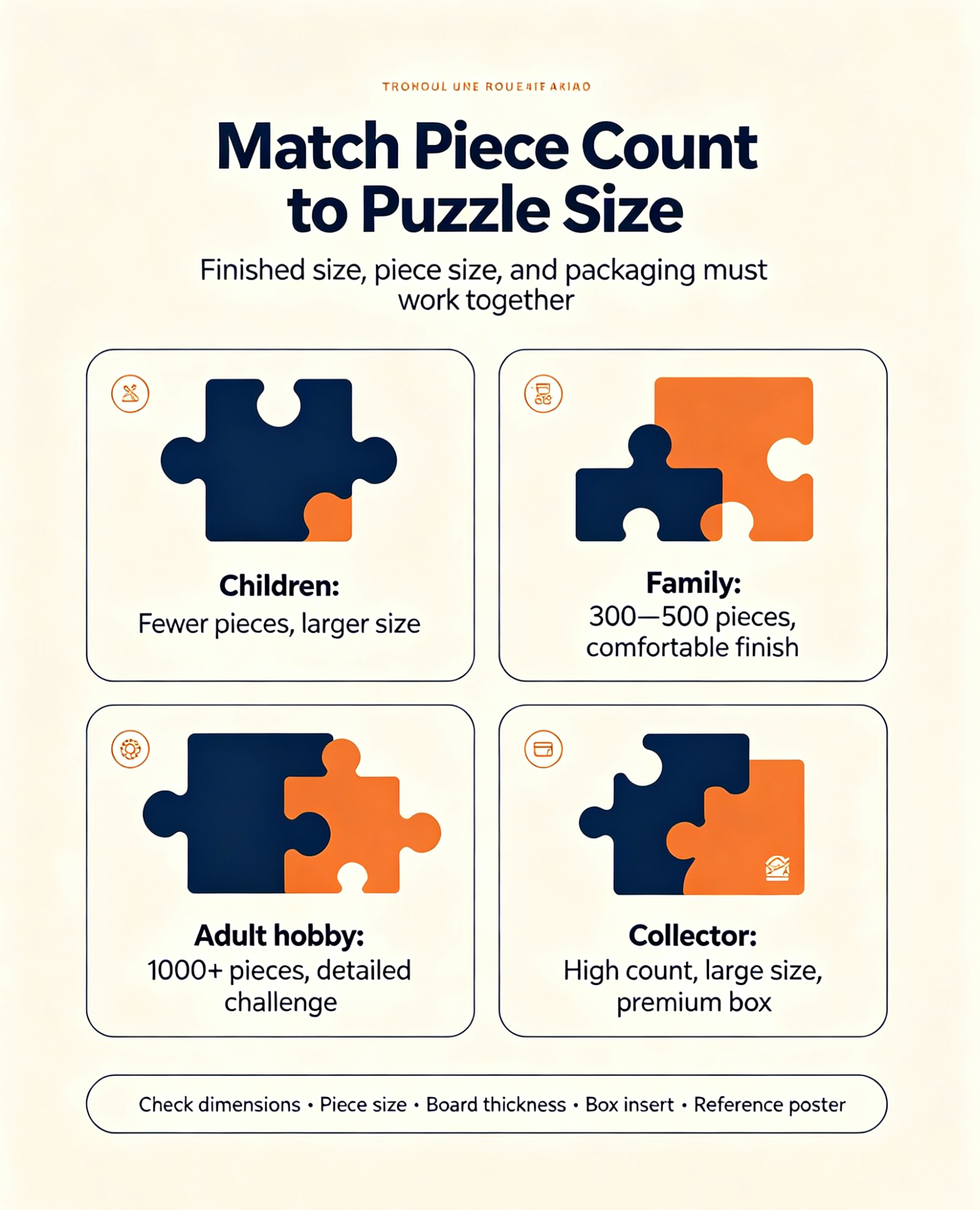
The finished size of a jigsaw puzzle is closely linked to the number of pieces. Buyers may assume a higher piece count automatically means a much larger puzzle, but that is not always true. Manufacturers can create a 1,000-piece puzzle with relatively small pieces or a 500-piece puzzle with larger pieces.
For brands, this decision affects both the user experience and manufacturing specification.
| Product goal | Recommended approach |
| Easier handling for children | Use fewer pieces with larger individual pieces |
| Premium adult challenge | Use 1,000+ pieces with standard or smaller pieces |
| Family activity | Use 300–500 pieces with a comfortable finished size |
| Wall-worthy photo puzzle | Increase finished size enough to preserve image detail |
| Travel or compact gift | Choose a lower count or compact finished dimensions |
| Luxury collector product | Combine high count, large finished size, rigid box, and premium print finish |
For reference, commercial examples show that puzzle sizes can range from about 13.5 × 18.875 inches for a 60-piece product to around 30 × 24 inches for a 1,000-piece product, depending on the manufacturer's die configuration and intended format. [springbok-puzzles]
When creating a custom puzzle, ask the supplier for the following details before finalizing the piece count:
1. Finished puzzle dimensions
2. Approximate individual piece size
3. Available die-line or cutting pattern
4. Board thickness and material specification
5. Box dimensions and insert options
6. Whether a reference poster is included
7. Recommended age grade and warning requirements
8. Artwork resolution requirements for the selected size
This process prevents a common mistake: approving an attractive digital design without checking whether it will still look clear after being divided into hundreds or thousands of pieces.
Select by Product Purpose
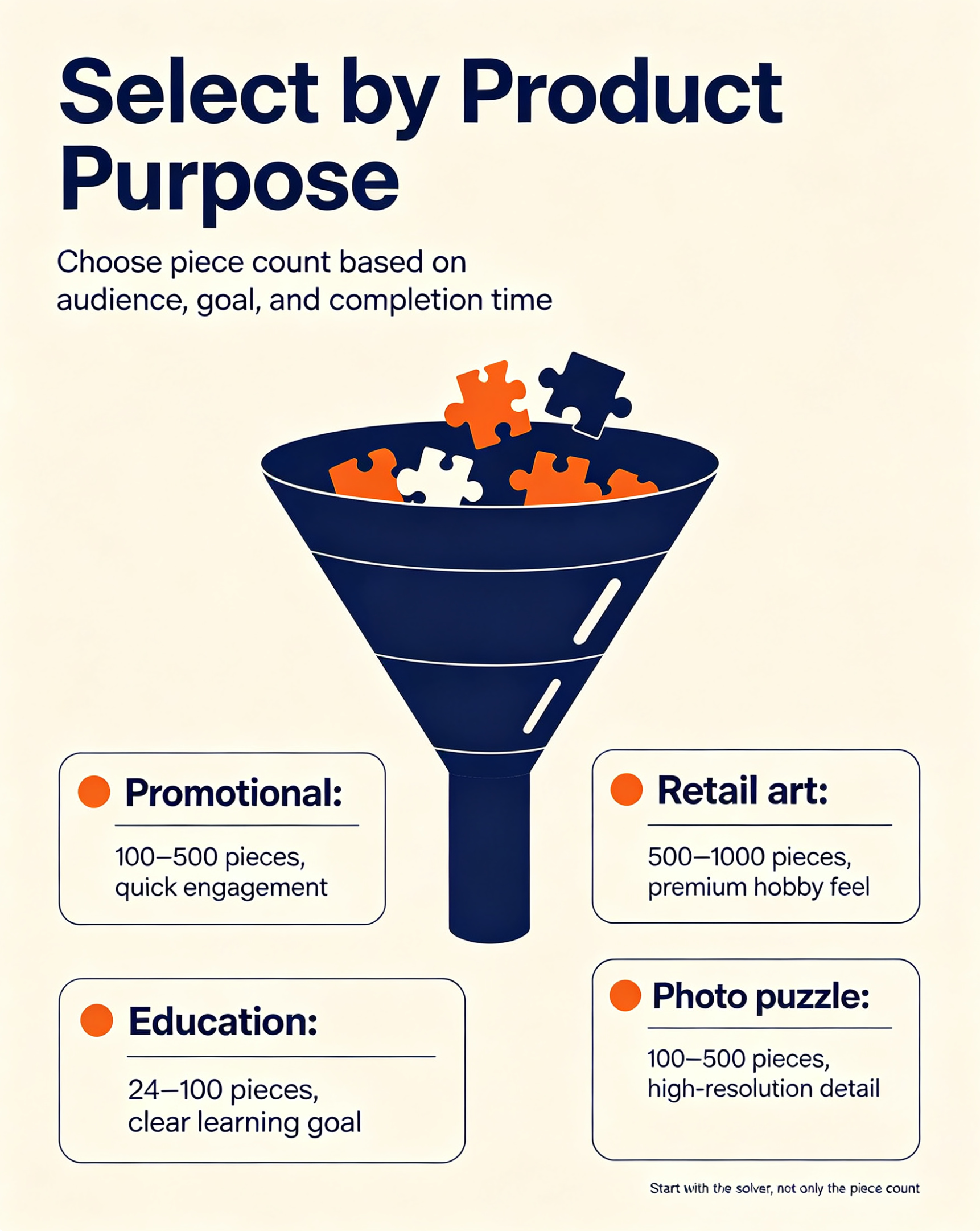
The best custom jigsaw puzzle piece count depends heavily on the commercial purpose of the product.
Promotional and Corporate Puzzles
For trade shows, direct mail, client gifts, employee engagement kits, and brand campaigns, 100 to 500 pieces often works best.
A 100- or 250-piece puzzle can be completed in a relatively short time and is more likely to be used by a wider audience. A 500-piece puzzle feels more valuable and can support richer brand storytelling, but it requires greater user commitment.
For a corporate campaign, consider using the puzzle image to reveal:
- A new product range
- A company milestone
- A destination or event theme
- A sustainability message
- A team or customer community image
- A "before and after" visual story
Retail Art and Hobby Puzzles
For adult retail, 500 and 1,000 pieces are usually the most commercially flexible formats. A 500-piece product can attract casual buyers, while a 1,000-piece format signals a more immersive hobby experience.
Use 1,000 pieces when your design has enough visual content to reward close attention. This format is especially suitable for illustrated art, city scenes, detailed interiors, seasonal collections, cultural themes, and premium boxed gift products.
Educational Puzzles
For educational brands, start with the learning objective rather than the highest possible count.
A 24-piece alphabet puzzle, a 48-piece animal habitat puzzle, or a 100-piece world-map puzzle may be more effective than a complicated 500-piece design. The puzzle should support learning, not overwhelm the learner.
Custom Photo Puzzles
Photo puzzles require special attention. Personal photos often contain large areas of sky, walls, grass, water, or low-contrast backgrounds. These areas can become difficult when the piece count is too high.
For a family portrait, wedding image, pet photo, or vacation image:
- Choose 100–300 pieces for a casual gift
- Choose 500 pieces for a more meaningful adult project
- Choose 1,000 pieces only when the photo has strong detail across the entire composition
- Avoid placing faces in very dark, blurry, or highly repetitive areas
- Use sharp, high-resolution source photography
- Consider adding a printed reference poster
A Practical Selection Framework
Before ordering a custom jigsaw puzzle, use this five-step decision process.
1. Define the Main User
Identify whether the product is for toddlers, children, families, casual adults, experienced hobbyists, or collectors.
Do not base the decision only on the purchaser. A parent may buy the puzzle, but the child is the actual user. A company may order the puzzle, but its clients or employees determine whether the experience succeeds.
2. Set the Desired Completion Time
Decide how long you want the puzzle experience to last.
- Short activity: 12–100 pieces
- One-session family activity: 100–300 pieces
- Weekend project: 300–500 pieces
- Multi-session hobby project: 500–1,000 pieces
- Long-term enthusiast challenge: 1,500–2,000+ pieces
Completion-time estimates are not guaranteed. They vary with artwork, piece shape, experience, and the number of people solving together. Still, defining a target time helps product teams make a more customer-centered choice. [eeboo]
3. Score the Artwork
Review the design before selecting a count.
Ask:
- Does the image contain clear focal points?
- Are colors visibly separated?
- Is there enough detail across the full image?
- Are there repetitive patterns?
- Will key branding elements remain visible when divided into pieces?
- Does the image have large empty areas?
If the artwork is complex but repetitive, lower the count or present the product as a deliberate challenge.
4. Confirm Physical Specifications
Piece count must work with the final product dimensions, material, board thickness, cutting style, and packaging.
For example, a 1,000-piece puzzle with very small pieces may appeal to advanced hobbyists but not to older users seeking easy handling. A 100-piece children's puzzle may need larger pieces and stronger board stock to withstand repeated assembly.
5. Test Before Full Production
For commercial puzzle programs, a physical sample is valuable. Test the puzzle with people who resemble the intended customer group.
Observe:
- Whether pieces connect smoothly
- Whether the image is easy to sort
- Whether pieces bend or delaminate
- Whether the box clearly states the count and age range
- Whether the puzzle feels too easy or too difficult
- Whether the finished size meets customer expectations
This sample stage can protect your product launch from complaints, returns, and poor reviews.
Custom Manufacturing Considerations
For OEM and ODM buyers, puzzle piece count should be specified together with the full production brief. A professional custom puzzle project requires more than a quantity and an image file.
At XingKun, a complete custom jigsaw puzzle inquiry can include:
- Target piece count
- Finished puzzle size
- Artwork file and resolution
- Intended age group
- Material preference, such as greyboard or other board options
- Piece cut style and die-line requirements
- Box type, such as tuck-end box, rigid box, magnetic box, or custom gift box
- Inner bag and accessory requirements
- Reference poster or instruction sheet
- Surface finish, such as matte lamination, gloss lamination, foil stamping, embossing, or spot UV
- Order quantity and target market
Packaging is also part of the puzzle experience. A well-designed box protects the pieces, communicates the difficulty level, showcases the artwork, and supports retail presentation. For higher-value 1,000-piece and collector editions, a rigid box, premium finish, clear product information, and a reference poster can strengthen perceived value.
Common Piece Count Mistakes
Avoid these frequent product-development errors.
- Choosing 1,000 pieces because it appears premium, even when the artwork lacks sufficient detail.
- Using very small pieces for children or users who need easier handling.
- Treating age guidance as universal rather than considering ability and safety requirements.
- Failing to state finished size on the packaging.
- Using low-resolution artwork that becomes blurry after printing.
- Selecting a high piece count for a promotional giveaway with limited user time.
- Ignoring board thickness, cutting precision, and interlocking quality.
- Skipping physical sampling before mass production.
- Not including a reference image for complex adult puzzles.
- Using vague packaging claims such as "for all ages" when the product is designed for a specific user group.
Conclusion
The right jigsaw puzzle piece count balances user ability, image complexity, completion time, finished size, and product positioning. For young children, fewer and larger pieces are usually the best choice. For family activities and promotional projects, 100 to 500 pieces often provide broad appeal. For adult hobby and retail collections, 500 and 1,000 pieces are versatile options. For premium collectors, 1,500 pieces and above can create a longer, more demanding experience.
The strongest custom puzzle products are planned from the user backward. Start with the intended solver, assess the artwork honestly, confirm the physical specifications, and test a sample before full production. XingKun can help brands, wholesalers, and manufacturers turn this information into a custom puzzle and packaging specification built for the right market.
Planning a custom jigsaw puzzle collection? Contact XingKun with your artwork, target market, desired piece count, finished size, and packaging concept to receive tailored OEM and ODM production guidance.
FAQ
1. What is the best jigsaw puzzle piece count for beginners?
For most adult beginners, a 300- to 500-piece puzzle is a good starting point. It provides a satisfying project without the long time commitment and visual complexity of a 1,000-piece puzzle. Choose a colorful image with distinct objects for the easiest experience. [eeboo]
2. Is a 500-piece or 1,000-piece puzzle better for adults?
A 500-piece puzzle is better for casual adults, families, gifts, and shorter projects. A 1,000-piece puzzle is better for hobbyists who want a longer challenge and enjoy detailed artwork. The correct choice depends on the user's experience, available time, and image complexity. [piecehouse.co]
3. How many pieces should a puzzle have for a 5-year-old?
A 24- to 48-piece puzzle is often a reasonable starting range for many five-year-olds, especially when it uses large pieces, bright colors, and clear visual subjects. Individual ability varies, so confirm age grading and safety requirements for the specific product. [rgsgroup.co]
4. Does a higher piece count always mean a harder puzzle?
Usually, more pieces increase the challenge because there are more possible placements and smaller visual areas per piece. But image complexity, repeated colors, puzzle cut style, and individual piece shape can make a lower-count puzzle more difficult than a higher-count puzzle. [piecehouse.co]
5. What piece count is best for a custom photo puzzle?
For most personal photo puzzles, 100 to 300 pieces work well as gifts and family activities. A 500-piece puzzle suits a detailed photo with clear subjects and varied colors. Use 1,000 pieces only for high-resolution images with detail across the full composition.
6. What jigsaw puzzle piece count is best for corporate gifts?
A 100-, 250-, or 500-piece puzzle is often suitable for corporate gifts. Choose 100 or 250 pieces for quick engagement, events, and promotions. Choose 500 pieces when you want a more premium, memorable product that recipients can complete over a weekend.
7. Can XingKun produce custom jigsaw puzzles with different piece counts?
Yes. XingKun can support OEM and ODM custom puzzle projects with specifications based on the intended audience, artwork, finished size, packaging, material, and order quantity. Contact the team with your project requirements to confirm available die-lines, dimensions, piece counts, and packaging options.
References
1. [Spark's Puzzles: Jigsaw Puzzle Difficulty Guide—Piece Count, Cuts & Patterns] — Piece-count ranges and estimated completion-time guidance for beginner through advanced puzzle formats. [sparkspuzzles]
2. [Piece House: What Factors Make a Jigsaw Puzzle Easier or Harder to Solve?] — Discussion of piece count, image complexity, repetitive patterns, and color similarity as difficulty factors. [piecehouse.co]
3. [eeBoo: What Makes a Puzzle Easy or Difficult to Complete?] — Overview of how piece count, experience level, available time, and image composition influence puzzle difficulty. [eeboo]
4. [Nautilus Puzzles: What Makes a Jigsaw Puzzle Difficult?] — Explanation of image complexity, color palette, and cut style as practical puzzle-difficulty variables. [nautiluspuzzles]
5. [Custom Jigsaw Puzzle: How Custom Puzzles Are Manufactured—A Buyer's Guide] — Common custom puzzle piece-count ranges and suggested market applications. [custom-jigsaw-puzzle]
6. [Springbok Puzzles: Custom Jigsaw Puzzles] — Example commercial piece-count and finished-size configurations. [springbok-puzzles]
7. [ActivePuzzle: Puzzles for Children According to Their Age] — Age-related puzzle-piece guidance and factors affecting suitability for children. [activepuzzles]
8. [RGS Group: Puzzle Age Guide] — Example age ranges associated with common children's jigsaw puzzle piece counts. [rgsgroup.co]


