Content Menu
● What Is a Custom Metal Badge?
● Why Turn a Logo Into a Metal Badge?
>> Brand value beyond a printed logo
● Step 1: Define the Badge's Purpose First
>> Questions to answer before design begins
● Step 2: Choose the Right Custom Metal Badge Type
>> Soft enamel vs. hard enamel: which is better?
● Step 3: Prepare Your Logo for Metal Badge Manufacturing
>> Submit a vector logo whenever possible
>> Convert your logo into a badge-friendly layout
>> Technical design checkpoints
● Step 4: Select Metal Material, Plating, and Color
>> Common metal materials
>> Choose plating deliberately
>> Use Pantone references for critical brand colors
● Step 5: Select the Right Badge Backing
>> Popular custom badge fasteners
>> Important safety note for magnetic badges
● Step 6: Approve a Production Proof Before Tooling
>> Custom metal badge proof checklist
● Step 7: Understand the Custom Badge Manufacturing Process
● Quality Control Standards That Buyers Should Request
>> Practical badge QC points
● Common Logo-to-Badge Mistakes to Avoid
>> 1. Using a website logo without redesigning it
>> 2. Making the badge too small
>> 3. Choosing too many colors
>> 4. Ignoring the metal plating
>> 5. Skipping physical sampling for premium projects
>> 6. Using a single pin post on a large badge
>> 7. Forgetting retail packaging
● How XingKun Can Support Your Custom Badge Project
>> Start your custom badge inquiry with these details
● Conclusion
● FAQ
>> 1. What file format is best for a custom metal badge logo?
>> 2. Can a complex logo with gradients become an enamel pin?
>> 3. What is the best size for a custom logo lapel pin?
>> 4. Should I choose soft enamel or hard enamel for my brand badge?
>> 5. Can I add my logo to the back of a metal badge?
>> 6. Are magnetic name badges safe for all products?
>> 7. Can XingKun provide packaging for custom metal badges?
>> 8. Can I order samples before placing a bulk custom badge order?
● References
A custom metal badge turns a flat brand logo into a durable, tactile brand asset that people can wear, collect, display, or attach to premium packaging. For overseas brands, wholesalers, and manufacturers, the key is not simply "putting a logo on metal"—it is redesigning the logo for a specific badge-making process, choosing the right material and finish, validating color and detail, and approving a production-ready proof before mass production.
At Shenzhen XingKun Packing Products Co., Ltd. (XingKun), we help businesses convert brand identities, character artwork, event graphics, and promotional concepts into custom badges, including custom lapel pins, enamel pins, magnetic badges, name badges, event badges, and logo pin badges. With more than 20 years of custom printing and packaging production experience, XingKun supports OEM and ODM projects for international brand owners, distributors, retailers, and promotional-product buyers. [xkdisplay]
This guide explains how to make a custom metal badge from your logo—from file preparation and badge type selection to proofing, quality control, packaging, and ordering decisions.
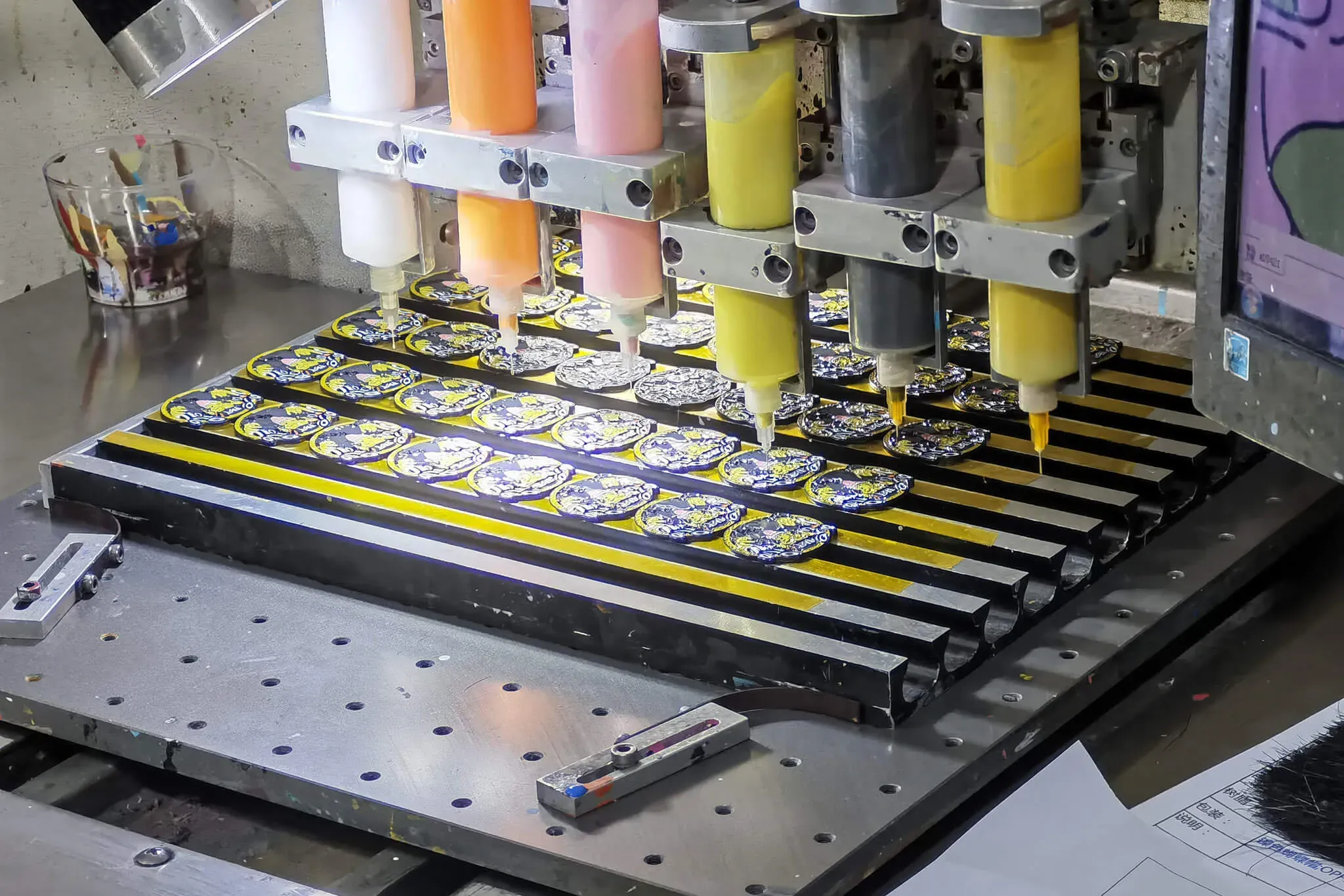
What Is a Custom Metal Badge?
A custom metal badge is a branded item made from metal—commonly zinc alloy, iron, brass, copper, stainless steel, or aluminum—and finished with techniques such as die striking, die casting, engraving, plating, enamel filling, screen printing, or epoxy coating.
Depending on the purpose, your logo can become:
- A custom enamel pin for merchandise, retail collections, fandom communities, and employee recognition
- A metal lapel badge for corporate uniforms, membership programs, conferences, and executive gifts
- A magnetic name badge for offices, hospitality teams, trade shows, and temporary staff identification
- A custom logo badge for premium packaging, product accessories, gift sets, and luxury-brand presentation
- A promotional pin badge for events, product launches, fundraisers, campaigns, and customer loyalty programs
- A collectible metal badge for limited editions, gaming communities, artists, museums, music brands, and anime-inspired products
The most successful badge designs do two things at once:
1. They preserve the recognizable elements of the original logo
2. They adapt those elements to the realities of metal manufacturing
A badge is not a printed business card. It has physical boundaries, raised metal lines, recessed color areas, thickness, plating, fasteners, and handling requirements. Designing with those constraints in mind is what makes the final product look premium rather than improvised.
Why Turn a Logo Into a Metal Badge?
A logo printed on paper or plastic can communicate your identity. A metal badge adds weight, permanence, texture, and perceived value.
For many brands, custom metal badges work particularly well because they are both functional and collectible. Employees can wear them. Customers can keep them. Retailers can include them with limited-edition products. Event organizers can use them as access markers or souvenirs.
Brand value beyond a printed logo
Metal badges can support several business goals:
- Build recognition: A repeatable badge design makes your identity visible at events, in retail environments, and on social media.
- Create merchandise revenue: Well-designed enamel pins can become standalone retail products or gift-with-purchase items.
- Reward loyalty: Brands can issue milestone pins, VIP badges, member badges, or seasonal collectible series.
- Improve uniform presentation: Corporate lapel pins and name badges help teams look consistent without requiring large logo placements on garments.
- Upgrade packaging: A metal badge added to a rigid box, gift box, or collectible kit creates a more premium unboxing experience.
- Commemorate moments: Anniversaries, product launches, company milestones, conferences, and charity campaigns all benefit from an item people can retain.
For example, a coffee brand could turn its icon into a 30 mm soft enamel pin for a membership reward program. The same artwork could be adapted into a magnetic staff name badge and attached to premium gift packaging for a holiday campaign. One visual asset becomes three practical brand touchpoints.
Step 1: Define the Badge's Purpose First
Before selecting colors or metal plating, identify exactly how the custom logo badge will be used. Your usage scenario determines the best size, thickness, attachment method, material, finish, and packaging.
Questions to answer before design begins
- Who will receive or wear the badge?
- Is it for retail sale, employee use, an event, a giveaway, or packaging decoration?
- Will it be worn daily, displayed, or included inside a product box?
- Does it need a pin, magnet, clip, adhesive, or keychain fitting?
- Is the audience adult consumers, collectors, employees, or children?
- Does the logo need exact corporate color matching?
- Is the priority low cost, luxury appearance, durability, or fine detail?
- Will this be a one-time campaign or a repeatable badge series?
- What quantity is needed for the first order?
- What is the deadline, including sample approval and shipping?
A vague request such as "make our logo into a pin" often leads to unnecessary revisions. A better brief is:
> "We need a 35 mm custom hard enamel lapel pin for a premium employee-recognition program. The logo must use our approved Pantone colors, have polished gold plating, include two butterfly clutches for stability, and be packed individually on branded backing cards."
That level of clarity helps your factory create a more accurate quotation and production proof.
Step 2: Choose the Right Custom Metal Badge Type
The best badge type depends on your logo style and product position. A design with bold outlines may be ideal for soft enamel. A luxury monogram may look stronger as a plated, engraved, or die-struck metal badge.
| Badge Type | Best For | Surface Appearance | Main Strength | Watch Out For |
| Soft enamel pin | Logos, mascots, promotional designs, collectible pins | Raised metal lines with recessed enamel color | Strong dimensional texture and cost-effective customization | Very small text and thin details may not reproduce cleanly |
| Hard enamel pin | Premium brands, corporate pins, retail collectibles | Smooth, polished, level surface | Refined and durable appearance | Usually needs simpler color areas and more processing |
| Die-struck metal badge | Luxury logos, anniversary badges, classic crests | Raised and recessed metal with little or no color | Elegant, durable, timeless | Less suitable for colorful illustrations |
| Printed metal badge | Complex artwork, gradients, photographic logos | Flat printed surface, often protected with epoxy | Reproduces detailed, full-color graphics | Does not create the same raised-line enamel look |
| Engraved badge | Name badges, serial information, premium identification | Permanent etched or laser-marked details | Excellent for text, names, numbers, and personalization | Limited color possibilities |
| Magnetic badge | Hospitality, office staff, uniforms, temporary use | Depends on face treatment | Avoids pinholes in clothing | Magnet selection requires safety and use-case review |
| Button badge | Large-volume promotions, campaigns, events | Printed artwork beneath a clear cover | Fast, economical, color-flexible | Less premium than enamel or die-struck metal |
XingKun's badge offering includes custom pin badges, magnetic name badges, event badges, custom lapel pins, cartoon enamel pins, and anime enamel pins, allowing brands to select a format aligned with their campaign or customer segment. [xkdisplay]
Soft enamel vs. hard enamel: which is better?
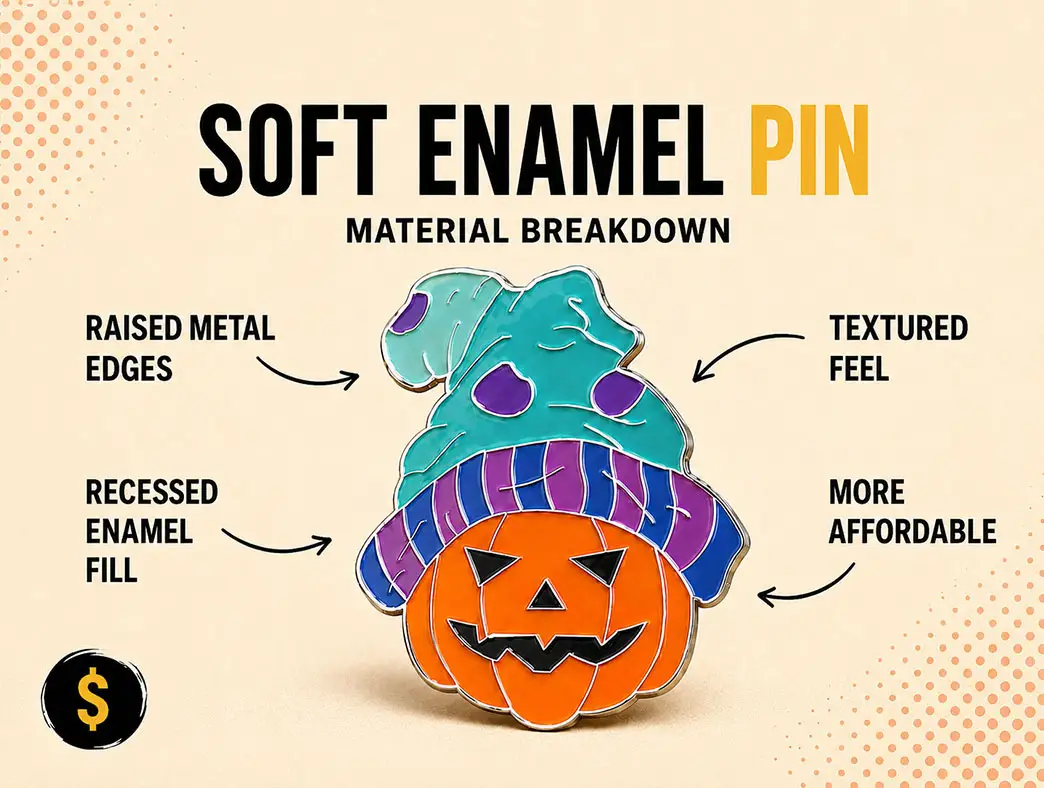
Choose soft enamel when you want obvious raised metal borders, richer texture, and a classic collectible-pin appearance. It works well for bold logos, line-art illustrations, icons, and designs that benefit from visible metal outlines.
Choose hard enamel when you want a smoother, more polished surface suitable for premium corporate gifts, polished brand logos, commemorative pins, and upscale merchandise.
Neither option is universally "better." The right choice depends on the feeling you want customers to experience:
- Soft enamel: expressive, dimensional, collectible, youthful
- Hard enamel: smooth, polished, formal, premium
- Die-struck metal: heritage, luxury, authority, minimalism
- Printed metal: detailed, colorful, illustrative, flexible
Step 3: Prepare Your Logo for Metal Badge Manufacturing
The most important production principle is simple: a logo must be translated, not merely copied.
A logo designed for a website, product label, or digital advertisement may contain gradients, hairline strokes, transparent effects, photographic textures, tiny trademark symbols, or small text. These elements often need adjustment before they can become a clean custom metal badge.
Submit a vector logo whenever possible
The most useful artwork formats are:
- AI
- EPS
- SVG
- PDF with editable vector paths
Vector artwork is preferred because it contains mathematical paths rather than pixels. This lets the supplier scale the artwork, create clean cut lines, and prepare the steel mold or production file accurately. Raster files such as JPG and PNG may be acceptable as visual references, but they can require redrawing before mold production. [createpins]
If you only have a PNG, JPG, screenshot, or photo of your logo, do not assume it is production-ready. Ask your badge supplier to confirm whether artwork tracing or vector reconstruction is needed.
Convert your logo into a badge-friendly layout
When adapting a logo, focus on the following design rules:
1. Simplify fine detail. Small internal lines can merge during stamping, casting, enamel filling, or plating.
2. Use strong metal borders. For enamel badges, metal lines separate one color area from another and help preserve the artwork's structure.
3. Avoid gradients in enamel designs. Enamel colors fill separate recessed areas; they do not naturally blend like a digital gradient. If your logo depends on a gradient, consider printed metal, screen printing, or a redesigned flat-color version. [patchmakersusa]
4. Increase the size of very small text. Tiny wording may become difficult to read. If a slogan is essential, enlarge the badge, reduce the copy, or move the slogan to the backing card.
5. Define color areas clearly. Adjacent enamel colors generally need metal separation rather than touching directly. [alchemymerch]
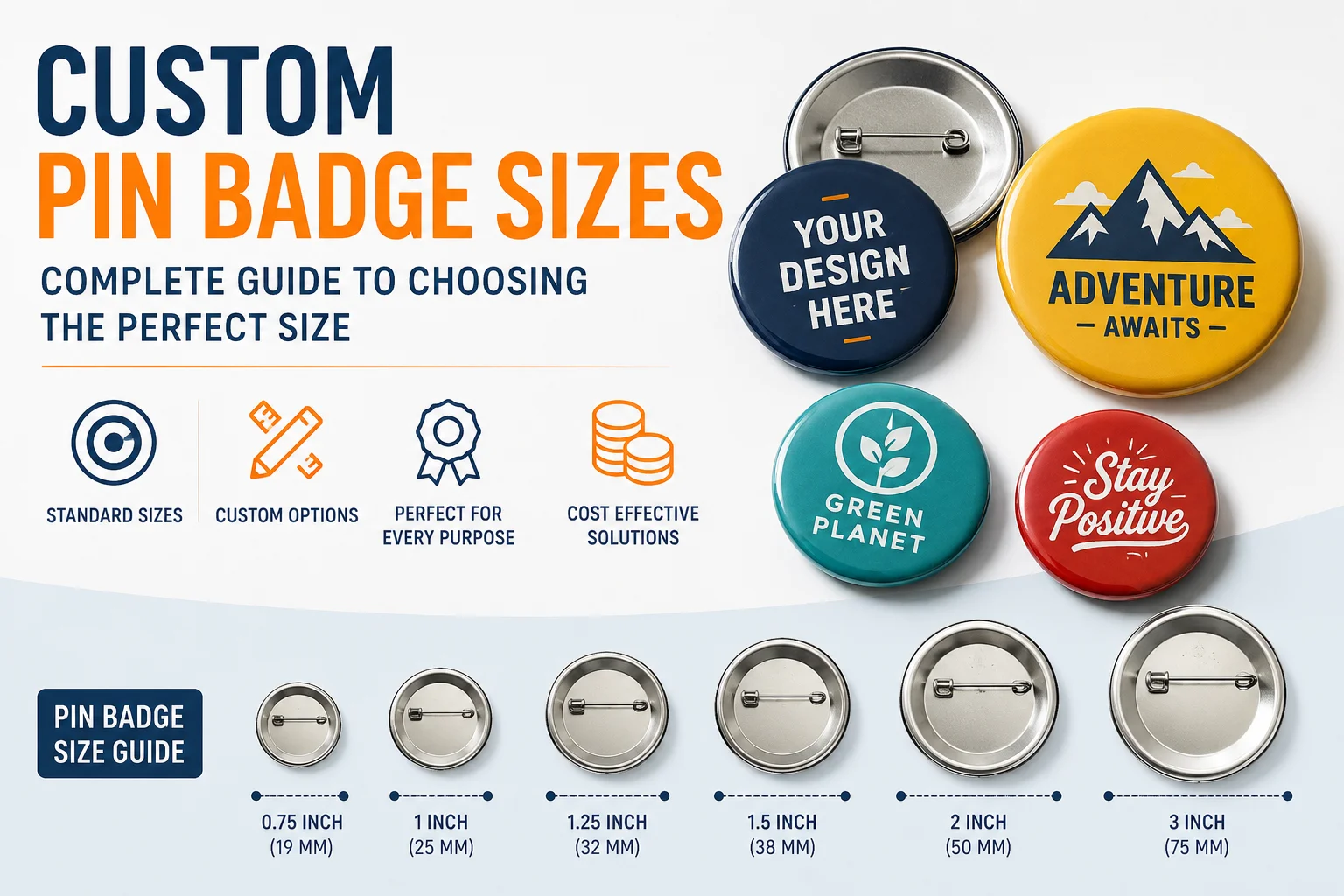
6. Choose a practical badge size. A simple icon may work at 20–25 mm. A logo with multiple characters, text, or fine elements may require 30–45 mm or more.
7. Plan the back of the badge. The reverse side can include a backstamp, serial number, copyright mark, edition number, manufacturer mark, or campaign message.
Technical design checkpoints
Production tolerances vary by process, material, plating, factory tooling, and design complexity. As a practical starting point, many pin-production guides recommend avoiding ultra-thin features, using metal lines around 0.2 mm or greater, maintaining enamel color areas around 0.3 mm or greater, and keeping text large enough to remain legible after production. [alchemymerch]
These are design guidelines, not universal guarantees. Your supplier should review the actual artwork and make recommendations based on the selected manufacturing process.
Step 4: Select Metal Material, Plating, and Color
A logo badge has two visual systems: the metal base and the color treatment. Both must support the brand identity.
Common metal materials
| Material | Best Use | Benefits | Considerations |
| Iron | Promotional pins and simple stamped badges | Economical and widely used | Less suitable for highly dimensional casting |
| Zinc alloy | Custom shapes, 3D badges, complex outlines | Flexible for die casting and detailed forms | Often selected for thick or irregular shapes |
| Brass | Premium lapel pins and fine detail | Solid feel and high-end appearance | Usually higher material cost |
| Copper | Luxury and antique-style badges | Rich visual character and plating compatibility | May not be necessary for standard campaigns |
| Stainless steel | Durable name badges and engraved pieces | Strong corrosion resistance and clean appearance | Less common for traditional enamel-pin tooling |
| Aluminum | Lightweight promotional pieces | Low weight and practical for some applications | May not create the same premium feel as brass or zinc alloy |
Choose plating deliberately
Plating changes the entire mood of the badge. Common choices include:
- Polished gold
- Antique gold
- Polished silver
- Antique silver
- Black nickel
- Matte black
- Copper
- Antique copper
- Dyed black metal
- Rainbow or specialty plating
A black-and-white logo might look striking in black nickel with white enamel. A luxury skincare brand could use polished gold with a minimal die-struck emblem. A heritage brand may prefer antique bronze or antique copper to create an established, archival character.
Use Pantone references for critical brand colors
For brand-sensitive projects, provide Pantone color references rather than relying only on RGB, CMYK, or screen screenshots. Screens vary, and a physical Pantone reference is more reliable for approving a target color. Suppliers commonly use Pantone Solid Coated references for enamel-pin color specification. [alchemymerch]
However, color matching should be discussed honestly. Plating, enamel chemistry, surface gloss, lighting conditions, and material texture can all influence how a final color appears. For critical projects, request a physical pre-production sample or color confirmation process before mass production.
Step 5: Select the Right Badge Backing
A beautiful front design can fail in use if the attachment method is wrong. The back fitting must match the badge size, weight, wear location, and user experience.
Popular custom badge fasteners
- Butterfly clutch: Standard and economical for lapel pins
- Rubber clutch: Comfortable and commonly used for collectible pins
- Deluxe locking clutch: More secure for premium or high-value pins
- Safety pin: Suitable for some button badges and event badges
- Magnet back: Avoids garment punctures and works well for name badges
- Tie tack: A refined option for formal lapel badges
- Brooch pin: Better for larger or heavier badge styles
- Adhesive back: Useful when the badge is attached to packaging, displays, or products rather than worn
For wide, heavy, or tall badges, use two attachment points to reduce spinning and help the badge sit flat on clothing.
Important safety note for magnetic badges
Magnetic fasteners can be convenient, but they require extra care—especially for products intended for children or consumer markets where magnets could detach. The U.S. Consumer Product Safety Commission states that certain consumer products containing loose or separable magnets are subject to a mandatory magnet safety standard; where a magnet fits entirely in the small-parts cylinder, the rule sets a flux-index limit of less than 50 kG² mm² for covered products. [cpsc]
For children's products, toys, collectibles, or products sold with detachable magnets, do not treat a magnet back as a simple aesthetic choice. Discuss age grading, applicable market rules, retention testing, warnings, packaging, and destination-country compliance with qualified testing and regulatory professionals.
Step 6: Approve a Production Proof Before Tooling
The production proof is one of the most valuable steps in the custom metal badge process. It is the document that converts your concept into production instructions.
Before approving a proof, check every detail carefully.
Custom metal badge proof checklist
- Correct logo version
- Correct spelling, punctuation, and dates
- Correct badge width and height
- Correct outline shape
- Correct metal plating
- Correct enamel or print colors
- Pantone references, where required
- Correct placement of raised metal lines
- Correct cutouts or holes
- Correct 2D or 3D effect
- Correct backstamp text or logo
- Correct fastener type and position
- Correct quantity
- Correct individual packaging or backing card requirement
Do not approve a proof based only on a fast visual glance. Ask: "If this exact proof becomes 5,000 pieces, is every element correct?"
A small typo, misplaced clutch, wrong plating, or missing color separation can be expensive to correct after a mold is made or mass production starts.
Step 7: Understand the Custom Badge Manufacturing Process
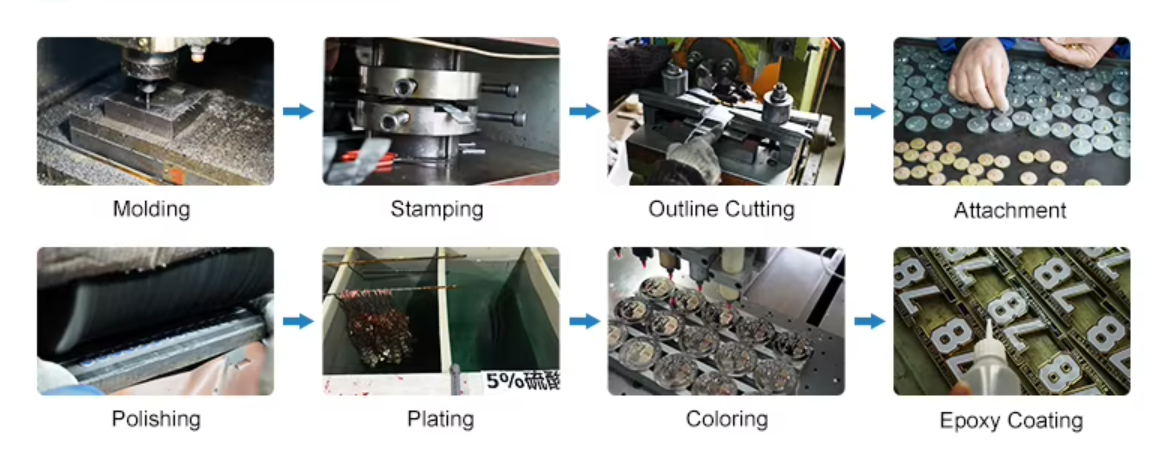
While exact processes differ by badge type, a typical enamel or metal badge workflow follows these stages:
1. Artwork review: The factory checks whether the logo can be produced cleanly at the chosen size and process.
2. Digital proof creation: The supplier prepares a production-style drawing with dimensions, colors, plating, and back fitting.
3. Customer approval: The buyer confirms the proof and final specifications.
4. Mold or tooling production: For die-struck or enamel pins, the approved artwork is converted into tooling that forms the metal design.
5. Stamping or die casting: The badge body is pressed or cast into the required shape and relief.
6. Trimming and polishing: Excess metal is removed and surfaces are refined.
7. Plating: The badge receives its selected metallic finish.
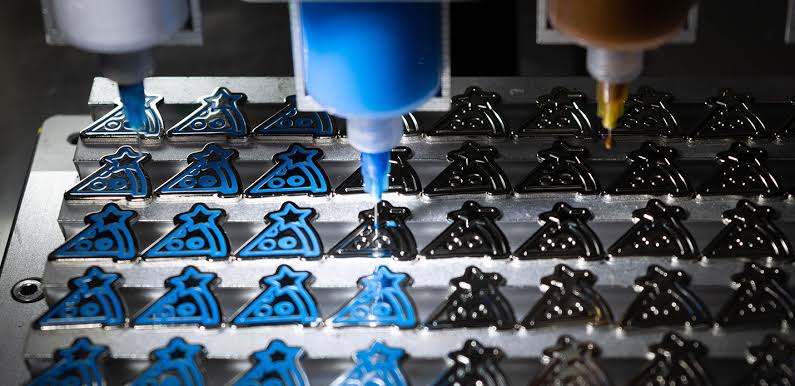
8. Enamel filling or printing: Recessed color areas are filled, or detailed graphics are printed depending on the product type.
9. Baking, curing, and surface finishing: Enamel is cured; epoxy or protective coatings may be added when required.
10. Attachment assembly: Pin backs, magnets, clutches, or other fittings are attached.
11. Quality control: The factory checks color, shape, plating, fastener strength, scratches, sharp edges, and packing condition.
12. Packaging and shipment: Finished badges are packed in polybags, backing cards, gift boxes, velvet pouches, or custom retail packaging.
XingKun's product information describes badge production stages including design, material selection, printing or engraving, stamping or casting, coloring, finishing, fastener attachment, quality control, and packaging. [xkdisplay]
Quality Control Standards That Buyers Should Request
A custom badge order should be evaluated as a manufactured branded product—not just as an artwork file. Buyers should define inspection priorities before the order begins.
Practical badge QC points
- Artwork accuracy: Does the finished badge match the approved proof?
- Color consistency: Are enamel or printed colors consistent across the production lot?
- Plating quality: Is the plating even, clean, and free from obvious discoloration?
- Edge quality: Are edges smooth and safe to handle?
- Enamel fill: Are color areas adequately filled without obvious overflow, bubbles, or contamination?
- Fastener strength: Is the pin, clutch post, magnetic fitting, or brooch fitting secure?
- Alignment: Is the back fitting centered and positioned correctly?
- Scratch control: Are polished surfaces protected from abrasion during packing and shipping?
- Count accuracy: Does every carton contain the correct quantity?
- Packaging compliance: Are backing cards, barcodes, warning labels, and retail packs correct?
For higher-value launches, ask about:
- Pre-production samples
- Approved-limit samples
- In-process photos
- Final random inspection
- AQL-based third-party inspection
- Carton drop testing for retail or e-commerce shipments
- Material declarations or compliance documentation when required by your market
Common Logo-to-Badge Mistakes to Avoid
1. Using a website logo without redesigning it
A digital logo may look excellent on a screen but contain gradients, tiny type, or fine lines that do not convert into enamel or stamped metal. Always request a manufacturability review.
2. Making the badge too small
A complex logo forced into a 15 mm badge can lose its identity. Increase size, simplify the artwork, or use printed metal if preserving detail is essential.
3. Choosing too many colors
Every additional enamel color can add complexity, risk, and cost. Limit the palette to the colors most important to brand recognition.
4. Ignoring the metal plating
Metal is not just a production detail. A wrong plating color can weaken the design even when the logo itself is correct.
5. Skipping physical sampling for premium projects
A digital proof cannot fully show plating brightness, enamel texture, weight, color appearance, or fastener feel. For luxury retail, corporate gifts, or major launches, a physical sample can reduce risk.
6. Using a single pin post on a large badge
Long or heavy badges may rotate on clothing. Two posts or a more stable attachment method often provide a better customer experience.
7. Forgetting retail packaging
If the badge is sold in stores or online, branded backing cards, barcodes, warning information, and protective individual bags should be considered from the beginning—not after production is finished.
How XingKun Can Support Your Custom Badge Project
XingKun is a China-based custom printing and packaging manufacturer serving overseas brands, wholesalers, and manufacturers with OEM and ODM solutions. In addition to custom packaging boxes, playing cards, jigsaw puzzles, printed books, stickers, and other printed products, XingKun offers badge categories such as magnetic badges, event badges, custom lapel pins, custom pin badges, cartoon enamel pins, and anime enamel pins. [xkdisplay]
Working with a supplier that understands both custom badges and packaging can be especially valuable when your project needs more than a loose pin. For example, you may need:
- A custom enamel pin with a branded backing card
- A collectible badge packed in a rigid gift box
- A limited-edition pin series included with playing cards or jigsaw puzzles
- Promotional badges for a product-launch kit
- Employee metal badges plus printed name cards and presentation packaging
- Retail-ready badge sets with custom inserts, labels, and outer cartons
Start your custom badge inquiry with these details
To receive a faster and more accurate quote, prepare:
- Your logo or artwork file
- Badge type: soft enamel, hard enamel, die-struck, printed, engraved, or magnetic
- Finished size in millimeters
- Shape: round, square, shield, custom outline, etc.
- Quantity
- Metal material or preferred plating
- Enamel colors and Pantone references if available
- Back fitting type
- Backstamp requirement
- Packaging requirement
- Target delivery date
- Destination country or region
- Any testing, labeling, or compliance requirements
Conclusion
Turning your logo into a custom metal badge is a strategic branding project, not just a decorative purchase. The strongest results come from choosing a badge type that suits the logo, simplifying artwork for metal production, specifying colors and plating clearly, selecting a practical fastener, and approving a detailed proof before tooling begins.
Whether you need premium custom lapel pins, collectible enamel badges, event badges, magnetic name badges, or retail-ready logo pins with custom packaging, the goal is the same: create a durable object that makes your brand more visible, memorable, and valuable.
Ready to transform your logo into a custom metal badge? Send XingKun your logo, intended badge size, quantity, preferred finish, and packaging requirements. Our team can help review manufacturability, recommend an appropriate badge process, prepare a production proof, and develop an OEM or ODM solution for your brand.
FAQ
1. What file format is best for a custom metal badge logo?
AI, EPS, SVG, and vector PDF files are preferred because they contain editable paths that can be used to prepare molds, cut lines, and production artwork. A JPG or PNG can be used as a reference, but it may need to be converted or redrawn as vector artwork before production. [createpins]
2. Can a complex logo with gradients become an enamel pin?
Not directly in most cases. Traditional enamel pin designs use separate color fills divided by metal lines, so they do not naturally reproduce smooth gradients. You can simplify the logo into flat colors, create a halftone-style interpretation, or choose printed metal with epoxy for detailed or gradient-based artwork. [patchmakersusa]
3. What is the best size for a custom logo lapel pin?
For simple icons, 20–25 mm may work well. For logos with text, multiple colors, or fine internal details, 30–45 mm is usually more practical. The final size should be determined after a supplier reviews the artwork and selected manufacturing method.
4. Should I choose soft enamel or hard enamel for my brand badge?
Choose soft enamel if you want visible raised metal borders and a textured, collectible appearance. Choose hard enamel if you prefer a smooth, polished, premium surface. The better option depends on your branding style, target price level, and artwork structure.
5. Can I add my logo to the back of a metal badge?
Yes. A backstamp can include your company logo, brand name, copyright notice, year, edition number, website, or product code. Backstamps are especially useful for collectible pins, official merchandise, and corporate badges.
6. Are magnetic name badges safe for all products?
No. Magnetic badges can be appropriate for adult workplace use, but detachable magnets require special consideration for children's products and certain consumer applications. U.S. safety requirements can apply to covered consumer products containing loose or separable magnets, so buyers should confirm use-case-specific compliance needs before production. [cpsc]
7. Can XingKun provide packaging for custom metal badges?
Yes. XingKun provides custom printing and packaging solutions and can support badge-related packaging such as branded backing cards, polybags, paper cards, gift boxes, rigid boxes, inserts, and retail-ready presentation packaging. [xkdisplay]
8. Can I order samples before placing a bulk custom badge order?
A sample or pre-production sample is recommended for high-value, color-critical, complex, or retail projects. It allows you to review the actual material, plating, enamel color, edge quality, fastener strength, and packaging before approving mass production.
References
1. XingKun. "[Badges]." Product categories, custom badge types, production-process overview, badge applications, and company information. Accessed August 31, 2026. [xkdisplay]
2. U.S. Consumer Product Safety Commission. "[Magnets Business Guidance]." Federal magnet-safety standard information, including the flux-index requirement for certain covered consumer magnet products. Accessed August 31, 2026. [cpsc]
3. U.S. Consumer Product Safety Commission. "[CPSC Approves New Federal Safety Standard for Magnets to Prevent Deaths and Serious Injuries from High-Powered Magnet Ingestion]." Safety context for high-powered magnets in consumer products. Accessed August 31, 2026. [cpsc]
4. WizardPins. "[Enamel Pin Guide]." General artwork guidance on enamel pin detail, metal-line thickness, color areas, and text sizing. Accessed August 31, 2026. [wizardpins]
5. Alchemy Merch. "[File Prep – Pins]." Vector artwork, Pantone color reference, line-thickness, color-area, and cutout guidance for pin production. Accessed August 31, 2026. [alchemymerch]
6. Create Pins. "[Complete Enamel Pin Design Guide (2026)]." Overview of vector artwork, mold preparation, layer setup, and enamel pin manufacturing workflow. Accessed August 31, 2026. [createpins]
7. Patch Makers USA. "[How to Design Your Own Custom Pin and the Best Color Schemes]." Practical guidance on flat colors, gradients, outline thickness, and logo-to-pin artwork adaptation. Accessed August 31, 2026. [patchmakersusa]
8. Ultimate Promotions. "[DIY Enamel Pin Design: Colour Matching]." Pantone-oriented color-matching considerations for enamel-pin projects. Accessed August 31, 2026. [ultimatepromotions]


