Content Menu
● What Is an Industrial Nameplate?
● Why Equipment Nameplates Matter
● What Information Should Be Included on a Nameplate?
>> Essential Content for Electrical Nameplates
>> Essential Content for Safety Nameplates
● Choose the Right Nameplate Material
>> Aluminum Nameplates
>> Stainless Steel Nameplates
>> Brass Nameplates
>> Plastic and Film Nameplates
● Match the Marking Method to the Environment
>> Screen Printing
>> Chemical Etching
>> Engraving
>> Embossing
>> Photo-Anodized Aluminum
● A Practical Nameplate Selection Checklist
● Common Nameplate Problems and How to Prevent Them
>> Problem: The Text Is Too Small
>> Problem: The Adhesive Fails
>> Problem: Printed Information Wears Off
>> Problem: The Nameplate Is Installed in the Wrong Place
>> Problem: Variable Data Is Incorrect
● Expert Insight: Design for the Product's Entire Life Cycle
● Why Work With an Experienced Custom Nameplate Manufacturer?
● Request a Custom Nameplate Quote
● Frequently Asked Questions
>> What is the best material for an industrial nameplate?
>> What should be included on a machine nameplate?
>> Are engraved nameplates more durable than printed nameplates?
>> Can QR codes and barcodes be added to metal nameplates?
>> How do I choose the right adhesive for a nameplate?
>> Can nameplates be made in multiple languages?
>> What files are needed for a custom nameplate order?
>> How can I make a nameplate last longer outdoors?
● References
Industrial nameplates do far more than display a logo or product number. A well-designed equipment nameplate communicates identity, operating limits, traceability, safety information, and maintenance requirements throughout a product's working life.
For machinery manufacturers, control-panel builders, equipment distributors, and global brands, the right nameplate can make information easier to read, simplify servicing, support product traceability, and help users recognize potential hazards. At Shenzhen XingKun Packing Products Co., Ltd., we have spent more than 20 years producing custom nameplates and printed identification products for brands and distributors in over 30 countries and regions. From our experience, the most effective nameplate is not simply attractive—it is engineered around the equipment, its environment, and the people who need to use it.
This guide explains what nameplates are, what information they should include, how to choose the right material and marking process, and how to avoid common specification mistakes before production begins.
What Is an Industrial Nameplate?
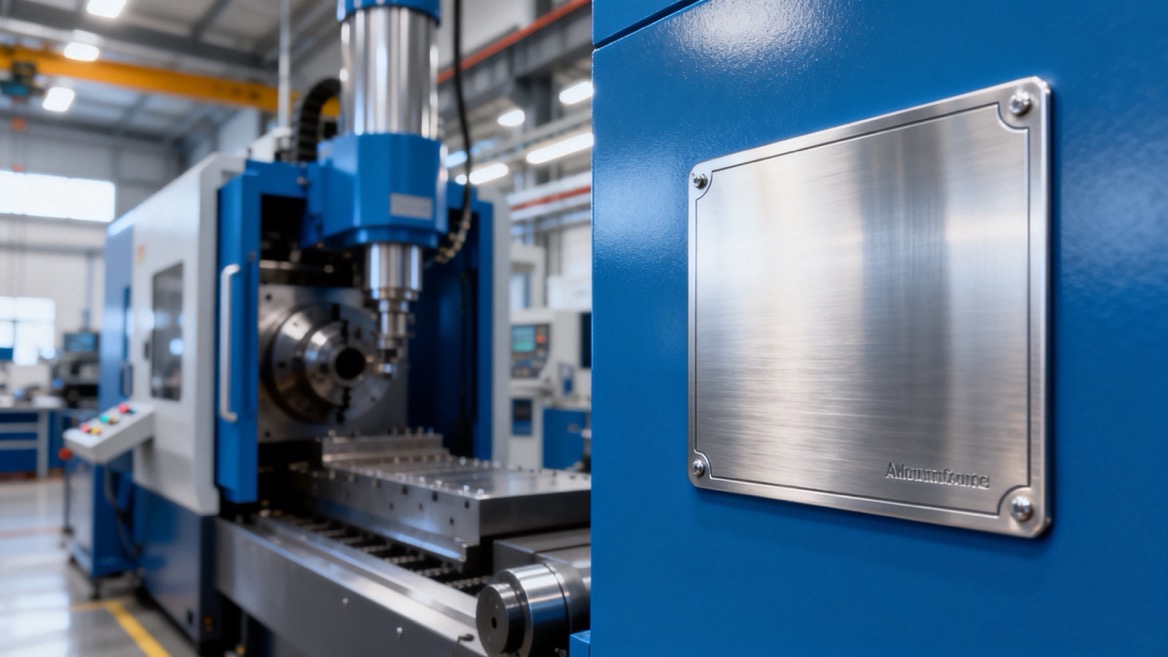
An industrial nameplate is a permanent or semi-permanent identification plate, label, or marking applied to equipment, machinery, electrical enclosures, tools, appliances, control panels, and industrial products.
Depending on its purpose, a nameplate may be made from aluminum, stainless steel, brass, polycarbonate, polyester, acrylic, or other engineered materials. It may carry printed, engraved, etched, embossed, anodized, or laser-marked information.
A custom nameplate commonly serves one or more of these functions:
- Product identification, including brand name, model, part number, and manufacturing origin.
- Traceability, including serial number, batch number, QR code, barcode, or date code.
- Electrical rating communication, such as voltage, current, frequency, phase, wattage, and protection rating.
- Safety communication, including hazard symbols, warning statements, load limits, and operating restrictions.
- Instructional guidance, such as connection diagrams, control labels, maintenance reminders, and directional indicators.
- Brand presentation, including logos, metallic finishes, color matching, and premium visual details.
- Asset management, helping operators, technicians, and distributors identify equipment quickly.
In other words, a nameplate is often a small component with a major operational role. If it becomes unreadable, detached, corroded, or inaccurate, users may lose access to information that is necessary for operation, maintenance, replacement, or safe handling.
Why Equipment Nameplates Matter
A machine can be technically advanced, but it is harder to operate correctly when its essential information is unclear. Nameplates help bridge the gap between a product's engineering documentation and the real-world user standing in front of the machine.
For example, a motor-driven machine may require a visible plate showing its rated voltage, phase, frequency, full-load current, model designation, and serial number. When a technician needs to inspect, repair, relocate, or replace that machine, these details can save time and reduce the risk of selecting incompatible parts or power supplies.
Industrial nameplates are especially important in sectors where equipment is exposed to frequent use, vibration, moisture, heat, cleaning agents, oil, abrasion, ultraviolet exposure, or outdoor weather.
Common applications include:
- Manufacturing machinery and production lines
- Electrical cabinets and control panels
- HVAC systems and refrigeration equipment
- Pumps, valves, compressors, and motors
- Medical and laboratory equipment
- Food-processing machinery
- Telecommunications devices
- Marine and transportation equipment
- Automotive components
- Construction machinery
- Aerospace and defense components
- Consumer appliances and electronics
- Warehousing and logistics equipment
For many products, a nameplate is also part of the customer experience. A sharply printed, firmly attached, durable identification plate signals product quality. A peeling label, inconsistent logo color, or poorly positioned warning plate can create the opposite impression—even if the equipment itself performs well.
What Information Should Be Included on a Nameplate?
The content of a nameplate should always match the product, its intended market, its operating environment, and any applicable customer or regulatory requirements. There is no single universal layout for every machine.
However, most industrial equipment nameplates include a combination of the following information.
| Information Type | Typical Content | Why It Matters |
| Brand identity | Company name, logo, website, address | Identifies the manufacturer or supplier |
| Product identification | Product name, model number, item code | Helps users distinguish product versions |
| Traceability | Serial number, lot number, manufacturing date | Supports service, warranty, recalls, and quality control |
| Electrical ratings | Voltage, current, wattage, frequency, phase | Helps users connect and operate equipment correctly |
| Technical specifications | Capacity, pressure, speed, temperature range, dimensions | Communicates operating limits |
| Certification information | Required marks, approval symbols, compliance references | Supports market-specific product documentation |
| Safety content | Warning text, hazard icons, load limits, handling instructions | Helps communicate foreseeable hazards |
| Digital access | QR code, barcode, data matrix code | Links to manuals, parts lists, or asset records |
Essential Content for Electrical Nameplates
Electrical and electronic equipment often needs more detailed identification because users may need to confirm compatibility before installation or maintenance.
Typical electrical nameplate fields include:
- Manufacturer or supplier name
- Model or type designation
- Serial number
- Rated voltage
- Rated current
- Frequency
- Number of phases
- Wattage or power rating
- Protection rating, where applicable
- Wiring diagram reference
- Required certification markings
- Manufacturing date or code
Machinery electrical-equipment guidance commonly emphasizes that supplier information, model designation, serial number, voltage, phase, frequency, and full-load current should be legible, durable, and visible after installation. This makes the nameplate a functional part of product identification—not an optional decorative item.
Essential Content for Safety Nameplates
Safety nameplates should communicate the hazard quickly and clearly. They work best when placed close to the relevant hazard, control, access point, or operating area.
Examples include:
- High voltage
- Hot surface
- Moving parts
- Pinch point
- Crushing hazard
- Rotating blade
- Maximum load capacity
- Disconnect power before servicing
- Wear protective equipment
- Do not operate without guard in place
Safety messages should use concise, understandable language. OSHA's requirements for accident-prevention signs and tags state that wording should be easily read, concise, and contain enough information to be understood.
Choose the Right Nameplate Material
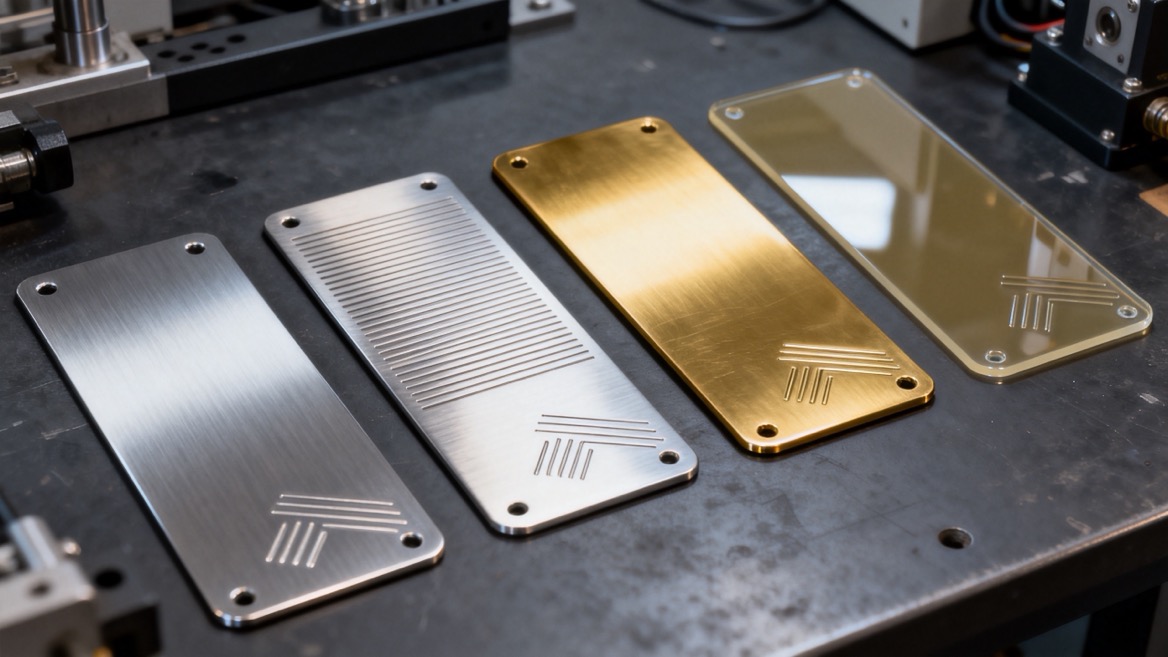
Material selection is one of the most important decisions in a custom nameplate project. A material that performs well in a clean indoor office may fail quickly on a factory floor, an outdoor generator, a commercial kitchen, or marine equipment.
The best choice depends on what the nameplate must survive.
Aluminum Nameplates
Aluminum is one of the most widely used materials for equipment identification plates. It is lightweight, corrosion-resistant, economical, and suitable for many industrial applications.
Aluminum nameplates are often used for:
- Machinery identification
- Electrical equipment
- Control panels
- Asset tags
- Appliance labels
- Outdoor equipment
- Serialized identification plates
Aluminum can be screen printed, engraved, embossed, anodized, or photo-anodized. Anodized aluminum is especially valued when long-term legibility and abrasion resistance are important because the image can be sealed beneath an anodic layer rather than sitting only on the surface.
Best for: General industrial equipment, serialized plates, lightweight applications, outdoor identification, and high-volume production.
Stainless Steel Nameplates
Stainless steel is selected when strength, corrosion resistance, hygiene, heat resistance, or aggressive cleaning conditions are priorities. It is commonly used in food processing, chemical environments, medical equipment, marine products, and heavy machinery.
Stainless steel is highly suitable for:
- Washdown environments
- Equipment exposed to frequent cleaning
- High-temperature locations
- Outdoor machinery
- Marine applications
- Chemical-processing equipment
- Premium permanent identification
Best for: Demanding environments where long service life matters more than minimum unit cost.
Brass Nameplates
Brass provides a traditional, premium appearance and can be engraved, etched, printed, or formed. It is often used for architectural plates, recognition plaques, premium equipment branding, memorial plates, and decorative applications.
Brass may be appropriate when visual character is as important as durability.
Best for: Premium branding, decorative identification, commemorative plates, and custom-shaped plaques.
Plastic and Film Nameplates
Polycarbonate, polyester, PVC, acrylic, and other engineered films can be excellent choices for control-panel overlays, membrane switch graphics, appliance labels, indoor equipment labels, and applications requiring color, transparency, or tactile features.
Plastic nameplates may offer:
- Full-color graphics
- Transparent windows
- Back printing
- Textured finishes
- Adhesive backing
- Flexible shapes
- Lower weight
- Fast application
Best for: Control panels, consumer products, electronics, branded overlays, indoor applications, and color-intensive designs.
Match the Marking Method to the Environment
The same material can perform very differently depending on how the information is added. Before choosing a process, consider whether the plate will face abrasion, solvents, sunlight, moisture, cleaning cycles, impact, or extreme temperatures.
Screen Printing
Screen printing applies ink through a mesh stencil to produce crisp text, logos, colors, and symbols. It is an efficient option for medium- to high-volume nameplates with bold graphics and consistent color requirements.
Screen printing works well for:
- Branded metal nameplates
- Instruction plates
- Electrical panels
- Appliance labels
- Safety graphics
- Multi-color designs
For demanding applications, ink selection and protective coatings are critical. A visually attractive printed plate is not automatically suitable for solvent exposure or harsh cleaning.
Chemical Etching
Chemical etching removes material from the surface to create recessed text, logos, and graphics. The recessed areas can then be color-filled to improve contrast.
Etched nameplates are valued for their professional appearance, durability, and precision. Because the design is physically recessed, it can remain readable even when the surface experiences wear.
Recommended for: Stainless steel and brass nameplates, premium equipment identification, industrial applications, and detailed logos.
Engraving
Engraving uses mechanical or laser-based methods to cut information into the material. It is particularly useful for variable data, short runs, serial numbers, custom text, and durable identification.
Engraved plates are commonly used for:
- Serial-number plates
- Asset tags
- Electrical identification
- Valve tags
- Machine labels
- Small-batch custom orders
Embossing
Embossing creates raised characters or graphics by forming the metal under pressure. The resulting text can be highly durable and tactile.
Embossed aluminum plates are often used where permanent identification and a classic industrial appearance are required.
Photo-Anodized Aluminum
Photo-anodized aluminum allows detailed images, fine text, color graphics, and variable information to be sealed within the anodized surface. This process is often selected for demanding identification applications requiring high detail and long-term readability.
A Practical Nameplate Selection Checklist
Before requesting a quotation, collect the information below. Doing this early reduces revisions, avoids unsuitable material choices, and helps suppliers provide a more accurate recommendation.
1. Define the nameplate's purpose.
Is it for branding, technical data, safety communication, asset tracking, control-panel labeling, or all of these functions?
2. Identify the installation location.
Will it be mounted indoors, outdoors, inside an enclosure, on a machine frame, near heat, or in a washdown area?
3. List environmental exposures.
Consider moisture, salt spray, oil, chemicals, UV light, vibration, abrasion, dust, high heat, low temperatures, and cleaning agents.
4. Confirm the required service life.
A temporary warehouse label and a 15-year outdoor equipment nameplate need very different materials and processes.
5. Prepare the artwork and variable data.
Supply vector logos when possible and clearly identify serial numbers, QR codes, barcodes, language versions, and batch-specific information.
6. Specify attachment requirements.
Options may include pressure-sensitive adhesive, screw holes, rivet holes, weld tabs, cable ties, or formed mounting features.
7. Review readability before mass production.
Check font size, contrast, spacing, icon clarity, language accuracy, and placement on the actual equipment.
8. Order samples for demanding environments.
If the nameplate will be exposed to chemicals, heat, UV, or repeated cleaning, sample validation is strongly recommended.
Common Nameplate Problems and How to Prevent Them
Many failures are preventable during the design and specification stage. The most common issue is treating a nameplate as a simple printing purchase rather than a component that must perform in a specific environment.
Problem: The Text Is Too Small
Small text may look acceptable in a digital proof but become difficult to read after installation, especially in low light, on curved surfaces, or from a working distance.
Prevention: Prioritize essential information. Use clear sans-serif fonts, strong contrast, sufficient spacing, and realistic viewing-distance checks.
Problem: The Adhesive Fails
An adhesive may lift because the surface was oily, textured, dusty, cold, wet, powder-coated, or incompatible with the chosen adhesive system.
Prevention: Confirm the mounting surface material, texture, temperature, and preparation method. Ask whether the plate needs industrial acrylic adhesive, foam tape, high-temperature adhesive, or mechanical fastening.
Problem: Printed Information Wears Off
Surface printing can fade, scratch, or dissolve when exposed to solvents, abrasion, UV light, or aggressive cleaning.
Prevention: Match the print system to the environment. For higher durability, consider anodized aluminum, etched metal, engraving, protective coatings, or tested label systems.
Durability testing for marking and labeling systems can include assessment of legibility, adhesion, temperature resistance, defacement resistance, and exposure to agents. UL's marking-and-labeling program evaluates labels, nameplates, markers, and related materials under ANSI/UL 969 and related requirements.
Problem: The Nameplate Is Installed in the Wrong Place
Even the best plate has limited value if users cannot see it during normal operation, inspection, or servicing.
Prevention: Place product information where technicians can access it without disassembly. Position hazard labels as close as safely possible to the associated hazard or action point.
Problem: Variable Data Is Incorrect
A single digit error in a serial number, voltage rating, barcode, or QR code can cause service problems, inventory errors, or traceability gaps.
Prevention: Use a controlled data file, approve variable-data proofs, verify barcode readability, and define an inspection process before shipment.
Expert Insight: Design for the Product's Entire Life Cycle
The most reliable approach is to design the nameplate around the full life cycle of the equipment—not just the moment it leaves the factory.
Ask the following questions:
- Can an installer identify the electrical requirements quickly?
- Can a technician read the serial number after years of use?
- Will cleaning chemicals damage the graphics?
- Can a distributor distinguish similar product models?
- Can a customer scan a QR code after the product has been exposed to dust or sunlight?
- Does the warning remain visible after normal wear?
- Does the brand presentation still look professional after long-term service?
This life-cycle mindset is particularly important for export manufacturers. Products may be installed in climates and operating conditions very different from the original factory environment. A nameplate designed for a dry indoor facility may not be suitable for a tropical market, a coastal installation, an outdoor construction site, or a food-production line with regular washdowns.
For global supply programs, it is also useful to build a controlled nameplate system: approved artwork, material specifications, color standards, mounting guidance, revision codes, and documented inspection requirements. This helps maintain consistency when products are manufactured in multiple batches or shipped to multiple regions.
Why Work With an Experienced Custom Nameplate Manufacturer?
A dependable supplier should do more than print a design file. They should help identify practical risks before production, including unsuitable material, unclear artwork, inadequate adhesion, insufficient contrast, incorrect hole positions, and variable-data errors.
At Shenzhen XingKun Packing Products Co., Ltd., we support custom nameplate programs with more than two decades of printing and packaging manufacturing experience. We work with international brands and distributors across more than 30 countries and regions, helping them develop nameplates and related printed products that align with their product identity, application environment, and production needs.
Our team can support projects involving:
- Custom metal nameplates
- Aluminum, stainless steel, and brass plates
- Printed and etched identification plates
- Engraved serial-number tags
- Equipment labels and warning labels
- QR code and barcode labels
- Adhesive-backed nameplates
- Custom shapes, sizes, holes, and mounting options
- Multi-language product identification
- Brand color and logo reproduction
- Sampling and bulk production
A successful nameplate project begins with clear requirements. Share the application, material preference, dimensions, artwork, quantity, environmental conditions, attachment method, and any required variable data. The earlier these details are confirmed, the more effectively the final product can be optimized for performance and appearance.
Request a Custom Nameplate Quote
If you need durable custom nameplates for machinery, electrical equipment, industrial products, appliances, or branded hardware, Shenzhen XingKun Packing Products Co., Ltd. can help turn your technical and visual requirements into a production-ready solution.
Send us your artwork, dimensions, quantity, installation method, and intended operating environment. Our team will help you evaluate suitable materials, printing methods, finishing options, and attachment solutions for your application.
Frequently Asked Questions
What is the best material for an industrial nameplate?
The best material depends on the environment. Aluminum is a versatile option for many industrial applications, stainless steel is ideal for demanding, corrosive, washdown, or high-temperature conditions, and brass is often chosen for premium decorative or commemorative applications. For control panels and color-rich graphics, polyester or polycarbonate may be suitable.
What should be included on a machine nameplate?
A machine nameplate commonly includes the manufacturer name, logo, model number, serial number, manufacturing date, electrical rating, operating capacity, certification markings, and relevant warning information. The exact content should reflect the equipment type and the market where it will be used.
Are engraved nameplates more durable than printed nameplates?
Engraved and etched nameplates are often highly durable because the information is physically recessed into the material. However, a properly designed printed or photo-anodized nameplate can also perform exceptionally well. The correct choice depends on exposure to abrasion, chemicals, UV light, cleaning, and temperature.
Can QR codes and barcodes be added to metal nameplates?
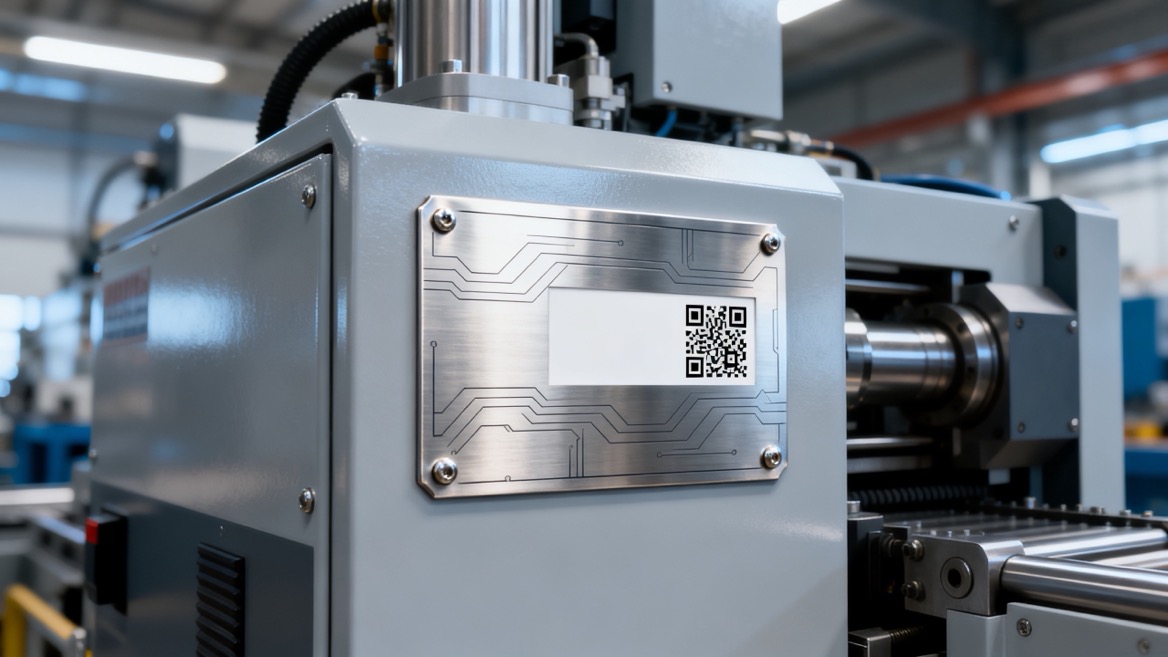
Yes. QR codes, barcodes, data matrix codes, serial numbers, and other variable data can be incorporated into metal nameplates and durable labels. They should be tested for scan reliability at the intended size and under expected lighting and surface conditions.
How do I choose the right adhesive for a nameplate?
Start with the mounting surface and operating environment. Consider whether the surface is smooth, textured, painted, powder-coated, oily, hot, cold, or exposed to moisture. Adhesive selection should also account for the required service life and whether mechanical fastening is needed for added security.
Can nameplates be made in multiple languages?
Yes. Multi-language nameplates can include English, Chinese, Spanish, French, German, Japanese, Arabic, or other required languages. It is important to review technical terminology, font support, layout space, and readability before production.
What files are needed for a custom nameplate order?
Vector artwork files such as AI, EPS, PDF, or SVG are preferred for logos and graphics. A complete request should also include dimensions, material preference, thickness, quantity, color requirements, hole locations, adhesive needs, and variable-data files if serial numbers or codes are required.
How can I make a nameplate last longer outdoors?
For outdoor use, choose weather-resistant materials and processes, such as anodized aluminum, stainless steel, durable coatings, or etched metal. Consider UV exposure, rain, humidity, salt spray, temperature changes, and abrasion. Use an adhesive or fastening method appropriate for outdoor installation.
References
1. American Nameplate. "[Important Nameplate Information: Machine Nameplates & More]."
2. Occupational Safety and Health Administration. "[29 CFR 1910.145: Specifications for Accident Prevention Signs and Tags]."
3. IDEC Corporation. "[Group Safety Standard: IEC 60204-1: 2016]."
4. UL Solutions. "[Marking and Labeling Systems Program]."
5. In Compliance Magazine. "[Marking and Labeling]."
6. Occupational Safety and Health Administration. "[Machine Guarding Standards]."


