Content Menu
● How Does Smart Packaging Work?
● Types of Smart Packaging: Active, Intelligent, and Connected
>> Active Packaging: Managing the Product Environment
>> Intelligent Packaging: Monitoring Conditions
>> Connected Packaging: Creating a Digital Touchpoint
● Which Smart Packaging Technology Fits Your Product?
>> QR Code Packaging for Accessible Information
>> NFC Packaging for Tap-Based Experiences
>> RFID Packaging for Operational Visibility
● Why Smart Packaging Matters for Brands and Distributors
>> Make Product Information Easier to Use
>> Support Traceability and More Targeted Responses
>> Help Address Waste Without Overstating Results
● Smart Packaging Trends: Preparing for Two-Dimensional Barcodes
● How to Develop Smart Packaging Boxes: A Six-Step Process
>> 1. Define One Primary Objective
>> 2. Map the User Journey
>> 3. Design the Structure and Feature Together
>> 4. Prototype with Final Materials
>> 5. Establish Data Ownership and Responsibilities
>> 6. Run a Controlled Pilot
● Smart Packaging Costs: Evaluate the Complete System
● Manufacturing, Safety, and Sustainability Checks
>> Separate Packaging Quality from Technology Performance
>> Validate Food-Contact Applications
>> Assess the Complete Environmental Trade-Off
● A Practical Brief for Your Packaging Manufacturer
● Build Packaging That Delivers Useful Value
● Frequently Asked Questions
>> What Is the Difference Between Smart Packaging and Traditional Packaging?
>> Can a Custom Paper Box Use Smart Packaging?
>> Does Smart Packaging Require Batteries?
>> Can a QR Code Prevent Counterfeiting?
>> Does Smart Packaging Guarantee Food Safety?
>> What Is the Best First Step for a Small Brand?
● References
Smart packaging combines physical packaging with technologies that protect products, monitor conditions, or connect users to digital information. For brands sourcing custom packaging boxes, it can turn an ordinary carton into a useful touchpoint for product guidance, traceability, and customer support.
However, adding a QR code or sensor does not automatically create a better package. The technology must solve a specific problem without compromising protection, usability, or production consistency.
At Shenzhen XingKun Packing Products Co., Ltd., our perspective starts with the physical package. With over 20 years of printing and packaging manufacturing experience, serving brands and distributors across more than 30 countries and regions, we believe smart packaging should begin with a clear purpose—not unnecessary complexity.
How Does Smart Packaging Work?
Smart packaging adds a functional layer to a conventional package. Depending on its design, that layer may interact with the product, measure environmental conditions, or provide access to online information.
A typical system includes:
- A physical component, such as a printed code, indicator, absorber, or electronic tag.
- A defined function, such as moisture control, identification, or temperature monitoring.
- A response, such as a color change, recorded event, or digital instruction.
Not every solution needs electronics. An oxygen absorber works through material interactions, while a printed QR code connects a smartphone to information stored elsewhere.
The essential distinction is between what the package physically does and what its supporting digital system can actually verify.
Types of Smart Packaging: Active, Intelligent, and Connected
These categories help buyers compare functions. They are not always mutually exclusive: one package may combine several technologies.
| Packaging type | Main function | Typical technology | Important limitation |
| Active packaging | Helps preserve product condition | Oxygen absorbers, moisture-control components | Requires product-specific validation |
| Intelligent packaging | Monitors or indicates conditions | Time-temperature indicators, sensors | Does not automatically prove product safety |
| Connected packaging | Links packaging to digital information | QR codes, NFC, RFID | Depends on reliable data and system management |
Active Packaging: Managing the Product Environment
Active packaging absorbs or releases substances to help maintain product quality or extend shelf life.
Examples include oxygen scavengers for oxidation-sensitive foods and moisture-control components for products vulnerable to humidity.
For custom paper boxes, the active component may sit inside a sealed inner package rather than within the outer carton. This distinction matters because an outer box alone may not provide the barrier performance required for preservation.
Any shelf-life claim should be supported by testing under the intended storage and distribution conditions.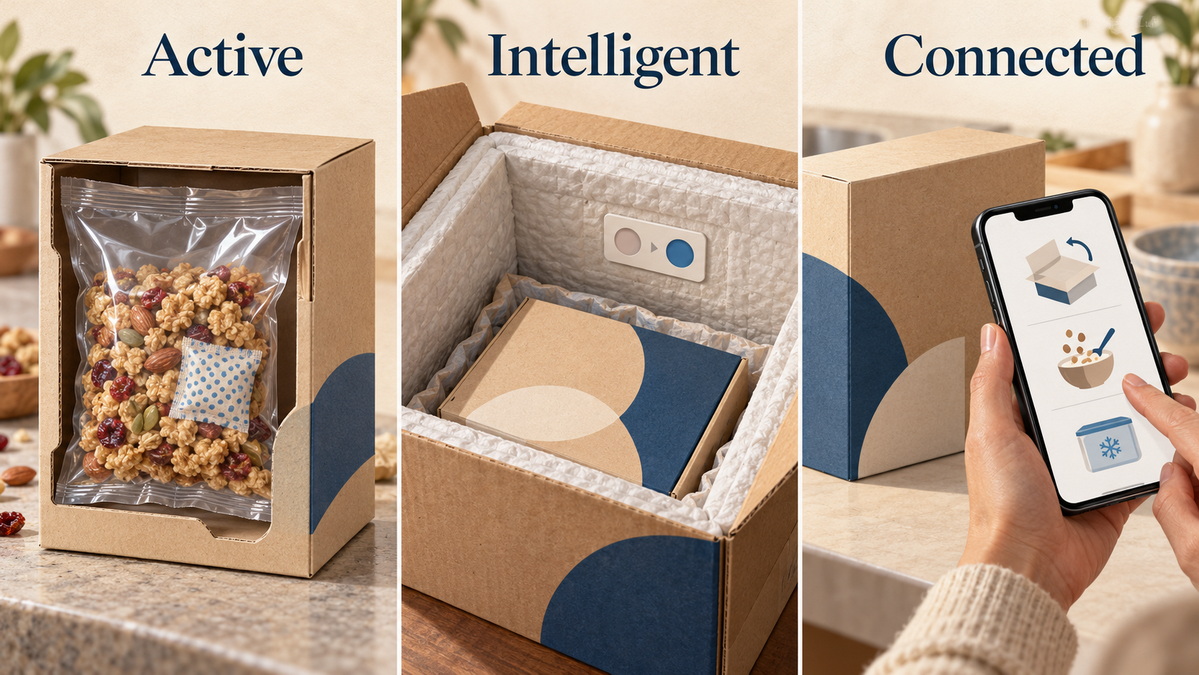
Intelligent Packaging: Monitoring Conditions
Intelligent packaging monitors the product or its surrounding environment.
A time-temperature indicator, for example, can respond to accumulated temperature exposure. Other systems may detect changes associated with product deterioration.
These indicators require careful interpretation. A temperature excursion does not establish the exact microbiological condition of every product, and a normal-looking indicator cannot guarantee safety under all circumstances.
Brands should define what the indicator measures, how it is validated, and what action users should take.
Connected Packaging: Creating a Digital Touchpoint
Connected packaging uses identifiers or communication technologies to link physical products with digital services.
Common options include:
- QR codes for instructions, registration, and product information.
- NFC tags for smartphone tap interactions.
- RFID tags for identification and inventory workflows.
A QR code linking to a product page is useful, but it does not independently authenticate an item. Authentication requires a supporting system designed to identify suspicious duplication or other anomalies.
Which Smart Packaging Technology Fits Your Product?
The right choice depends on the business problem, product value, distribution environment, and required user action.
QR Code Packaging for Accessible Information
QR codes are a practical starting point when customers need installation videos, multilingual instructions, care guidance, or warranty registration.
For example, a printed electronics box could link customers directly to the correct setup guide instead of a general homepage.
The destination must remain useful throughout the product's expected life. Assign responsibility for maintaining the domain, content, redirects, and technical support.
NFC Packaging for Tap-Based Experiences
NFC can support a convenient tap interaction on compatible smartphones. It may suit premium products where brands want a discreet digital feature without making a printed code central to the artwork.
However, tag placement must be tested on the actual package. Nearby materials and the finished construction can influence performance.
Choose NFC because it improves the experience—not simply because it appears more sophisticated.
RFID Packaging for Operational Visibility
RFID can support identification workflows without requiring each tag to be visually presented like a printed barcode.
Its value depends on reader infrastructure, tag suitability, software integration, and operating procedures.
Before specifying RFID-enabled packaging boxes, define the reading environment and test real packed products. A successful desktop demonstration is not enough to validate a warehouse deployment.
Why Smart Packaging Matters for Brands and Distributors
Make Product Information Easier to Use
Printed space is limited. Connected packaging can provide detailed instructions, troubleshooting, language options, and accessible content without overcrowding the box.
Keep essential information on the physical package wherever required. Digital content should complement mandatory labeling, not be assumed to replace it.
Support Traceability and More Targeted Responses
Batch-level or item-level identifiers can connect packages to production and distribution records.
When those records are accurate, teams may investigate complaints or identify affected batches more efficiently. However, a code cannot create traceability if the underlying records are missing or inconsistent.
Help Address Waste Without Overstating Results
The United Nations Environment Programme estimated that 1.05 billion tonnes of food waste occurred across households, food service, and retail in 2022.
Appropriate preservation and monitoring technologies may help address some causes of waste. That does not mean every smart package reduces waste, or that packaging technology alone can solve the problem.
Measure actual changes in spoilage, product disposal, and packaging impacts before making environmental claims.
Smart Packaging Trends: Preparing for Two-Dimensional Barcodes
One important development is the transition toward two-dimensional barcodes carrying standardized product information.
The GS1 Sunrise 2027 initiative aims to support retail checkout systems in reading and processing compatible two-dimensional barcodes. QR codes using GS1 Digital Link can connect product identifiers with online information.
This creates opportunities to coordinate checkout identification, product information, and consumer engagement.
However, the initiative is not a universal legal requirement for every brand to remove conventional barcodes immediately.
For packaging buyers, practical preparation includes:
1. Confirming product identifier requirements with trading partners.
2. Establishing whether existing and new barcodes must coexist.
3. Planning artwork space and variable-data printing.
4. Testing both checkout scanning and smartphone use.
Coordinate with retailers and technology providers before approving production artwork.
How to Develop Smart Packaging Boxes: A Six-Step Process
1. Define One Primary Objective
Start with a measurable problem.
Examples include reducing setup-related support requests, improving product registration, or investigating distribution conditions.
Avoid a vague objective such as "making packaging innovative." It offers no clear basis for selecting technology or judging results.
2. Map the User Journey
Identify who interacts with the package: warehouse staff, retailers, distributors, or consumers.
Then define the intended action. A warehouse identification system and a consumer instruction link need different placement, content, and testing.
For consumer-facing features, use a direct prompt such as "Scan for assembly instructions."
3. Design the Structure and Feature Together
Reserve space for the code, tag, or indicator before finalizing the dieline and artwork.
Check folds, glue areas, opening points, inserts, and product visibility.
A feature hidden by a sleeve or damaged during opening will underperform regardless of the quality of its digital platform.
4. Prototype with Final Materials
Test the intended board, printing method, coating, and finishing.
Metallic effects, reflections, low contrast, curvature, and surface damage can affect readability. Do not assume that a code scanning successfully on a screen will perform equally well on a finished box.
Evaluate samples using representative devices and operating conditions.
5. Establish Data Ownership and Responsibilities
Document who controls product identifiers, destination pages, software accounts, and customer information.
Clarify what happens if a service provider changes or a subscription ends.
Where personal information is collected, assess applicable privacy requirements and collect only what the service needs.
6. Run a Controlled Pilot
Start with a manageable product range and distribution route.
Measure performance against a baseline, collect user feedback, and investigate failures before expanding.
A pilot should test the whole system: printed package, digital destination, staff workflow, and customer experience.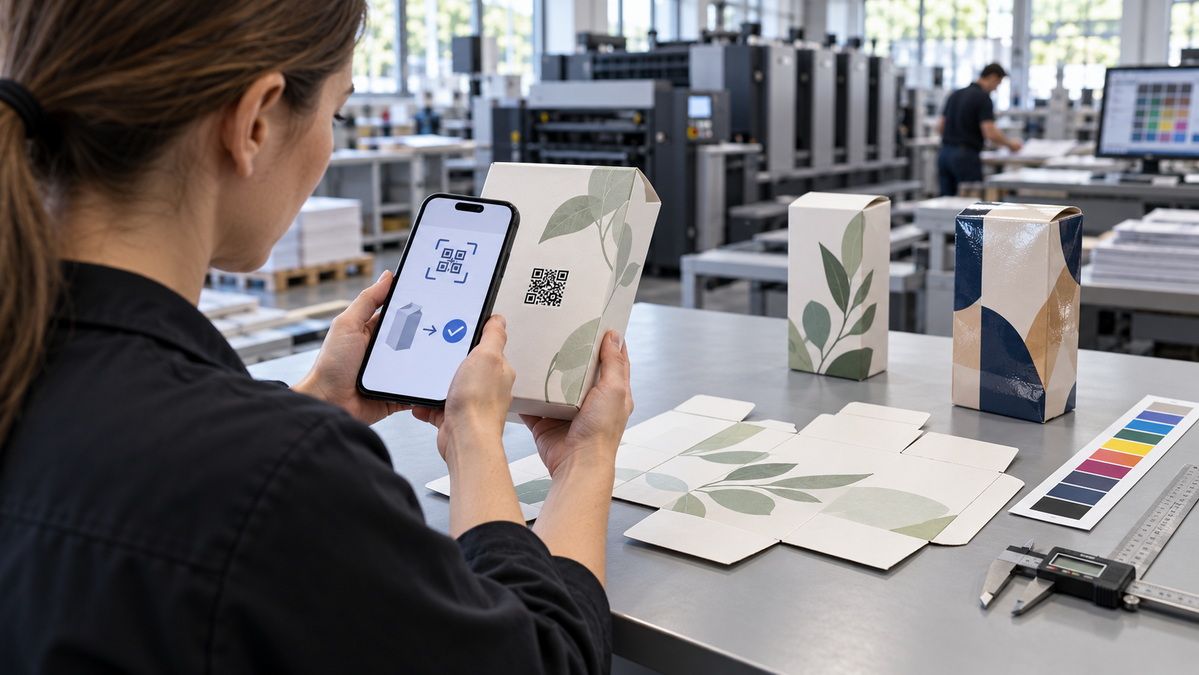
Smart Packaging Costs: Evaluate the Complete System
A meaningful cost assessment extends beyond the price of a printed code or electronic tag.
Consider:
- Artwork and structural development.
- Printing, encoding, and inspection.
- Tags, labels, indicators, or sensors.
- Software subscriptions and integration.
- Content maintenance and translation.
- Production rejects and troubleshooting.
- Training and ongoing support.
For a pilot, compare total incremental costs with measurable benefits over the same period.
Relevant benefits may include fewer support contacts, lower verified losses, or more completed registrations. Avoid counting scans as revenue unless there is evidence connecting them.
Different technologies require different measures. A cold-chain monitoring project should not be judged primarily by consumer engagement.
Manufacturing, Safety, and Sustainability Checks
Separate Packaging Quality from Technology Performance
A package must still protect the product, stack appropriately, open reliably, and present the brand consistently.
Smart features should not weaken structural performance or interfere with assembly. Production acceptance criteria should cover both conventional packaging quality and the added function.
Validate Food-Contact Applications
Active and intelligent food-contact materials require particular care.
In the European Union, Regulation (EC) No 450/2009 establishes specific requirements for these materials and articles. Safety assessment can involve migration and toxicological considerations.
Requirements depend on the application and market. Do not assume that an additive, ink, adhesive, or component is suitable for food contact merely because it is described as innovative.
Assess the Complete Environmental Trade-Off
Paper-based packaging does not automatically make every added component recyclable.
Electronic tags, adhesives, laminates, and mixed materials can affect recovery options. Recycling outcomes also depend on local collection and processing infrastructure.
Assess whether the function justifies the additional material, and explain separation instructions where appropriate.
A Practical Brief for Your Packaging Manufacturer
Before requesting a quotation, prepare:
- Product dimensions, weight, and protection requirements.
- Target markets and distribution conditions.
- Packaging style, quantity, and finishing preferences.
- The intended smart feature and user action.
- Technology provider and data-management responsibilities.
- Required inspection methods and acceptance criteria.
For Shenzhen XingKun Packing Products Co., Ltd., this information provides a clearer starting point for discussing the physical box and printing requirements.
Advanced features such as sensors, authentication systems, or RFID infrastructure should have their integration scope confirmed separately rather than assumed to be included in standard box production.
Build Packaging That Delivers Useful Value
Successful smart packaging connects a clear customer or operational need with a reliable physical package.
Start with the function, validate the experience, and expand only when the results justify the investment.
Planning a new packaging project? Share your product specifications, target markets, order quantity, preferred box style, and intended digital or monitoring function with Shenzhen XingKun Packing Products Co., Ltd. These details will support a focused discussion of packaging design, printing requirements, and integration feasibility.
Frequently Asked Questions
What Is the Difference Between Smart Packaging and Traditional Packaging?
Traditional packaging primarily contains, protects, and presents a product. Smart packaging adds functions such as preservation, monitoring, identification, or access to digital services.
Can a Custom Paper Box Use Smart Packaging?
Yes. Paper boxes can carry printed QR codes, applied labels, or appropriately integrated tags. Suitability depends on the box construction, finishing, product, and intended operating conditions.
Does Smart Packaging Require Batteries?
No. Printed QR codes require no battery, and passive NFC or RFID tags use energy supplied by compatible readers. Some monitoring systems use powered electronics.
Can a QR Code Prevent Counterfeiting?
Not by itself. A standard QR code can be copied. Stronger protection requires supporting measures such as serialized identities, secure verification, tamper evidence, and investigation procedures.
Does Smart Packaging Guarantee Food Safety?
No. Indicators provide information within their validated operating limits. They do not replace food safety controls, appropriate storage, legally required labeling, or product-specific testing.
What Is the Best First Step for a Small Brand?
Choose one clearly defined need and test the simplest suitable solution. A QR-linked instruction page may be appropriate for information access, while condition monitoring requires a different technical approach.
References
1. [Custom Box Makers — "What Is Smart Packaging? Types, Benefits, & Examples"]. Original article reviewed for its topic coverage, definitions, examples, and areas requiring deeper practical explanation. [customboxmakers]
2. [European Food Safety Authority — "Active and Intelligent Materials"]. Authoritative background on active and intelligent food-contact materials, their functions, migration considerations, and safety assessment. [efsa.europa]
3. [EUR-Lex — "Active and Intelligent Materials and Articles That Come into Contact with Food"]. Summary of Regulation (EC) No 450/2009 and related requirements for food-contact applications. [eur-lex.europa]
4. [United Nations Environment Programme — "Food Waste Index Report 2024"]. Background on the scale and measurement of food waste. The associated report presentation details the estimate of 1.05 billion tonnes across households, food service, and retail in 2022. [wedocs.unep]
5. [GS1 US — "What Is GS1 Sunrise 2027?"]. Guidance on the transition toward two-dimensional retail barcodes, checkout readiness, and GS1 Digital Link. [gs1us]
6. [GS1 — "The Retail and Consumer Goods Industries Support the Transition to QR Codes with GS1 Standards"]. Industry endorsement explaining the initiative's aims, implementation considerations, and manufacturer and retailer responsibilities. [gs1]


